





Advi interview experience Real time questions & tips from candidates to crack your interview
Internee on AIML Robotics
Advi


2 rounds | 1 Coding
problems

 Selected
 Interview preparation journey

Application story
I received this opportunity through my campus placement drive. After reviewing the role requirements, I revised my Python fundamentals and basic AI/ML concepts, along with practicing problem-solving. I prepared specifically for MCQs and algorithm-based questions, which helped me confidently clear both rounds of the interview process.
Preparation
Duration: 1 month
Topics: Python, DSA, Dijkstra's Algorithm, OOPs, SQL

Tip 1: Revise core graph algorithms.
Be comfortable with shortest path concepts (like Dijkstra’s algorithm) and greedy approaches.
Tip 2: Practice coding in Python regularly.
Focus on clean implementations using lists, dictionaries, and basic libraries like heapq.
Application process
Where: Campus
Eligibility: Above 7 CGPA, No backlogs allowed. (Salary Package: 6.5 LPA)
Tip 1: Highlight problem-solving.
Mention the algorithms, challenges, or technical problems you solved—not just project names.
Tip 2: List only defendable skills.
Include technologies you can confidently explain with real examples.

Interview rounds
01
Round
Easy
Online Coding Interview
Duration60 minutes
Interview date3 Jan 2026
Coding problem0
MCQ-based questions on the basics of Python and AI/ML.
02
Round
Easy
Face to Face
Duration60 minutes
Interview date1 Feb 2026
Coding problem1
1. Dijkstra's shortest path
Moderate
25m average time
65% success

0/80
Asked in companies



You have been given an undirected graph of ‘V’ vertices (labeled 0,1,..., V-1) and ‘E’ edges. Each edge connecting two nodes (‘X’,’Y’) will have a weight denoting the distance between node ‘X’ and node ‘Y’.
Your task is to find the shortest path distance from the source node, which is the node labeled as 0, to all vertices given in the graph.
Example:
Input:
4 5
0 1 5
0 2 8
1 2 9
1 3 2
2 3 6
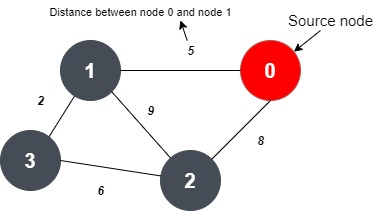
In the given input, the number of vertices is 4, and the number of edges is 5.

In the input, following the number of vertices and edges, three numbers are given. The first number denotes node ‘X’, the second number denotes node ‘Y’ and the third number denotes the distance between node ‘X’ and ‘Y’.

As per the input, there is an edge between node 0 and node 1 and the distance between them is 5.

The vertices 0 and 2 have an edge between them and the distance between them is 8.
The vertices 1 and 2 have an edge between them and the distance between them is 9.
The vertices 1 and 3 have an edge between them and the distance between them is 2.
The vertices 2 and 3 have an edge between them and the distance between them is 6.
Note:
1. There are no self-loops(an edge connecting the vertex to itself) in the given graph.

2. There can be parallel edges i.e. two vertices can be directly connected by more than 1 edge.


Here's your problem of the day 
Solving this problem will increase your chance to get selected in this company
Skill covered: Programming
How do you remove whitespace from the start of a string?
Choose another skill to practice
Similar interview experiences

SDE - 1
3 rounds | 7 problems
Interviewed by OYO
 Selected
6182 views

0 comments

0 upvotes
SDE - Intern
2 rounds | 3 problems
Interviewed by Amazon
Rejected
1565 views
0 comments
0 upvotes

SDE - 1
2 rounds | 5 problems
Interviewed by Meesho
Rejected
7245 views
0 comments
0 upvotes

SDE - 1
3 rounds | 9 problems
Interviewed by Salesforce
Selected 4552 views
0 comments
0 upvotes