





Ajio interview experience Real time questions & tips from candidates to crack your interview
SDE - 2
Ajio


3 rounds | 4 Coding
problems

 Selected
 Interview preparation journey

Journey
For this role, I focused more on core subjects instead of DSA. I only practiced basic DSA questions from online coding platforms. I practiced System Design, Networking, OOPs, and DBMS from various YouTube channels. I was also interested in Cloud Computing, so I later took a course on the same.
Application story
First, I applied by filling out the forms. They shortlisted candidates on the basis of GPA. Later, they called us for the interview rounds.
Why selected/rejected for the role?
I was selected because I think the interview focused on a wide variety of topics. I prepared all the topics in depth. I had knowledge of the basic fundamentals and answered almost every question.
Preparation
Duration: 3 Months
Topics: Data Structures, System Design, Low level design, Machine Coding, OOPs

Tip 1: Practice topic-wise coding questions from the basics.
Tip 2: Watch numerous system design mock interviews.
Tip 3: Do mock interviews with friends for DSA and system design rounds.
Application process
Where: Linkedin
Eligibility: Not aware of any such thing as I applied as experienced person.
Tip 1: Single-page resume.
Tip 2: Get it proofread by friends and professionals and take feedback.

Interview rounds
01
Round
Hard
Video Call
Duration60 Minutes
Interview date18 Aug 2022
Coding problem1
1. Snake and Ladder
Moderate
30m average time
60% success

0/80
Asked in companies



You have been given a Snake and Ladder Board with 'N' rows and 'N' columns with the numbers written from 1 to (N*N) starting from the bottom left of the board, and alternating direction each row.
For example
For a (6 x 6) board, the numbers are written as follows:
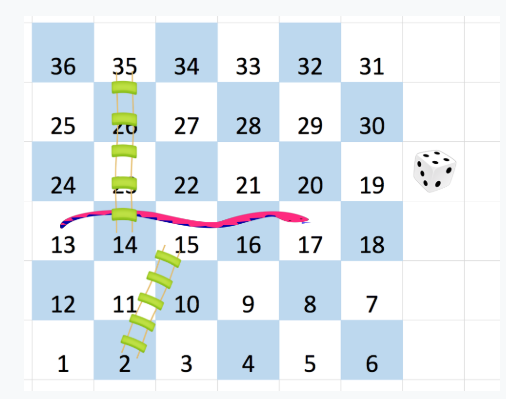
You start from square 1 of the board (which is always in the last row and first column). On each square say 'X', you can throw a dice which can have six outcomes and you have total control over the outcome of dice throw and you want to find out the minimum number of throws required to reach the last cell.
Some of the squares contain Snakes and Ladders, and these are possibilities of a throw at square 'X':
You choose a destination square 'S' with number 'X+1', 'X+2', 'X+3', 'X+4', 'X+5', or 'X+6', provided this number is <= N*N.
If 'S' has a snake or ladder, you move to the destination of that snake or ladder.  Otherwise, you move to S.
A board square on row 'i' and column 'j' has a "Snake or Ladder" if board[i][j] != -1. The destination of that snake or ladder is board[i][j].
Note :
You can only take a snake or ladder at most once per move: if the destination to a snake or ladder is the start of another snake or ladder, you do not continue moving - you have to ignore the snake or ladder present on that square.

For example, if the board is:
-1 1 -1
-1 -1 9
-1 4 -1
Let's say on the first move your destination square is 2  [at row 2, column 1], then you finish your first move at 4 [at row 1, column 2] because you do not continue moving to 9 [at row 0, column 0] by taking the ladder from 4.

A square can also have a Snake or Ladder which will end at the same cell.
For example, if the board is:
-1 3 -1
-1 5 -1
-1 -1 9
Here we can see Snake/Ladder on square 5 [at row 1, column 1] will end on the same square 5.
02
Round
Medium
Video Call
Duration60 Minutes
Interview date18 Aug 2022
Coding problem2
1. K Most Frequent Elements
Moderate
10m average time
85% success
0/80
Asked in companies



You are given an Integer array ‘ARR’ and an Integer ‘K’.
Your task is to find the ‘K’ most frequent elements in ‘ARR’. Return the elements in any order.
For Example:
You are given ‘ARR’ = {1, 2, 2, 3, 3} and ‘K’ = 2.

The answer will {2, 3} as 2 and 3 are the elements occurring most times.
2. System Design Question
Tagging system across all JIO products (MyJIO, AJIO, JIO TV). Addition, update, or deletion of a tag in one product should reflect across all other products. Design the DB schema and high-level architecture workflow.
03
Round
Medium
HR Round
Duration40 Minutes
Interview date18 Aug 2022
Coding problem1
1. Basic HR Questions
Questions about my past projects (not an extremely deep dive, but a very high-level overview, etc.) and situational-based questions (e.g., what would you do if you had a conflict with other team members, etc.).
AJIO has five core values. Situational questions will be asked to assess whether you have demonstrated those values in your past experiences.
Strengths and weaknesses.


Here's your problem of the day 
Solving this problem will increase your chance to get selected in this company
Skill covered: Programming
What is the purpose of the return keyword?
Choose another skill to practice
Similar interview experiences
SDE - 1
2 rounds | 3 problems
Interviewed by Ajio
 Selected
0 views

0 comments

0 upvotes

SDE - 1
4 rounds | 8 problems
Interviewed by Amazon
Selected 11047 views
0 comments
0 upvotes
SDE - Intern
1 rounds | 3 problems
Interviewed by Amazon
Selected 4380 views
0 comments
0 upvotes

SDE - 2
4 rounds | 6 problems
Interviewed by Expedia Group
 Selected
 3318 views
0 comments
0 upvotes
Companies with similar interview experiences

SDE - 2
5 rounds | 12 problems
Interviewed by Walmart
Selected 31082 views
8 comments
0 upvotes

SDE - 2
3 rounds | 4 problems
Interviewed by HashedIn
 Selected
 9967 views
0 comments
0 upvotes
SDE - 2
3 rounds | 5 problems
Interviewed by Amazon

Rejected
7162 views
1 comments
0 upvotes