





Amadeus Lab interview experience Real time questions & tips from candidates to crack your interview

Senior Software Engineer
Amadeus Lab


3 rounds | 7 Coding
problems

 Selected
 Interview preparation journey

Preparation
Duration: 5 months
Topics: C++, Data Structures, Algorithms, System Design, Aptitude, OOPS

Tip 1 : Must do Previously asked Interview as well as Online Test Questions.
Tip 2 : Go through all the previous interview experiences from Codestudio and Leetcode.
Tip 3 : Do at-least 2 good projects and you must know every bit of them.
Application process
Where: Other
Eligibility: Above 7 CGPA
Tip 1 : Have at-least 2 good projects explained in short with all important points covered.
Tip 2 : Every skill must be mentioned.
Tip 3 : Focus on skills, projects and experiences more.

Interview rounds
01
Round
Easy
Video Call
Duration60 minutes
Interview date27 Apr 2020
Coding problem2
The first round was a DSA/Algo round.
1. Sort an array of 0s, 1s and 2s
Easy
10m average time
90% success

0/40
Asked in companies



You have been given an array/list 'arr' consisting of 'n' elements.
Each element in the array is either 0, 1 or 2.
Sort this array/list in increasing order.
Do not make a new array/list. Make changes in the given array/list.
Example :
Input: 'arr' = [2, 2, 2, 2, 0, 0, 1, 0]

Output: Final 'arr' = [0, 0, 0, 1, 2, 2, 2, 2]

Explanation: The array is sorted in increasing order.
Problem approach
The simple approach is to simply count the number of 0’s, 1’s, and 2’s. Then, place all 0’s at the beginning of the array followed by 1’s and 2's. The time complexity of this approach would be O(n) and space complexity O(1).
However, the approach requires two traversals of the array. The question can also be solved in a single scan of the array by maintaining the correct order of 0’s, 1’s, and 2’s using variables.
We divide the array into four groups using three pointers. Let us name these pointers as low, mid, and high.
1. a[0…low-1] only zeroes
2. a[low..mid-1] only ones
3. a[mid…high] unknown
4. a[high+1..n-1] only twos
Algorithm :
1. Initialise three pointers low = 0, mid = 0 and high = n -1
2. Run a while loop until mid<=high :
2.1 If (a[mid] ==0), then swap the element with the element low and increment low and mid (low++ and mid++).
2.2 If (a[mid] ==1), then increment mid (mid++).
2.3 If (a[mid] ==2), then swap it with an element in high range and decrement high (high--).
2. Intersection point of two Linked Lists
Easy
25m average time
73% success
0/40
Asked in companies


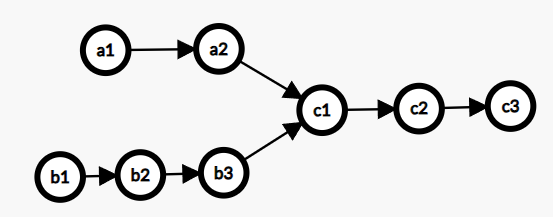
You are given two Singly Linked Lists of integers, which may have an intersection point.
Your task is to return the first intersection node. If there is no intersection, return NULL.
Example:-
The Linked Lists, where a1, a2, c1, c2, c3 is the first linked list and b1, b2, b3, c1, c2, c3 is the second linked list, merging at node c1.
Problem approach
Steps :
• Calculate number of nodes in the first list, let it be c1.
• Calculate number of nodes in the second list, let it be c2.
• Take the difference of counts d = abs(c1 – c2)
• Now traverse the bigger list from the first node till d nodes so that from here onwards both the lists have equal no of nodes
• Then, Traverse both the lists in parallel till you come across a common node.
02
Round
Easy
Video Call
Duration60 minutes
Interview date27 Apr 2020
Coding problem4
The second round was entirely C++ based. Core concepts of C++ were asked.
1. C++ Question
What is a virtual function?
Problem approach
A C++ virtual function is a member function in the base class that you redefine in a derived class. It is declared using the virtual keyword. It is used to tell the compiler to perform dynamic linkage or late binding on the function. A 'virtual' is a keyword preceding the normal declaration of a function. When the function is made virtual, C++ determines which function is to be invoked at the runtime based on the type of the object pointed by the base class pointer.
2. C++ Question
What are the different types of casting supported in C++?
Problem approach
C++ supports four types of casting:
1. Static Cast : This is the simplest type of cast which can be used. It is a compile time cast.It does things like implicit conversions between types (such as int to float, or pointer to void*), and it can also call explicit conversion functions (or implicit ones).
2. Dynamic Cast : In C++, dynamic casting is mainly used for safe downcasting at run time. To work on dynamic_cast there must be one virtual function in the base class. A dynamic_cast works only polymorphic base class because it uses this information to decide safe downcasting.
3. Const Cast : const_cast is used to cast away the constness of variables. const_cast can be used to change non-const class members inside a const member function.
4. Reinterpret Cast : It is used to convert a pointer of some data type into a pointer of another data type, even if the the data types before and after conversion are different. It does not check if the pointer type and data pointed by the pointer is same or not.
3. C++ Question
Explain the concept of Overloading.
Problem approach
C++ allows to specify more than one definition for a function name or an operator in the same scope, which is called function overloading and operator overloading respectively.
An overloaded declaration is a declaration that is declared with the same name as a previously declared declaration in the same scope, except that both declarations have different arguments and obviously different definition (implementation). When you call an overloaded function or operator, the compiler determines the most appropriate definition to use, by comparing the argument types you have used to call the function or operator with the parameter types specified in the definitions. The process of selecting the most appropriate overloaded function or operator is called overload resolution.
Function Overloading in C++
You can have multiple definitions for the same function name in the same scope. The definition of the function must differ from each other by the types and/or the number of arguments in the argument list. You cannot overload function declarations that differ only by return type.
Operators Overloading in C++
You can redefine or overload most of the built-in operators available in C++. Thus, a programmer can use operators with user-defined types as well. Overloaded operators are functions with special names: the keyword "operator" followed by the symbol for the operator being defined. Like any other function, an overloaded operator has a return type and a parameter list.
4. C++ Question
What is a Smart Pointer?
Problem approach
A Smart Pointer is a wrapper class over a pointer with an operator like * and -> overloaded. The objects of the smart pointer class look like normal pointers. But, unlike Normal Pointers it can deallocate and free destroyed object memory. The idea is to take a class with a pointer, destructor and overloaded operators like * and ->. Since the destructor is automatically called when an object goes out of scope, the dynamically allocated memory would automatically be deleted (or reference count can be decremented).
03
Round
Easy
HR Round
Duration30 minutes
Interview date27 Apr 2020
Coding problem1
The last round was a typical HR round.
1. Basic HR Questions
Q1. Introduction
Q2. What are your strengths and weaknesses?
Q3. Why Amadeus?
Problem approach
Tip 1 : The cross questioning can go intense some time, think before you speak.
Tip 2 : Be open minded and answer whatever you are thinking, in these rounds I feel it is important to have opinion.
Tip 3 : Context of questions can be switched, pay attention to the details. It is okay to ask questions in these round, like what are the projects currently the company is investing, which team you are mentoring. How all is the work environment etc.


Here's your problem of the day 
Solving this problem will increase your chance to get selected in this company
Skill covered: Programming
How do you remove whitespace from the start of a string?
Choose another skill to practice
Similar interview experiences
SDE - 1
3 rounds | 3 problems
Interviewed by Amadeus Lab
Selected 
1793 views

0 comments

0 upvotes
SDE - 2
3 rounds | 5 problems
Interviewed by Amadeus Lab
Selected 2836 views
0 comments
0 upvotes

SDE - 1
4 rounds | 8 problems
Interviewed by Amazon
Selected 11210 views
0 comments
0 upvotes
SDE - Intern
1 rounds | 3 problems
Interviewed by Amazon
Selected 4456 views
0 comments
0 upvotes
Companies with similar interview experiences

Senior Software Engineer
1 rounds | 6 problems
Interviewed by Arcesium
Rejected
4245 views
0 comments
0 upvotes

Senior Software Engineer
3 rounds | 3 problems
Interviewed by Ernst & Young (EY)
Selected 6312 views
0 comments
0 upvotes

Senior Software Engineer
3 rounds | 3 problems
Interviewed by HCL Technologies
 Selected
 3732 views
3 comments
0 upvotes