





Amazon interview experience Real time questions & tips from candidates to crack your interview

SDE
Amazon


3 rounds | 4 Coding
problems

 Selected
 Interview preparation journey

Preparation
Duration: 3 Months
Topics: Standard Coding Problems, Data Structures, algorithms, DBMS, Resume Projects.

Tip 1 : Practice all previous Amazon problems
Tip 2 : Focus on optimised approach
Application process
Where: Campus
Eligibility: Above 7 CGPA
Tip 1 : Simple and clear
Tip 2 : Internship should be detailed

Interview rounds
01
Round
Medium
Online Coding Interview
Duration60 minutes
Interview date10 Apr 2020
Coding problem2
Coding test with two coding questions.
1. Longest Common Subsequence
Moderate
39m average time

0/80
Asked in companies



Given two strings, 'S' and 'T' with lengths 'M' and 'N', find the length of the 'Longest Common Subsequence'.
For a string 'str'(per se) of length K, the subsequences are the strings containing characters in the same relative order as they are present in 'str,' but not necessarily contiguous. Subsequences contain all the strings of length varying from 0 to K.
Example :
Subsequences of string "abc" are: ""(empty string), a, b, c, ab, bc, ac, abc.
Problem approach
A naive solution is to check if every subsequence of X[1…m] to see if it is also a subsequence of Y[1…n]. As there are 2m subsequences possible of X, the time complexity of this solution would be O(n.2m), where m is the length of the first string and n is the length of the second string.
The LCS problem has optimal substructure. That means the problem can be broken down into smaller, simple “subproblems”, which can be broken down into yet simpler subproblems, and so on, until, finally, the solution becomes trivial. Use DP
2. Running Median
Hard
46m average time
50% success
0/120
Asked in companies



You are given a stream of 'N' integers. For every 'i-th' integer added to the running list of integers, print the resulting median.
Print only the integer part of the median.
Problem approach
Similar to balancing BST in Method 2 above, we can use a max heap on the left side to represent elements that are less than effective median, and a min-heap on the right side to represent elements that are greater than effective median.
After processing an incoming element, the number of elements in heaps differs utmost by 1 element. When both heaps contain the same number of elements, we pick the average of heaps root data as effective median. When the heaps are not balanced, we select effective median from the root of the heap containing more elements.
02
Round
Easy
Face to Face
Duration40 minutes
Interview date10 Apr 2020
Coding problem1
1. Binary Tree Zigzag Traversal
Easy
15m average time
85% success
0/40
Asked in companies


You have been given a Binary Tree of 'N' nodes, where the nodes have integer values. Your task is to print the zigzag traversal of the given tree.
Note:
In zigzag order, level 1 is printed from left to right fashion, level 2 is printed from right to left. and level 3 is printed from left to right again, and so on…..
For example:
For the given binary tree
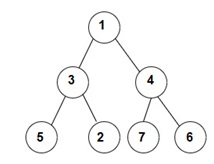
The zigzag traversal is [1, 4, 3, 5, 2, 7, 6]
Problem approach
This problem can be solved using two stacks. Assume the two stacks are current: currentlevel and nextlevel. We would also need a variable to keep track of the current level order(whether it is left to right or right to left). We pop from the currentlevel stack and print the nodes value. Whenever the current level order is from left to right, push the nodes left child, then its right child to the stack nextlevel. Since a stack is a LIFO(Last-In-First_out) structure, next time when nodes are popped off nextlevel, it will be in the reverse order. On the other hand, when the current level order is from right to left, we would push the nodes right child first, then its left child. Finally, do-not forget to swap those two stacks at the end of each level(i.e., when current level is empty)
03
Round
Medium
Face to Face
Duration30 minutes
Interview date10 Apr 2020
Coding problem1
1. Find Number of Islands
Moderate
34m average time
60% success
0/80
Asked in companies

You are given a 2-dimensional array/list having N rows and M columns, which is filled with ones(1) and zeroes(0). 1 signifies land, and 0 signifies water.
A cell is said to be connected to another cell, if one cell lies immediately next to the other cell, in any of the eight directions (two vertical, two horizontal, and four diagonals).
A group of connected cells having value 1 is called an island. Your task is to find the number of such islands present in the matrix.
Problem approach
A graph where all vertices are connected with each other has exactly one connected component, consisting of the whole graph. Such a graph with only one connected component is called a Strongly Connected Graph.
The problem can be easily solved by applying DFS() on each component. In each DFS() call, a component or a sub-graph is visited. We will call DFS on the next un-visited component. The number of calls to DFS() gives the number of connected components.


Here's your problem of the day 
Solving this problem will increase your chance to get selected in this company
Skill covered: Programming
How do you remove whitespace from the start of a string?
Choose another skill to practice
Similar interview experiences
SDE - 1
4 rounds | 8 problems
Interviewed by Amazon
Selected 
8962 views

0 comments

0 upvotes
Fullstack Developer
2 rounds | 4 problems
Interviewed by Amazon
Rejected
7905 views
2 comments
0 upvotes
Support Engineer
4 rounds | 7 problems
Interviewed by Amazon
Selected 8293 views
0 comments
0 upvotes
SDE - Intern
1 rounds | 3 problems
Interviewed by Amazon
Selected 3502 views
0 comments
0 upvotes
Companies with similar interview experiences

SDE
3 rounds | 6 problems
Interviewed by PhonePe
Selected 0 views
0 comments
0 upvotes

SDE
5 rounds | 8 problems
Interviewed by Mathworks
Selected 1223 views
0 comments
0 upvotes
SDE
4 rounds | 7 problems
Interviewed by PhonePe
Selected 0 views
0 comments
0 upvotes