





Amazon interview experience Real time questions & tips from candidates to crack your interview

SDE - 1
Amazon


4 rounds | 8 Coding
problems

 Selected
 Interview preparation journey

Journey
I began my journey in the 3rd semester by learning DSA in Java and regularly practiced online while participating in coding contests. I later explored web development and completed two internships to gain hands-on experience. With 1.7 years of experience as a backend SWE using Java, Spring Boot, and AWS, I was able to confidently crack this job interview by building on both my academic foundation and real-world experience.
Application story
I directly applied for SDE-1 opening on Amazon Job Portal. I received Online Assessment 3 days after applying, 6 days after submitting Online Assessment I got the mail for the process. It was mentioned that 3 rounds will take place and all will be eliminatory, 2 DSA rounds and then a Bar Raiser. For First Round, I was given 6 days to prepare and it was mentioned it would not be possible to reschedule.
After First Round, I got the mail 2 days later that the 2nd round is scheduled in next 21 hours and although rescheduling was possible I appeared for interview 21 hrs later.
After Second Round(was on Friday), I got mail 2 days later that Bar Raiser Round will be scheduled 8 days later.
2 days after Bar Raiser I received verbal offer and 5 days later I received Offer Letter.
Why selected/rejected for the role?
I believe I raised the bar successfully as well as I aced the two prior rounds. I solved problems completely from Brute to most Optimal, I kept communicating and solved problems out loud. I answered all the follow-ups and answered all Leadership Principle based questions in STAR format and answered all the follow ups without hesitation.
Preparation
Duration: 3 months
Topics: Data Structures, Algorithms, OOPS, Amazon Leadership Principles, AWS

Tip 1: Participate in coding contests online.
Tip 2: Prepare for patterns, solve concepts.
Tip 3: Solve hard questions first and then work backwards towards medium level questions.
Application process
Where: Company Website
Eligibility: 1+ Year Experience, (Salary Package: 46 LPA)
Tip 1: Mention achievements and problem solving profiles.
Tip 2: Mention your contributions and impact you made as experienced professional.

Interview rounds
01
Round
Hard
Online Coding Interview
Duration180 minutes
Interview date27 Mar 2025
Coding problem2
2 DSA problems : 1 Medium, 1 Hard (Problems have lot of unnecessary story, convert problem to simple task)
Workstyle Simulation (Problems to test how you handle work situations)
Leadership Principle and Behaviour based questions (Strongly Disagree/Disagree/Agree/Strongly Agree)
1. Capacity To Ship Packages Within D Days
Moderate
15m average time
85% success

0/80
Asked in companies


You are the owner of a Shipment company. You use conveyor belts to ship packages from one port to another. The packages must be shipped within 'd' days.
The weights of the packages are given in an array 'weights'. The packages are loaded on the conveyor belts every day in the same order as they appear in the array. The loaded weights must not exceed the maximum weight capacity of the ship.
Find out the least-weight capacity so that you can ship all the packages within 'd' days.
Problem approach
Solved Completely.
Using binary search on answer.
2. Minimum Moves to Equal Array Elements
Moderate
0/80
Asked in companies


Ninja has given an array 'ARR' containing 'N' integers; he can perform several moves on that array. In one move, he can increment any 'N' - 1 element of it by 1.
Ninja wants to make all elements of the array equal by performing some finite number of moves. As Ninjas friend, your task is to tell the Ninja that the minimum number of moves is needed to make all array elements equal.
Example:
Input: 'N' = 3, ‘ARR’ = [1, 2, 3]
Output: 3

It is possible to make all elements of the given array equal by three moves only. There is no possible solution that can perform the task in minimum moves than 3.
[1, 2, 3] => [2, 3, 3] => [3, 4, 3] => [4, 4, 4]
02
Round
Hard
Video Call
Duration120 minutes
Interview date8 Apr 2025
Coding problem3
2 DSA problems (1 Medium + 1 Hard) + 4 LP based questions
Timing : Morning
Interviewer was kind
1. Leadership Principles
- Tell me about a time you were proud of your work.
- Tell me about a time you dove deep and optimized something.
- Tell me about time where you completed a project on your own.
- Tell me about how will you communicate if you think you will miss deadline.
Problem approach
Tip 1: Answer in STAR format.
Tip 2: Prepare stories.
2. Redundant Connection - II
Moderate
20m average time
80% success
0/80
Asked in companies

You are given a directed graph that starts as a rooted tree with 'N' nodes (with distinct values from 1 to 'N'), with one additional directed edge added. The added edge has two different vertices chosen from 1 to ‘N’ and was not an edge that already existed.
The resulting graph is given as a 2D-array of edges. Each element of edges is a pair ['Ui', 'Vi'] that represents a directed edge connecting nodes ‘Ui’ and ‘Vi’, where ‘Ui’ is a parent of the child ‘Vi’.
Your task is to find and return that single edge that if removed, the resulting graph will be a tree of 'N' nodes.
Note:
1. A rooted tree is a directed graph such that, there is exactly one node (the root) for which all other nodes are descendants of this node, plus every node has exactly one parent, except for the root node which has no parents.
2. If there are multiple answers, return the answer that occurs last in the given 2D-array. The answer edge [u, v] should be in the same format, with u < v.
Example:
Let’s say we have 3 edges that are {1 , 2} , {1 , 3} and {2 , 3}. So the resulting graph from these edges will be :
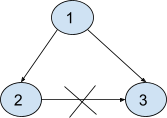
If we remove the edge {2, 3} then the resulting graph will be a tree
with 'N' nodes.
Problem approach
I discussed the problem out loud and realised DSU approach and coded it and did dry run.
3. Asteroid Collision
Moderate
15m average time
85% success
0/80
Asked in companies


You are given an array/list 'asteroids' representing asteroids in a row.
For each element of the given array, its absolute value denotes the size of that asteroid, and its sign denotes the direction it moves in(+ve meaning right and -ve meaning left).
An asteroid with a weight of 0 denotes a massless asteroid that moves in the right direction.
All asteroids are moving at the same speed. Whenever two asteroids collide, the smaller asteroid gets destroyed.
If both asteroids are the same size, then both asteroids get destroyed. Two asteroids moving in the same direction never collide.
You are supposed to find the state of the asteroids after all collisions.
Example :
Input: ‘asteroids’ = [3,-2,4]

Output: [3, 4]

Explanation: The first asteroid will destroy the second asteroid. Hence, after the collision, the state of the asteroids will be [3,4].
Note:
You don’t need to print anything. Just implement the given function.
Problem approach
I solved straight away using stack approach as interviewer mentioned time is less.
coded and did dry run.
03
Round
Hard
Video Call
Duration110 minutes
Interview date11 Apr 2025
Coding problem2
2 DSA problems : 1 Medium, 1 Hard (most optimal approach is on moderate-hard end i.e. Greedy), 1 Hard (Trees)
Timing (Morning)
Interviewer was kind
1. Jump Game
Moderate
15m average time
85% success
0/80
Asked in companies


You have been given an array 'ARR' of ‘N’ integers. You have to return the minimum number of jumps needed to reach the last index of the array i.e ‘N - 1’.
From index ‘i’, we can jump to an index ‘i + k’ such that 1<= ‘k’ <= ARR[i] .
'ARR[i]' represents the maximum distance you can jump from the current index.
If it is not possible to reach the last index, return -1.
Note:
Consider 0-based indexing.
Example:
Consider the array 1, 2, 3, 4, 5, 6
We can Jump from index 0 to index 1
Then we jump from index 1 to index 2
Then finally make a jump of 3 to reach index N-1

There is also another path where
We can Jump from index 0 to index 1
Then we jump from index 1 to index 3
Then finally make a jump of 2 to reach index N-1

So multiple paths may exist but we need to return the minimum number of jumps in a path to end which here is 3.
Problem approach
I gave Brute Force Approach
Interviewer asked me to optimize Time Complexity
Interviewer asked me to optimize Space Complexity
I gave Greedy Approach and coded it and did dry run
2. Binary Tree Maximum Path Sum
Moderate
20m average time
80% success
0/80
Asked in companies


You are given a binary tree with ‘N’ nodes.
Your task is to find the “Maximum Path Sum” for any path.
Note :
1. A ‘path’ is a sequence of adjacent pair nodes with an edge between them in the binary tree.
2. The ‘path’ doesn’t need to pass through the root.
3. The ‘path sum’ is the sum of the node’s data in that path.
Problem approach
I gave Brute Force Approach
Interviewer asked me to optimize
I discussed and coded optimized approach and did dry run
04
Round
Hard
Video Call
Duration40 minutes
Interview date21 Apr 2025
Coding problem1
Bar Raiser Round - Talked about leadership principle based questions.
There were lots of follow ups, dove deep in AWS services used and microservices and logic of my project.
1. Complex Problem Solving
Can you describe a complex problem you encountered that required in-depth research, development of proof of concepts, and exploration of multiple solutions to address the issue?
Problem approach
Tip 1: Answer in STAR format.
Tip 2: Prepare stories.


Here's your problem of the day 
Solving this problem will increase your chance to get selected in this company
Skill covered: Programming
An AI invents a fake court case to support its legal answer. This is a:
Choose another skill to practice
Similar interview experiences
SDE - 1
3 rounds | 5 problems
Interviewed by Amazon
Rejected

3373 views

0 comments

0 upvotes
SDE - 1
4 rounds | 8 problems
Interviewed by Amazon
Rejected
2483 views
1 comments
0 upvotes
SDE - 1
3 rounds | 6 problems
Interviewed by Amazon
Rejected
1709 views
0 comments
0 upvotes
SDE - 1
4 rounds | 8 problems
Interviewed by Amazon
Selected 10067 views
0 comments
0 upvotes
Companies with similar interview experiences
SDE - 1
4 rounds | 5 problems
Interviewed by Microsoft
Selected 59101 views
5 comments
0 upvotes

SDE - 1
4 rounds | 8 problems
Interviewed by Samsung
Selected 12815 views
2 comments
0 upvotes
SDE - 1
4 rounds | 8 problems
Interviewed by Microsoft
Selected 6136 views
5 comments
0 upvotes