





Amazon interview experience Real time questions & tips from candidates to crack your interview

SDE - Intern
Amazon


3 rounds | 6 Coding
problems

 Selected
 Interview preparation journey

Preparation
Duration: 6 months
Topics: Graph, Tree, Dynamic Programming, Binary Search, Array, String, Sorting Algos, Tries, Linked List, Stack, Queue

Tip 1 : Give regular contests without cheating
Tip 2 : Practice daily, maintain daily streak on platform, this will keeps you motivated
Tip 3 : Read article and can follow standard sheets (if beginner)
Application process
Where: Company Website
Eligibility: No Backlogs
Tip 1 : Have some projects on resume
Tip 2 : Do not put false things on resume

Interview rounds
01
Round
Hard
Online Coding Interview
Duration180 minutes
Interview date17 Aug 2021
Coding problem2
The test was divided into 11 sections
First section was Pure Coding.
Other sections was based on computer fundamentals and reasonings
1. Chocolate Problem
Moderate
15m average time
85% success

0/80
Asked in companies



Given an array/list of integer numbers 'CHOCOLATES' of size 'N', where each value of the array/list represents the number of chocolates in the packet. There are ‘M’ number of students and the task is to distribute the chocolate to their students. Distribute chocolate in such a way that:
1. Each student gets at least one packet of chocolate.
2. The difference between the maximum number of chocolate in a packet and the minimum number of chocolate in a packet given to the students is minimum.
Example :
Given 'N' : 5 (number of packets) and 'M' : 3 (number of students)
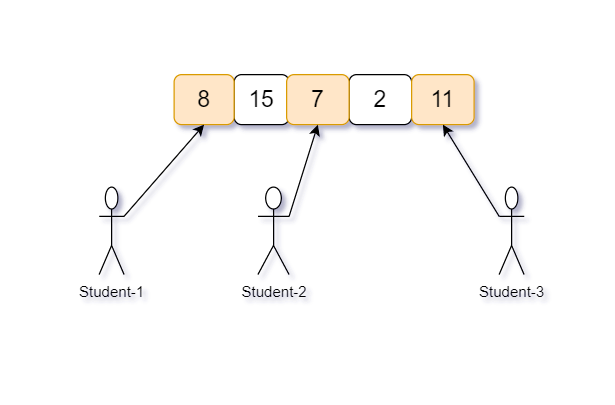
And chocolates in each packet is : {8, 11, 7, 15, 2}

All possible way to distribute 5 packets of chocolates among 3 students are -

( 8,15, 7 ) difference of maximum-minimum is ‘15 - 7’ = ‘8’
( 8, 15, 2 ) difference of maximum-minimum is ‘15 - 2’ = ‘13’
( 8, 15, 11 ) difference of maximum-minimum is ‘15 - 8’ = ‘7’
( 8, 7, 2 ) difference of maximum-minimum is ‘8 - 2’ = ‘6’
( 8, 7, 11 ) difference of maximum-minimum is ‘11 - 7’ = ‘4’
( 8, 2, 11 ) difference of maximum-minimum is ‘11 - 2’ = ‘9’
( 15, 7, 2 ) difference of maximum-minimum is ‘15 - 2’ = 13’
( 15, 7, 11 ) difference of maximum-minimum is ‘15 - 7’ = ‘8’
( 15, 2, 11 ) difference of maximum-minimum is ‘15 - 2’ = ‘13’
( 7, 2, 11 ) difference of maximum-minimum is ‘11 - 2’ = ‘9’

Hence there are 10 possible ways to distribute ‘5’ packets of chocolate among the ‘3’ students and difference of combination (8, 7, 11) is ‘maximum - minimum’ = ‘11 - 7’ = ‘4’ is minimum in all of the above.
Problem approach
Standard Chocolate distribution problem, applied the standard approach for it
2. Reverse First K elements of Queue
Easy
10m average time
90% success
0/40
Asked in companies

You are given a QUEUE containing ‘N’ integers and an integer ‘K’. You need to reverse the order of the first ‘K’ elements of the queue, leaving the other elements in the same relative order.
You can only use the standard operations of the QUEUE STL:
1. enqueue(x) : Adds an item x to rear of the queue
2. dequeue() : Removes an item from front of the queue
3. size() : Returns number of elements in the queue.
4. front() : Finds the front element.
For Example:
Let the given queue be { 1, 2, 3, 4, 5 } and K be 3.
You need to reverse the first K integers of Queue which are 1, 2, and 3.
Thus, the final response will be { 3, 2, 1, 4, 5 }.
02
Round
Hard
Online Coding Interview
Duration180 Minutes
Interview date22 Aug 2021
Coding problem2
It was a coding round. 2 coding questions were asked and I have to code them
1. Reverse A LL
Moderate
30m average time
65% success
0/80
Asked in companies


Ninjas is practicing problems on the linked list. He came across a problem in which he has given a linked list of ‘N’ nodes and two integers, ‘LOW’ and ‘HIGH’. He has to return the linked list ‘HEAD’ after reversing the nodes between ‘LOW’ and ‘HIGH’, including the nodes at positions ‘LOW’ and ‘HIGH’.
2. Trapping Rain Water
Moderate
15m average time
80% success
0/80
Asked in companies



You have been given a long type array/list 'arr’ of size 'n’.
It represents an elevation map wherein 'arr[i]’ denotes the elevation of the 'ith' bar.
Print the total amount of rainwater that can be trapped in these elevations.
Note :
The width of each bar is the same and is equal to 1.
Example:
Input: ‘n’ = 6, ‘arr’ = [3, 0, 0, 2, 0, 4].

Output: 10

Explanation: Refer to the image for better comprehension:

Note :
You don't need to print anything. It has already been taken care of. Just implement the given function.
03
Round
Hard
Face to Face
Duration60 minutes
Interview date10 Oct 2021
Coding problem2
Timing was 11 am to 12 pm
1. Minimum Character Deletion
Moderate
15m average time
80% success
0/80
Asked in companies



You are given a string ‘STR’. You need to find and return the minimum number of characters to be deleted from ‘STR’ so that the frequency of each character in the string becomes unique.
Example:
If the given string is “aaBBccc” then the frequency of characters: { a:2, B:2, c:3 }. Now, as ‘a’ and ‘B’ both have the same frequency 2, we need to delete one character either one ‘a’ or one ‘B’, to make their frequency different. After deleting any character we will get frequency as 1,2 and 3, as they all are different. Thus we got our solution as 1.
Problem approach
Solved using dynamic programming.
Simply calculate longest palindromic subsequence of string S, and reverse of string S.
Delete LPS from original length is what you need to return.
2. Maximum Product Subarray
Moderate
25m average time
75% success
0/80
Asked in companies

You are given an array “arr'' of integers. Your task is to find the contiguous subarray within the array which has the largest product of its elements. You have to report this maximum product.
An array c is a subarray of array d if c can be obtained from d by deletion of several elements from the beginning and several elements from the end.

For e.g.- The non-empty subarrays of an array [1,2,3] will be- [1],[2],[3],[1,2],[2,3],[1,2,3].
For Example:
If arr = {-3,4,5}.
All the possible non-empty contiguous subarrays of “arr” are {-3}, {4}, {5}, {-3,4}, {4,5} and {-3,4,5}.
The product of these subarrays are -3, 4, 5, -12, 20 and -60 respectively.
The maximum product is 20. Hence, the answer is 20.
Follow Up:
Can you solve this in linear time and constant space complexity?
Problem approach
We discussed many approaches and coded two of them, the interviewer was satisfied. Most optimised was of binary search since the array was sorted.


Here's your problem of the day 
Solving this problem will increase your chance to get selected in this company
Skill covered: Programming
How do you remove whitespace from the start of a string?
Choose another skill to practice
Similar interview experiences
SDE - Intern
3 rounds | 3 problems
Interviewed by Amazon

Rejected

2163 views

0 comments

0 upvotes
SDE - Intern
3 rounds | 7 problems
Interviewed by Amazon

Rejected
1068 views
0 comments
0 upvotes
SDE - Intern
2 rounds | 3 problems
Interviewed by Amazon
Rejected
1043 views
0 comments
0 upvotes
SDE - Intern
1 rounds | 3 problems
Interviewed by Amazon
Selected 3502 views
0 comments
0 upvotes
Companies with similar interview experiences
SDE - Intern
4 rounds | 7 problems
Interviewed by Microsoft
 Selected
 15499 views
1 comments
0 upvotes
SDE - Intern
3 rounds | 6 problems
Interviewed by Microsoft
Selected 8187 views
0 comments
0 upvotes
SDE - Intern
2 rounds | 4 problems
Interviewed by Microsoft
 Selected
 4915 views
2 comments
0 upvotes