





Amazon interview experience Real time questions & tips from candidates to crack your interview

SDE - Intern
Amazon


3 rounds | 7 Coding
problems

 Selected
 Interview preparation journey

Preparation
Duration: 1.5 Months
Topics: Data Structures(Binary Trees, Arrays, LinkedList, Graph, Stack, Queue), OOPS, Operating Systems, Computer Networks

Tip 1 : Practice Amazon Tagged Questions on gfg
Tip 2 : Practice DS Algo MCQ's on gfg
Tip 3 : Try to read as much as past interview experiences when you have limited time left for interview(eg:1 or two weeks)
Application process
Where: Other
Eligibility: No criteria
Tip 1 : Do not write anything on the resume which you can't defend on the day of the interview(You might have a cool project but it's of no use if you are not thorough about it on the day of interview).
Tip 2 : Write the work in the project which you done and the impact you created via it and not generic details about the project

Interview rounds
01
Round
Medium
Online Coding Interview
Duration120 minutes
Interview date2 Dec 2020
Coding problem2
28 MCQ's + 2 coding question
1. Dice Throws
Hard
35m average time
65% success

0/120
Asked in companies



You are given D dice, each having F faces numbered 1 to F, both inclusive. The task is to find the possible number of ways to roll the dice together such that the sum of face-up numbers equal the given target S.
Note :
As the answer can be large, return your answer modulo 10^9 + 7.
Follow Up :
Can you solve this using not more than O(S) extra space?
2. Count Set Bits
Hard
15m average time
85% success
0/120
Asked in companies



You are given a positive integer ‘N’. Your task is to find the total number of ‘1’ in the binary representation of all the numbers from 1 to N.
Since the count of ‘1’ can be huge, you are required to return it modulo 1e9+7.
Note:
Do not print anything, just return the number of set bits in the binary representation of all integers between 1 and ‘N’.
02
Round
Hard
Face to Face
Duration45 Minutes
Interview date15 Dec 2019
Coding problem2
Coding Round
Brief Introduction in starting and then two DSA questions(medium and hard)
1. Postorder Traversal
Easy
15m average time
85% success
0/40
Asked in companies

You have been given a Binary Tree of 'n' nodes, where the nodes have integer values. Your task is to return its postorder traversal.
For Example:
For the given tree below,
Postorder traversal for the given tree will be [4, 5, 2, 3, 1]. Hence, the answer is [4, 5, 2, 3, 1].

2. Longest Increasing Subsequence
Moderate
30m average time
65% success
0/80
Asked in companies

For a given array with N elements, you need to find the length of the longest subsequence from the array such that all the elements of the subsequence are sorted in strictly increasing order.
Strictly Increasing Sequence is when each term in the sequence is larger than the preceding term.
For example:
[1, 2, 3, 4] is a strictly increasing array, while [2, 1, 4, 3] is not.
03
Round
Medium
Face to Face
Duration60 Minutes
Interview date15 Dec 2019
Coding problem3
Coding Round
No introduction
3 DSA Questions
1. Sort an array in wave form
Easy
10m average time
85% success
0/40
Asked in companies


You have been given an unsorted array ‘ARR’.
Your task is to sort the array in such a way that the array looks like a wave array.
Example:
If the given sequence ‘ARR’ has ‘N’ elements then the sorted wave array looks like -
‘ARR[0] >= ARR[1]’ and ‘ARR[1] <= ARR[2]’
‘ARR[2] >= ARR[3]’ and ‘ARR[3] <= ARR[4]’
‘ARR[4] >= ARR[5]’ and ‘ARR[5] <= ARR[6]’  And so on.
Note:
1. ‘ARR[0]’ must be greater than or equal to ‘ARR[1]’.

2. There can be multiple arrays that look like a wave array but you have to return only one.

3. We have an internal function that will check your solution and return 'True' in case your array is one of the solutions otherwise return 'False'.
Explanation
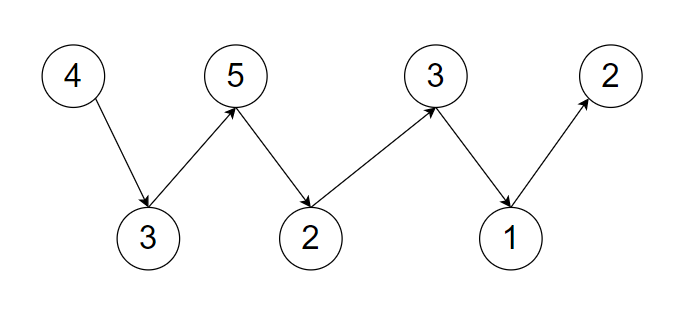
The given array ‘ ARR = { 4, 3, 5, 2, 3, 1, 2 } ’
The below figure is a visual representation of the given ‘ARR’ and you can see we can express ‘ARR’ in a waveform array because
4>3 and 3<5
5>2 and 2<3
3>1 and 1<2
And it follows the condition of wave array.
Follow up:
Try to solve this problem in linear time complexity.
2. System Design Question
Implement a data structure for implementing the feature of showing three last watched movies on Amazon Prime.
3. Data Structure Supporting Insert Delete And GetRandom
Easy
15m average time
85% success
0/40
Asked in companies

Design and implement a data structure which supports the following operations:
insert(X): Inserts an element X in the data structure and returns true if the element was not present, and false otherwise.

remove(X): Removes the element X from the data structure, if present. Returns true if the element was present and false otherwise.

search(X): Search the element X in the data structure. Returns true if the element was present and false otherwise.

getRandom(): Return a random element present in the data structure.
Four types of queries denote these operations:
Type 1: for insert(X) operation.
Type 2: for remove(X) operation.
Type 3: for search(X) operation.
Type 4: for getRandom() operation.
Note:
It is guaranteed that at least one element will be present in the data structure when getRandom() operation is performed.
Follow Up:
Can you implement every operation such that it works in O(1) time?


Here's your problem of the day 
Solving this problem will increase your chance to get selected in this company
Skill covered: Programming
What does dict.keys() return?
Choose another skill to practice
Similar interview experiences
SDE - Intern
3 rounds | 3 problems
Interviewed by Amazon
Rejected

2534 views

0 comments

0 upvotes
SDE - Intern
3 rounds | 7 problems
Interviewed by Amazon

Rejected
1367 views
0 comments
0 upvotes
SDE - Intern
2 rounds | 3 problems
Interviewed by Amazon
Rejected
1585 views
0 comments
0 upvotes
SDE - Intern
1 rounds | 3 problems
Interviewed by Amazon
Selected 4481 views
0 comments
0 upvotes
Companies with similar interview experiences
SDE - Intern
4 rounds | 7 problems
Interviewed by Microsoft
 Selected
 16245 views
1 comments
0 upvotes
SDE - Intern
3 rounds | 6 problems
Interviewed by Microsoft
Selected 8454 views
0 comments
0 upvotes
SDE - Intern
2 rounds | 4 problems
Interviewed by Microsoft
 Selected
 5202 views
2 comments
0 upvotes