





Amazon interview experience Real time questions & tips from candidates to crack your interview

SDE - Intern
Amazon


3 rounds | 6 Coding
problems
 Selected
 Interview preparation journey

Preparation
Duration: 8 months
Topics: Data Structures and Algorithms, Operating System, Database Management System, Object-Oriented Programming System

Tip 1 : Practice Data Structures and Algorithms from Coding Ninjas website and GeeksforGeeks.
Tip 2 : Give coding contests regularly so as to maintain your speed to code, (Leetcode is recommended for weekly contests)
Tip 3 : Do atleast 2 projects and think about all possible questions about them that can be asked during an Interview.
Application process
Where: Campus
Eligibility: Above 6.5 CGPA
Tip 1 : Make your resume short and try to make it of one page only and do mention all your skills which you are confident of in your resume.
Tip 2 : You can also add your Contests rank and ratings if they are good enough.

Interview rounds
01
Round
Medium
Online Coding Interview
Duration145 Minutes
Interview date18 Nov 2021
Coding problem2
Test consists of 4 sections:
Debugging: 7Qs and 20 mins. Overall Easy Level.
Coding: 2Qs and 70 mins, Moderate to Hard difficulty
Behavioural: 60-70 Qs and 20 minutes.
Aptitude: 24 MCQs and 35 minutes. Easy Level
1. Smaller Than Triplet Sum
Moderate
40m average time
60% success

0/80
Asked in companies


You are given an array ‘ARR’ containing ‘N’ integers, and you are also given an integer ‘TARGET’.
You task is to find the count of triplets i, j, k ( 0 ≤ i < j < k < N ), such that 'ARR[i]' + 'ARR[j]' + 'ARR[j]' is less than the value of ‘TARGET’.
For Example :
If ‘N’ = 7, ‘ARR’ = { 1, 5, 2, 3, 4, 6, 7 } and ‘TARGET’ = 9

Then, there are three triplets with sum less than 9:
1) {1, 5, 2}
2) {1, 2, 3}
3) {1, 2, 4}
4) {1, 3, 4}

Thus, the output will be 4.
2. N-ary tree Level Order Traversal
Moderate
20m average time
80% success
0/80
Asked in companies


You are given an N-ary tree where every node has at most ‘N’ child nodes. You need to find the level order traversal of this tree
Note:
Note that the level order traversal must not contain any null values, simply return the tree in level order.
02
Round
Medium
Video Call
Duration60 Minutes
Interview date20 Dec 2021
Coding problem2
The interview round was scheduled at 1:00 pm, Interview was very friendly. Initially asked for my introduction and project, After that proceeded to 2 Algo-DS problems.
1. Remove Half Nodes
Easy
15m average time
80% success
0/40
Asked in companies

You are given a binary tree consisting of ‘N’ nodes. Your task is to replace all the half nodes present in the binary tree with its child node. Half nodes are those nodes that have only one child.
For Example:
In this given binary tree, nodes 7, 5, and 9 are half nodes because they have only one child node. So we have to replace these nodes with their child. The inorder traversal of the updated binary tree is [1, 6, 11, 2, 4]. Hence, the answer is [1, 6, 11, 2, 4].

Example:
Elements are in the level order form. The input consists of values of nodes separated by a single space in a single line. In case a node is null, we take -1 in its place.

For example, the input for the tree depicted in the below image would be :
 1
2 3
4 -1 5 6
-1 7 -1 -1 -1 -1
-1 -1
1
2 3
4 -1 5 6
-1 7 -1 -1 -1 -1
-1 -1
Explanation :
Level 1 :
The root node of the tree is 1

Level 2 :
Left child of 1 = 2
Right child of 1 = 3

Level 3 :
Left child of 2 = 4
Right child of 2 = null (-1)
Left child of 3 = 5
Right child of 3 = 6

Level 4 :
Left child of 4 = null (-1)
Right child of 4 = 7
Left child of 5 = null (-1)
Right child of 5 = null (-1)
Left child of 6 = null (-1)
Right child of 6 = null (-1)

Level 5 :
Left child of 7 = null (-1)
Right child of 7 = null (-1)

The first not-null node (of the previous level) is treated as the parent of the first two nodes of the current level.

The second not-null node (of the previous level) is treated as the parent node for the next two nodes of the current level and so on.

The input ends when all nodes at the last level are null (-1).
Note :
The above format was just to provide clarity on how the input is formed for a given tree.

The sequence will be put together in a single line separated by a single space. Hence, for the above-depicted tree, the input will be given as:

1 2 3 4 -1 5 6 -1 7 -1 -1 -1 -1 -1 -1
Problem approach
Step 1 : Initially I took 2 minutes to develop the approach for the problem
Step 2 : I got that I have to work in the post-order traversal.
Step 3 : Think of the time complexity correctly.
2. Product Array Puzzle
Easy
15m average time
85% success
0/40
Asked in companies


You are given an array of ‘N’ integers. You need to return another array ‘product’ such that ‘product[i]’ contains the product of all the arrays except the element at the ith position in the given array.
Note
As the product of elements can be very large you need to return the answer in mod (10^9+7).
Follow Up
Try to do this without using the division operator ‘/’, in constant space. The output array does not count as extra space for the purpose of space complexity analysis.
Problem approach
I was asked for all the optimizations I can do and we discussed around 3 approaches for the same.
03
Round
Medium
Video Call
Duration65 Minutes
Interview date21 Dec 2021
Coding problem2
This round was taken by a Senior Software Development Engineer at Amazon, working in the company for more than 7 years.
He was very friendly and made me really comfortable. Initially, my intro was asked and 10 minutes discussion on one of my projects.
Then, he came on to two coding problems.
1. Validate BST
Moderate
25m average time
70% success
0/80
Asked in companies


Given a binary tree with N number of nodes, check if that input tree is Partial BST (Binary Search Tree) or not. If yes, return true, return false otherwise.
A binary search tree (BST) is said to be a Partial BST if it follows the following properties.
• The left subtree of a node contains only nodes with data less than and equal to the node’s data.
• The right subtree of a node contains only nodes with data greater than and equal to the node’s data.
• Both the left and right subtrees must also be partial binary search trees.
Example:
Input:
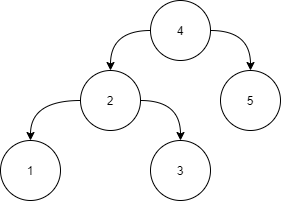
Answer:
Level 1:

All the nodes in the left subtree of 4 (2, 1, 3) are smaller
than 4, all the nodes in the right subtree of the 4 (5) are
larger than 4.

Level 2 :

For node 2:
All the nodes in the left subtree of 2 (1) are smaller than
2, all the nodes in the right subtree of the 2 (3) are larger than 2.
For node 5:
The left and right subtree for node 5 is empty.

Level 3:

For node 1:
The left and right subtree for node 1 are empty.
For node 3:
The left and right subtree for node 3 are empty.
Because all the nodes follow the property of a Partial binary
search tree, the above tree is a Partial binary search tree.
2. Longest Substring Without Repeating Characters
Moderate
20m average time
80% success
0/80
Asked in companies


Given a string 'S' of length 'L', return the length of the longest substring without repeating characters.
Example:
Suppose given input is "abacb", then the length of the longest substring without repeating characters will be 3 ("acb").
Problem approach
I gave 3 approaches for the problem and the most optimal solution was O(n) time and O(26) space, which can be done using HASHMAPS, using Acquire and Release technique.


Here's your problem of the day 
Solving this problem will increase your chance to get selected in this company
Skill covered: Programming
Why is "hello world" (2 tokens) more than "helloworld" (1 token)?
Choose another skill to practice
Similar interview experiences
SDE - Intern
3 rounds | 3 problems
Interviewed by Amazon

Rejected

2221 views

0 comments

0 upvotes
SDE - Intern
3 rounds | 7 problems
Interviewed by Amazon

Rejected
1105 views
0 comments
0 upvotes
SDE - Intern
2 rounds | 3 problems
Interviewed by Amazon
Rejected
1113 views
0 comments
0 upvotes
SDE - Intern
1 rounds | 3 problems
Interviewed by Amazon
Selected 3670 views
0 comments
0 upvotes
Companies with similar interview experiences
SDE - Intern
4 rounds | 7 problems
Interviewed by Microsoft
 Selected
 15609 views
1 comments
0 upvotes
SDE - Intern
3 rounds | 6 problems
Interviewed by Microsoft
Selected 8225 views
0 comments
0 upvotes
SDE - Intern
2 rounds | 4 problems
Interviewed by Microsoft
 Selected
 4963 views
2 comments
0 upvotes