





Amazon interview experience Real time questions & tips from candidates to crack your interview

SDE - 1
Amazon


4 rounds | 9 Coding
problems

 Selected
 Interview preparation journey

Journey
I started my coding journey from the second year of graduation. I asked and consulted seniors on how to start in my career. I started doing DSA. In starting it was not regular but from the seventh semester, I started practicing DSA on regular basis. Meanwhile I also learned Web Development in the last phase of third year. Then, I was ready to apply in different companies
Application story
We were notified about the campus drive by the placement cell of our college through a mail. All the unplaced students were eligible and were asked to fill a form. I applied through the same.
Preparation
Duration: 10+ months
Topics: Dynamic Programming, Trees, LinkedList, Binary Search, Sorting and Searching, Strings, Graphs

Tip 1 : Make sure to do previously asked questions by Amazon (most of the questions were repeated).
Tip 2 : Do not forget to prepare for behavioural questions(amazon principles).
Tip 3 : You should always practice your communication skill, even if you are not able to code but you are comfortable explaining your solution, you can pass the interview.
Application process
Where: Campus
Eligibility: 7 CGPA+, Batch of 2022 only
Tip 1 : Projects with deployed links show a good impression.
Tip 2 : Try to bold or underline skills like react.js, redux, node.js, MySQL, etc.

Interview rounds
01
Round
Medium
Online Coding Interview
Duration90 minutes
Interview date12 Feb 2022
Coding problem2
Timing: 90mins (you can take the test in 24hrs)
How was the environment: good (amazon internal website)
There were 4 sections:
section 1: code debugging round
7 code snippets were present in C language and we have to find the correct the code
section 2: reasoning MCQ
15 reasoning questions were present with 4 options
section 3: coding round
2 coding questions were asked
section 4: work style assessment
behavioral questions were asked
1. Asteroid Collision
Moderate
15m average time
85% success

0/80
Asked in companies


You are given an array/list 'asteroids' representing asteroids in a row.
For each element of the given array, its absolute value denotes the size of that asteroid, and its sign denotes the direction it moves in(+ve meaning right and -ve meaning left).
An asteroid with a weight of 0 denotes a massless asteroid that moves in the right direction.
All asteroids are moving at the same speed. Whenever two asteroids collide, the smaller asteroid gets destroyed.
If both asteroids are the same size, then both asteroids get destroyed. Two asteroids moving in the same direction never collide.
You are supposed to find the state of the asteroids after all collisions.
Example :
Input: ‘asteroids’ = [3,-2,4]

Output: [3, 4]

Explanation: The first asteroid will destroy the second asteroid. Hence, after the collision, the state of the asteroids will be [3,4].
Note:
You don’t need to print anything. Just implement the given function.
Problem approach
Step 1 : create a stack that will store the current asteroid.
Step 2 : if the current asteroid is positive we will push it inside our stack.
Step 3 : else we will pop while the top element is greater.
vector asteroidCollision(vector& asteroids) {
stack st;
int n = asteroids.size();
for(int i = 0;i 0 ) {
st.push(asteroids[i]);
}
else {
while(st.size() != 0 && st.top() > 0 && -asteroids[i] > st.top()) {
st.pop();
}
if(st.size() != 0 && st.top() == -asteroids[i])
st.pop();
else if(st.size() == 0 || st.top()<0)
st.push(asteroids[i]);
}
}
vector ans(st.size(),0);
int i = st.size()-1;
while(i>=0) {
ans[i--] = st.top();
st.pop();
}
return ans;
}
2. Search In A Row Wise And Column Wise Sorted Matrix
Moderate
15m average time
80% success
0/80
Asked in companies



You are given an 'N * N' matrix of integers where each row and each column is sorted in increasing order. You are given a target integer 'X'.
Find the position of 'X' in the matrix. If it exists then return the pair {i, j} where 'i' represents the row and 'j' represents the column of the array, otherwise return {-1,-1}
For example:
If the given matrix is:
[ [1, 2, 5],
  [3, 4, 9],
  [6, 7, 10]]
We have to find the position of 4. We will return {1,1} since A[1][1] = 4.
Problem approach
Naive approach: The simple idea is to traverse the array and to search elements one by one.
Algorithm:
Run a nested loop, outer loop for row and inner loop for the column
Check every element with x and if the element is found then print “element found”
If the element is not found, then print “element not found”.
Efficient approach: The simple idea is to remove a row or column in each comparison until an element is found. Start searching from the top-right corner of the matrix. There are three possible cases.
The given number is greater than the current number: This will ensure that all the elements in the current row are smaller than the given number as the pointer is already at the right-most elements and the row is sorted. Thus, the entire row gets eliminated and continues the search for the next row. Here, elimination means that a row needs not be searched.
The given number is smaller than the current number: This will ensure that all the elements in the current column are greater than the given number. Thus, the entire column gets eliminated and continues the search for the previous column, i.e. the column on the immediate left.
The given number is equal to the current number: This will end the search.
Algorithm:
Let the given element be x, create two variable i = 0, j = n-1 as index of row and column
Run a loop until i = n
Check if the current element is greater than x then decrease the count of j. Exclude the current column.
Check if the current element is less than x then increase the count of i. Exclude the current row.
If the element is equal, then print the position and end.
int search(int mat[4][4], int n, int x)
{
if (n == 0)
return -1;
int smallest = mat[0][0], largest = mat[n - 1][n - 1];
if (x < smallest || x > largest)
return -1;
int i = 0, j = n - 1;
while (i < n && j >= 0)
{
if (mat[i][j] == x)
{
return 1;
}
if (mat[i][j] > x)
j--;
else
i++;
}
return 0;
}
02
Round
Medium
Face to Face
Duration60 minutes
Interview date30 Mar 2022
Coding problem3
1. House Robber
Moderate
26m average time
0/80
Asked in companies


A thief wants to loot houses. He knows the amount of money in each house. He cannot loot two consecutive houses. Find the maximum amount of money he can loot.
Problem approach
Naive Approach: Given an array, the solution is to find the maximum sum subsequence where no two selected elements are adjacent. So the approach to the problem is a recursive solution. So there are two cases.
If an element is selected then the next element cannot be selected.
if an element is not selected then the next element can be selected.
Method 2: Dynamic Programming : Top Down Approach
So the recursive solution can easily be devised. The sub-problems can be stored thus reducing the complexity and converting the recursive solution to a Dynamic programming problem.
Method 3: Dynamic Programming : Bottom Up Approach
So the recursive solution can easily be devised. The sub-problems can be stored thus reducing the complexity and converting the recursive solution to a Dynamic programming problem.
Efficient Approach: By carefully observing the DP array, it can be seen that the values of previous two indices matter while calculating the value for an index. To replace the total DP array by two variables.
Algorithm:
Tackle some basic cases, if the length of the array is 0, print 0, if the length of the array is 1, print the first element, if the length of the array is 2, print maximum of two elements.
Create two variables value1 and value2 value1 as array[0] and value2 as maximum of array[0] and array[1] and a variable max_val to store the answer
Traverse the array from the second element (2nd index) to the end of array.
For every index, update max_val as maximum of value1 + array[i] and value2, this step defines the two cases, if an element is selected then the previous element cannot be selected and if an element is not selected then the previous element can be selected.
For every index, Update value1 = value2 and value2 = max_val
Print the value of max_val
int maxLoot(int* hval, int n)
{
if (n == 0)
return 0;
int value1 = hval[0];
if (n == 1)
return value1;
int value2 = max(hval[0], hval[1]);
if (n == 2)
return value2;
int max_val;
for (int i = 2; i < n; i++) {
max_val = max(hval[i] + value1, value2);
value1 = value2;
value2 = max_val;
}
return max_val;
}
2. Number of Islands
Easy
0/40
Asked in companies

You have been given a non-empty grid consisting of only 0s and 1s. You have to find the number of islands in the given grid.
An island is a group of 1s (representing land) connected horizontally, vertically or diagonally. You can assume that all four edges of the grid are surrounded by 0s (representing water).
Problem approach
Step 1 : Use DFS to mark and travel to each adjacent land.
Step 2 : Each time a new land is found increment our answer.
void helper(vector>& grid, int i, int j, int m, int n, vector>& vis){
vis[i][j] = true;
if(i+1 < m && grid[i+1][j] == '1' && vis[i+1][j] == false){
helper(grid, i+1, j, m, n, vis);
}
if(j - 1 >= 0 && grid[i][j-1] == '1' && vis[i][j-1] == false){
helper(grid, i, j-1, m, n, vis);
}
if(i - 1 >= 0 && grid[i-1][j] == '1' && vis[i-1][j] == false){
helper(grid, i-1, j, m, n, vis);
}
if(j + 1 < n && grid[i][j+1] == '1' && vis[i][j+1] == false){
helper(grid, i, j+1, m, n, vis);
}
}
int numIslands(vector>& grid) {
int ans = 0;
int m=grid.size();
int n = grid[0].size();
vector> vis(n, vector (m));
for(int i=0;i for(int j=0;j if(grid[i][j] == '1' && vis[i][j] == false){
ans++;
helper(grid, i, j, m, n, vis);
}
}
}
return ans;
}
3. Height of Binary Tree
Easy
15m average time
80% success
0/40
Asked in companies


The height of a tree is equal to the number of nodes on the longest path from the root to a leaf.
You are given an arbitrary binary tree consisting of 'n' nodes where each node is associated with a certain value.
Find out the height of the tree.
Example :
Input: Let the binary tree be:
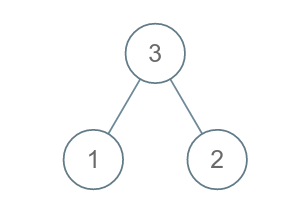
Output: 2

Explanation: The root node is 3, and the leaf nodes are 1 and 2.

There are two nodes visited when traversing from 3 to 1.
There are two nodes visited when traversing from 3 to 2.

Therefore the height of the binary tree is 2.
Problem approach
Step 1 : same as normal binary tree height but the only thing different is to find leaf node.
Step 2 : for that we will just check our right child -> left == curr && left child -> right == curr
The idea is to follow similar approach as we do for finding height of a normal binary tree. We recursively calculate height of left and right subtrees of a node and assign height to the node as max of the heights of two children plus 1. But left and right child of a leaf node are null for normal binary trees. But, here leaf node is a circular doubly linked list node. So for a node to be a leaf node, we check if node’s left’s right is pointing to the node and its right’s left is also pointing to the node itself.
bool isLeaf(Node* node)
{
return node->left && node->left->right == node
&& node->right && node->right->left == node;
}
Nodes along the longest path from the root node
down to the farthest leaf node.*/
int maxDepth(Node* node)
{
if (node == NULL)
return 0;
if (isLeaf(node))
return 1;
return 1
+ max(maxDepth(node->left),
maxDepth(node->right));
}
03
Round
Hard
Face to Face
Duration60 minutes
Interview date18 Apr 2022
Coding problem2
1. Word Break
Moderate
15m average time
85% success
0/80
Asked in companies



You are given a list of “N” strings A. Your task is to check whether you can form a given target string using a combination of one or more strings of A.
Note :
You can use any string of A multiple times.
Examples :
A =[“coding”, ”ninjas”, “is”, “awesome”]  target = “codingninjas”
Ans = true as we use “coding” and “ninjas” to form “codingninjas”
Problem approach
Step 1 : Recursive implementation:
The idea is simple, we consider each prefix and search it in dictionary. If the prefix is present in dictionary, we recur for rest of the string (or suffix).
If the recursive call for suffix returns true, we return true, otherwise we try next prefix. If we have tried all prefixes and none of them resulted in a solution, we return false.
Step 2 : memorize your code
Step 3 : Tabulation
In this approach, apart from the dp table, we also maintain all the indexes which have matched earlier. Then we will check the substrings from those indexes to the current index. If anyone of that matches then we can divide the string up to that index.
In this program, we are using some extra space. However, its time complexity is O(n*s) where s is the length of the largest string in the dictionary and n is the length of the given string.
int dictionaryContains(string word)
{
string dictionary[]
= { "mobile", "samsung", "sam", "sung", "man",
"mango", "icecream", "and", "go", "i",
"like", "ice", "cream" };
int size = sizeof(dictionary) / sizeof(dictionary[0]);
for (int i = 0; i < size; i++)
if (dictionary[i].compare(word) == 0)
return true;
return false;
}
bool wordBreak(string s)
{
int n = s.size();
if (n == 0)
return true;
vector dp(n + 1, 0); // Initialize all values
vector matched_index;
matched_index.push_back(-1);
for (int i = 0; i < n; i++) {
int msize = matched_index.size();
int f = 0;
for (int j = msize - 1; j >= 0; j--) {
string sb = s.substr(matched_index[j] + 1,
i - matched_index[j]);
if (dictionaryContains(sb)) {
f = 1;
break;
}
}
if (f == 1) {
dp[i] = 1;
matched_index.push_back(i);
}
}
return dp[n - 1];
}
2. Next Greater Element
Easy
10m average time
90% success
0/40
Asked in companies

You have been given an array/list ‘ARR’ consisting of ‘N’ positive integers. Your task is to return the Next Greater Element(NGE) for every element.
The Next Greater Element for an element ‘X’ is the first element on the right side of ‘X’ in the array 'ARR', which is greater than ‘X’. If no such element exists to the right of ‘X’, then return -1.
For example:
For the given array 'ARR' = [7, 12, 1, 20]

The next greater element for 7 is 12.
The next greater element for 12 is 20.
The next greater element for 1 is 20.
There is no greater element for 20 on the right side.

So, the output is [12, 20, 20, -1].
Problem approach
Method 1 (Simple)
Use two loops: The outer loop picks all the elements one by one. The inner loop looks for the first greater element for the element picked by the outer loop. If a greater element is found then that element is printed as next, otherwise, -1 is printed.
Method 2 (Using Stack)
Push the first element to stack.
Pick rest of the elements one by one and follow the following steps in loop.
Mark the current element as next.
If stack is not empty, compare top element of stack with next.
If next is greater than the top element, Pop element from stack. next is the next greater element for the popped element.
Keep popping from the stack while the popped element is smaller than next. next becomes the next greater element for all such popped elements.
Finally, push the next in the stack.
After the loop in step 2 is over, pop all the elements from the stack and print -1 as the next element for them.
void printNGE(int arr[], int n)
{
stack s;
s.push(arr[0]);
for (int i = 1; i < n; i++)
{
if (s.empty()) {
s.push(arr[i]);
continue;
}
while (s.empty() == false
&& s.top() < arr[i])
{
s.pop();
}
s.push(arr[i]);
}
while (s.empty() == false) {
s.pop();
}
}
04
Round
Medium
Face to Face
Duration60 minutes
Interview date13 Jun 2022
Coding problem2
1. Binary Tree Zigzag Traversal
Easy
15m average time
85% success
0/40
Asked in companies


You have been given a Binary Tree of 'N' nodes, where the nodes have integer values. Your task is to print the zigzag traversal of the given tree.
Note:
In zigzag order, level 1 is printed from left to right fashion, level 2 is printed from right to left. and level 3 is printed from left to right again, and so on…..
For example:
For the given binary tree
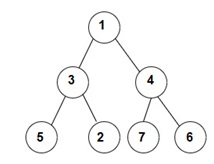
The zigzag traversal is [1, 4, 3, 5, 2, 7, 6]
Problem approach
Step 1 : This problem can be solved using two stacks. Assume the two stacks are current: currentlevel and nextlevel.
Step 2 : We would also need a variable to keep track of the current level order(whether it is left to right or right to left). We pop from the currentlevel stack and print the nodes value. Whenever the current level order is from left to right, push the nodes left child, then its right child to the stack nextlevel. Since a stack is a LIFO(Last-In-First_out) structure, next time when nodes are popped off nextlevel, it will be in the reverse order. On the other hand, when the current level order is from right to left, we would push the nodes right child first, then its left child.
step3: Finally, do-not forget to swap those two stacks at the end of each level(i.e., when current level is empty)
void zizagtraversal(struct Node* root)
{
if (!root)
return;
stack currentlevel;
stack nextlevel;
currentlevel.push(root);
bool lefttoright = true;
while (!currentlevel.empty()) {
struct Node* temp = currentlevel.top();
currentlevel.pop();
if (temp) {
if (lefttoright) {
if (temp->left)
nextlevel.push(temp->left);
if (temp->right)
nextlevel.push(temp->right);
}
else {
if (temp->right)
nextlevel.push(temp->right);
if (temp->left)
nextlevel.push(temp->left);
}
}
if (currentlevel.empty()) {
lefttoright = !lefttoright;
swap(currentlevel, nextlevel);
}
}
}
2. Maximum Consecutive Ones
Moderate
30m average time
70% success
0/80
Asked in companies

Given a binary array 'ARR' of size 'N', your task is to find the longest sequence of continuous 1’s that can be formed by replacing at-most 'K' zeroes by ones. Return the length of this longest sequence of continuous 1’s.
Problem approach
Step 1 : A simple solution is consider every subarray and count 1’s in every subarray. Finally return return size of largest subarray with all 1’s.
Step 2 : An efficient solution is traverse array from left to right. If we see a 1, we increment count and compare it with maximum so far. If we see a 0, we reset count as 0.
int getMaxLength(bool arr[], int n)
{
int count = 0;
int result = 0;
for (int i = 0; i < n; i++)
{
if (arr[i] == 0)
count = 0;
else
{
count++;
result = max(result, count);
}
}
return result;
}


Here's your problem of the day 
Solving this problem will increase your chance to get selected in this company
Skill covered: Programming
How do you remove whitespace from the start of a string?
Choose another skill to practice
Similar interview experiences
SDE - 1
3 rounds | 5 problems
Interviewed by Amazon
Rejected

3085 views

0 comments

0 upvotes
SDE - 1
4 rounds | 8 problems
Interviewed by Amazon
Rejected
2295 views
1 comments
0 upvotes
SDE - 1
3 rounds | 6 problems
Interviewed by Amazon
Rejected
1593 views
0 comments
0 upvotes
SDE - 1
4 rounds | 8 problems
Interviewed by Amazon
Selected 8962 views
0 comments
0 upvotes
Companies with similar interview experiences
SDE - 1
4 rounds | 5 problems
Interviewed by Microsoft
Selected 58238 views
5 comments
0 upvotes

SDE - 1
4 rounds | 8 problems
Interviewed by Samsung
Selected 12649 views
2 comments
0 upvotes
SDE - 1
4 rounds | 8 problems
Interviewed by Microsoft
Selected 5983 views
5 comments
0 upvotes