





Amazon interview experience Real time questions & tips from candidates to crack your interview

SDE - 1
Amazon


4 rounds | 13 Coding
problems

Rejected
Interview preparation journey

Preparation
Duration: 6 months
Topics: Brush up on Data Structures, Algorithms, Coding practice with pen & paper, Reading previous interview experiences, OOPS & Java mostly asked questions

Tip 1 : Code & practice
Tip 2 : Have good grip on DS & Algorithms
Application process
Where: Other
Eligibility: Strong resume
Tip 1 : Clean one page resume
Tip 2 : Mention previous experiences, projects, coding profile links

Interview rounds
01
Round
Hard
Online Coding Interview
Duration120 minutes
Interview date9 Feb 2021
Coding problem2
OA consisted of 2 coding questions followed by the explanations on why this solution was proposed. Then a series of behavioral based questions (Work style)
1. Optimize Suggestions
Optimize Suggestions
Search nearest X restaurants in the city relative to the customer's location.
Input -
1. Pair of x & y coordinates representing the location of restaurants.
2. Number of restaurants returned to customer X
Note - Customer begins at (0,0)
Problem approach
Find the distance with the coordinates provided, the sort & pick first X elements & return
2. Shortest Route
Easy
15m average time
85% success

0/40
Asked in companies


You want to visit your friend’s house who lives at some location in an infinite grid. You are initially at the origin of the infinite grid and can move only in four directions (i.e East, West, North, South).
For Example, If you are at cell (X, Y) then you can move to East i.e at cell (X+1, Y), or West i.e at cell (X-1, Y), or North i.e at cell (X, Y+1), or South i.e at cell (X, Y-1).
Your friend gives you a string ‘STR’ of length ‘N’ that represents the route to his house from the origin. The string ‘STR’ has only four different characters, i.e ‘E’, ‘W’, ‘N’, ‘S’. which represent direction East, West, North, South, respectively.
You find out that the route given by your friend is very long, and a shorter route is also possible. Your task is to find the smallest route to reach your friend’s house. See the example for better clarity.
Note:
1. There can be more than one shortest route, you should return the one which is lexicographically smallest among them.
Example:
Consider that your friend’s house is in the cell (2, 1) in the grid. And the route given by your friend is represented by the string ‘STR’= “NNSEWEE”.

One of the smallest route to reach cell (2, 1) from origin i.e cell (0, 0) is given by string  “EEN”  i.e you start from the cell (0, 0), then move East, i.e at cell (1, 0), then again move East, i.e at cell (2, 0), and then finally move North i.e at cell (2, 1).

Note, there are some other smallest routes such as “NEE”,  “ENE” etc, but “EEN” is the lexicographically smallest among them, so you should return it.
Problem approach
To find optimal answer, a bigger number just smaller than the max distance that can be formed by combination of both the forward & return routes.
Binary search can be used here.
02
Round
Medium
Face to Face
Duration60 minutes
Interview date13 Feb 2021
Coding problem3
Coding Interview (Chime)
1. Maximum Path Sum Between Two Leaves
Hard
50m average time
35% success
0/120
Asked in companies



You are given a non-empty binary tree where each node has a non-negative integer value. Return the maximum possible sum of path between any two leaves of the given tree.
The path is also inclusive of the leaf nodes and the maximum path sum may or may not go through the root of the given tree.
If there is only one leaf node in the tree, then return -1.
Problem approach
For each node there can be four ways that the max path goes through the node:
1. Node only
2. Max path through Left Child + Node
3. Max path through Right Child + Node
4. Max path through Left Child + Node + Max path through Right Child
2. Rotting Oranges
Moderate
20m average time
78% success
0/80
Asked in companies



You have been given a grid containing some oranges. Each cell of this grid has one of the three integers values:
Every second, any fresh orange that is adjacent(4-directionally) to a rotten orange becomes rotten.
Your task is to find out the minimum time after which no cell has a fresh orange. If it's impossible to rot all the fresh oranges then print -1.
Note:
1. The grid has 0-based indexing.
2. A rotten orange can affect the adjacent oranges 4 directionally i.e. Up, Down, Left, Right.
Problem approach
BFS
3. DSA based Questions
Different types of graph traversals, which one should be used for shortest distance/time & why? Time complexities.
Problem approach
Tip 1 : Understand DS & TC well
03
Round
Hard
Face to Face
Duration60 minutes
Interview date17 Feb 2021
Coding problem3
1. Level Order Traversal
Easy
15m average time
85% success
0/40
Asked in companies



You have been given a Binary Tree of integers. You are supposed to return the level order traversal of the given tree.
For example:
For the given binary tree
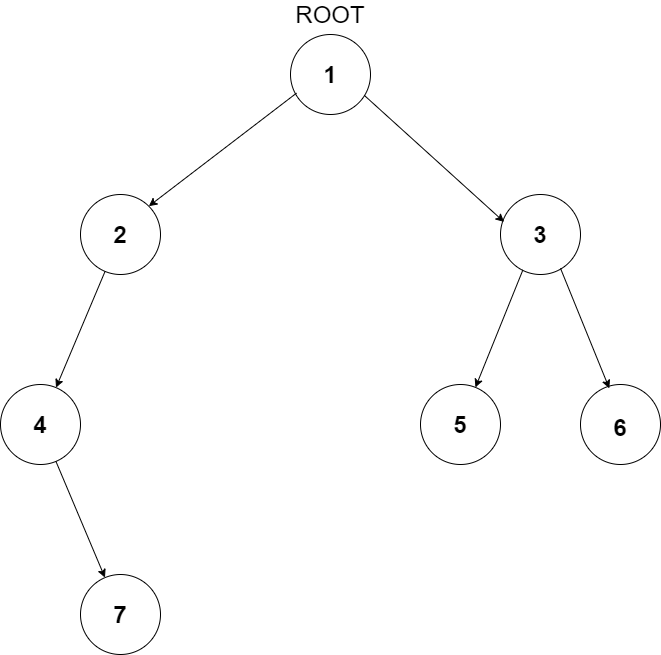
The level order traversal will be {1,2,3,4,5,6,7}.
Problem approach
BFS + Flags to find the direction of visit
2. Binary Tree Zigzag Traversal
Easy
15m average time
85% success
0/40
Asked in companies


You have been given a Binary Tree of 'N' nodes, where the nodes have integer values. Your task is to print the zigzag traversal of the given tree.
Note:
In zigzag order, level 1 is printed from left to right fashion, level 2 is printed from right to left. and level 3 is printed from left to right again, and so on…..
For example:
For the given binary tree
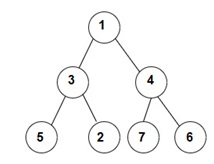
The zigzag traversal is [1, 4, 3, 5, 2, 7, 6]
Problem approach
Simulate the scenario & count the occurrences
3. Search In Rotated Sorted Array
Moderate
30m average time
65% success
0/80
Asked in companies



Aahad and Harshit always have fun by solving problems. Harshit took a sorted array consisting of distinct integers and rotated it clockwise by an unknown amount. For example, he took a sorted array = [1, 2, 3, 4, 5] and if he rotates it by 2, then the array becomes: [4, 5, 1, 2, 3].
After rotating a sorted array, Aahad needs to answer Q queries asked by Harshit, each of them is described by one integer Q[i]. which Harshit wanted him to search in the array. For each query, if he found it, he had to shout the index of the number, otherwise, he had to shout -1.
For each query, you have to complete the given method where 'key' denotes Q[i]. If the key exists in the array, return the index of the 'key', otherwise, return -1.
Note:
Can you solve each query in O(logN) ?
Problem approach
Use Binary search
04
Round
Medium
Face to Face
Duration60 minutes
Interview date23 Feb 2021
Coding problem5
1. Count Pairs
Moderate
25m average time
70% success
0/80
Asked in companies


You are given an array 'A' of length 'N' consisting only of integers. You are also given three integers 'X', 'Y' and 'SUM'. Count the number of pairs ('i', 'j') where 'i' < 'j' such that ('A[i]' * 'X' + 'A[j]' * 'Y') = 'SUM'.
Example :
'N' = 3, 'A' = {3, 1, 2, 3}, 'X' = 4, 'Y'= 2, 'SUM' = 14

For 'i' = 1, 'j' = 2, Value of the expression = 4 * 3 + 2 * 1 = 14.
For 'i' = 1, 'j' = 3, Value of the expression = 4 * 3 + 2 * 2 = 16.
For 'i' = 1, 'j' = 4, Value of the expression = 4 * 3 + 2 * 3 = 18.
For 'i' = 2, 'j' = 3, Value of the expression = 4 * 1 + 2 * 2 = 8.
For 'i' = 2, 'j' = 4, Value of the expression = 4 * 1 + 2 * 3 = 10.
For 'i' = 3, 'j' = 4, Value of the expression = 4 * 2 + 2 * 3 = 14.

The possible pairs are :
(1, 3), (3,4)
Problem approach
One method - Using hashmaps
2. Data Structure based Question
What is a hashmap? When is it used. What is the time complexity while retrieving data, inserting data?
Explain the internal working of maps in Java.
Problem approach
Tip 1 : Know the internal working of DS
3. Project based Question
Explain about the project you're currently working on. What are the challenges faced?
Problem approach
Tip 1 : Know your current project, know the tasks undertaken at work
4. Majority element
Easy
15m average time
85% success
0/40
Asked in companies


You have been given an array/list 'ARR' consisting of 'N' integers. Your task is to find the majority element in the array. If there is no majority element present, print -1.
Note:
A majority element is an element that occurs more than floor('N' / 2) times in the array.
Problem approach
Solved using Moore's voting algorithm
5. Resume based Questions
Questions based on the projects mentioned in the Resume
Problem approach
Tip 1 : Know your resume well


Here's your problem of the day 
Solving this problem will increase your chance to get selected in this company
Skill covered: Programming
How do you remove whitespace from the start of a string?
Choose another skill to practice
Similar interview experiences
SDE - 1
3 rounds | 5 problems
Interviewed by Amazon
Rejected

3085 views

0 comments

0 upvotes
SDE - 1
4 rounds | 8 problems
Interviewed by Amazon
Rejected
2294 views
1 comments
0 upvotes
SDE - 1
3 rounds | 6 problems
Interviewed by Amazon
Rejected
1593 views
0 comments
0 upvotes
SDE - 1
4 rounds | 8 problems
Interviewed by Amazon
 Selected
 8962 views
0 comments
0 upvotes
Companies with similar interview experiences
SDE - 1
4 rounds | 5 problems
Interviewed by Microsoft
Selected 58238 views
5 comments
0 upvotes
SDE - 1
4 rounds | 8 problems
Interviewed by Samsung
Selected 12649 views
2 comments
0 upvotes
SDE - 1
4 rounds | 8 problems
Interviewed by Microsoft
Selected 5983 views
5 comments
0 upvotes