





Amazon interview experience Real time questions & tips from candidates to crack your interview

Support Engineer
Amazon


2 rounds | 5 Coding
problems

Rejected
Interview preparation journey

Preparation
Duration: 3 months
Topics: Data Structures, Pointers, OOPS, System Design, Algorithms, Dynamic Programming

Tip 1 : Practice Atleast 250 Questions
Tip 2 : Do atleast 2 projects
Tip 3 : Do practice on internet
Tip 4 : Practice past year questions
Application process
Where: Company Website
Eligibility: 7 CGPA
Tip 1 : Have some projects on resume.
Tip 2 : Do not put false things on resume.

Interview rounds
01
Round
Medium
Online Coding Interview
Duration60 minutes
Interview date22 Aug 2022
Coding problem2
MCQ round consists of 20 questions and 2 coding questions
1. Ninja And The Strictly Increasing Array
Moderate
23m average time
78% success

0/80
Asked in company
Ninja is a brilliant student in the class, so his teacher assigned him a problem.
He has been given an array ‘A’ containing positive integers ‘N’ integers.
He has also been given another array ‘B’ of size ‘N’ initially filled with 0’s at all the positions.
Now, In one move, Ninja can update any ‘B[i]’ as ‘B[i] - A[i]’ or as ‘B[i] + A[i]’, and he has been asked to find the minimum number of moves to make this array ‘B’ strictly increasing.
Your task is to help Ninja and print the minimum number of the above moves to make the array ‘B’ strictly increase.
Example :
Input: ‘N’ = 5, ‘A’ = [1, 2, 3, 4, 5]
Output: 4

Initially, array ‘B = [0, 0, 0, 0, 0], we will perform the following sequence of moves:
‘B[0] = B[0] - A[0]’
‘B[2] = B[2] + A[2]’
‘B[3] = B[3] + A[3]’
‘B[4] = B[4] + A[4]’
 After these moves, the updated array will be [-1, 0, 3, 4, 5], and this is the minimum possible number of moves to make this array strictly increase.
Problem approach
lenOfLongIncSubArr(arr, n)
Declare max = 1, len = 1
for i = 1 to n-1
if arr[i] > arr[i-1]
len++
else
if max < len
max = len
len = 1
if max < len
max = len
return max
2. Check If Linked List Is Palindrome
Easy
15m average time
85% success
0/40
Asked in companies



You are given a Singly Linked List of integers. You have to return true if the linked list is palindrome, else return false.
A Linked List is a palindrome if it reads the same from left to right and from right to left.
Example:
The lists (1 -> 2 -> 1), (3 -> 4 -> 4-> 3), and (1) are palindromes, while the lists (1 -> 2 -> 3) and (3 -> 4) are not.
Problem approach
Follow the steps below to solve the problem:
A simple solution is to use a stack of list nodes. This mainly involves three steps.
Traverse the given list from head to tail and push every visited node to stack.
Traverse the list again. For every visited node, pop a node from the stack and compare data of popped node with the currently visited node.
If all nodes matched, then return true, else false.
02
Round
Easy
Video Call
Duration45 minutes
Interview date11 Sep 2022
Coding problem3
1. Longest Common Subsequence
Moderate
0/80
Asked in companies


You have been given two Strings “STR1” and “STR2” of characters. Your task is to find the length of the longest common subsequence.
A String ‘a’ is a subsequence of a String ‘b’ if ‘a’ can be obtained from ‘b’ by deletion of several (possibly, zero or all) characters. A common subsequence of two Strings is a subsequence that is common to both Strings.
Problem approach
The idea is to use Hashing. We first insert all elements in a Set. Then check all the possible starts of consecutive subsequences.
2. Sum Tree
Moderate
29m average time
0/80
Asked in companies


For a given binary tree, convert it to its sum tree. That is, replace every node data with sum of its immediate children, keeping leaf nodes 0. Finally, return its preorder.
For example:
The input for the tree depicted in the below image would be :
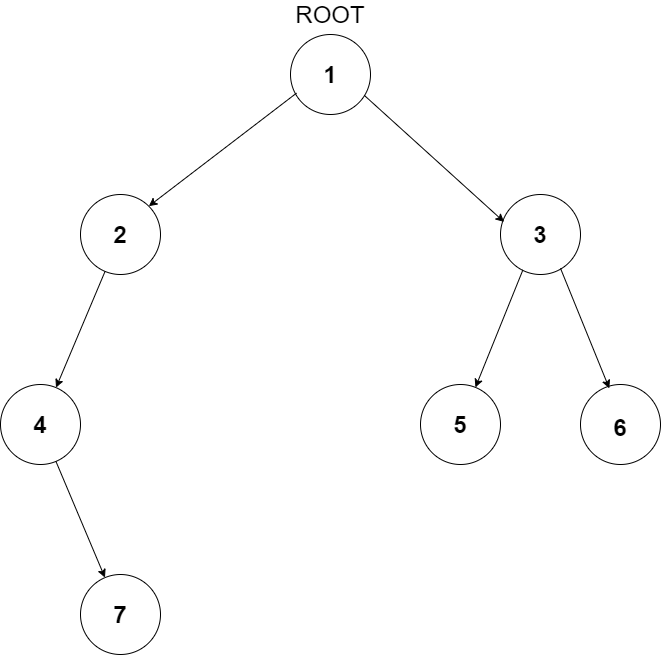
1
2 3
4 -1 5 6
-1 7 -1 -1 -1 -1
-1 -1
Explanation :
Level 1 :
The root node of the tree is 1

Level 2 :
Left child of 1 = 2
Right child of 1 = 3

Level 3 :
Left child of 2 = 4
Right child of 2 = null (-1)
Left child of 3 = 5
Right child of 3 = 6

Level 4 :
Left child of 4 = null (-1)
Right child of 4 = 7
Left child of 5 = null (-1)
Right child of 5 = null (-1)
Left child of 6 = null (-1)
Right child of 6 = null (-1)

Level 5 :
Left child of 7 = null (-1)
Right child of 7 = null (-1)

The first not-null node (of the previous level) is treated as the parent of the first two nodes of the current level. The second not-null node (of the previous level) is treated as the parent node for the next two nodes of the current level and so on.
The input ends when all nodes at the last level are null (-1).
Note :
The above format was just to provide clarity on how the input is formed for a given tree.
 In the input, each value of the sequence will be present on a separate line.
Problem approach
Get the sum of nodes in the left subtree and right subtree. Check if the sum calculated is equal to the root’s data. Also, recursively check if the left and right subtrees are SumTrees.
3. ML Questions
Difference between Data Science and Data Analyst
Machine learning algorithm you will used for predicting car sales in next year
What is SVM and reinforcement technique?


Here's your problem of the day 
Solving this problem will increase your chance to get selected in this company
Skill covered: Programming
Providing input/output examples in your prompt is a technique called:
Choose another skill to practice
Similar interview experiences
Support Engineer
2 rounds | 3 problems
Interviewed by Amazon

Rejected

3356 views

0 comments

0 upvotes
Support Engineer
3 rounds | 6 problems
Interviewed by Amazon

 Selected
 7975 views
0 comments
0 upvotes
SDE - Intern
2 rounds | 3 problems
Interviewed by Amazon
Rejected
1226 views
0 comments
0 upvotes
Support Engineer
4 rounds | 7 problems
Interviewed by Amazon
Selected 8417 views
0 comments
0 upvotes
Companies with similar interview experiences

Support Engineer
2 rounds | 4 problems
Interviewed by Adobe

Rejected
1653 views
0 comments
0 upvotes