





Amazon interview experience Real time questions & tips from candidates to crack your interview

SDE - 1
Amazon


3 rounds | 7 Coding
problems

 Selected
 Interview preparation journey

Preparation
Duration: 6 months
Topics: Graphs, DFS, BFS, Dijkstra's, Linked List.

Tip 1 : Focus on graphs every interviewer ask at least one graph question
Tip 2 : Read about amazon leadership principles and STAR
Tip 3 : Make 2-3 good personal projects, interviewers ask about questions about personal projects.
Application process
Where: Company Website
Eligibility: Graduating in 2022
Tip 1 : Make 2-3 good personal projects, interviewers ask about questions about personal projects.
Tip 2 : Make a single page resume

Interview rounds
01
Round
Easy
Video Call
Duration60 minutes
Interview date8 Jun 2022
Coding problem2
Interviewer was helpful and was giving hints when I was struck.
1. Shortest Path in a Binary Matrix
Moderate
37m average time
65% success

0/80
Asked in companies



You have been given a binary matrix of size 'N' * 'M' where each element is either 0 or 1. You are also given a source and a destination cell, both of them lie within the matrix.
Your task is to find the length of the shortest path from the source cell to the destination cell only consisting of 1s. If there is no path from source to destination cell, return -1.
Note:
1. Coordinates of the cells are given in 0-based indexing.
2. You can move in 4 directions (Up, Down, Left, Right) from a cell.
3. The length of the path is the number of 1s lying in the path.
4. The source cell is always filled with 1.
For example -
1 0 1
1 1 1
1 1 1
For the given binary matrix and source cell(0,0) and destination cell(0,2). Few valid paths consisting of only 1s are

X 0 X     X 0 X
X X X     X 1 X
1 1 1     X X X
The length of the shortest path is 5.
2. Detect And Remove Cycle
Easy
10m average time
90% success
0/40
Asked in companies



You have been given a Singly Linked List of integers, determine if it forms a cycle or not. If there is a cycle, remove the cycle and return the list.
A cycle occurs when a node's ‘next’ points back to a previous node in the list.
Problem approach
I came up with the O(nˆ2) approach by detecting the cycle first then traversing the list to find the point where the cycle starts.
then optimised it to O(n) using hashmap
02
Round
Easy
Video Call
Duration60 minutes
Interview date17 Jun 2022
Coding problem3
Coding. + Behavioural round
Interview included discussion about personal projects and asked about motivation to make that project.
1. Pair Product Div by K
Moderate
35m average time
65% success
0/80
Asked in companies
Given a integer array nums of length ‘N’ and an integer ‘K’, return the number of pairs ‘(i, j)’ such that:
1 <= ‘i’ < ‘j’ <= ‘N’ and ‘nums[i] * nums[j]’ is divisible by ‘K’.
EXAMPLE :
‘N’ = 5, ‘K’ = 4, ‘nums’ = [2, 6, 1, 7, 8]
Output: 5
Explanation: (1, 2), (1, 5), (2, 5), (3, 5), and (4, 5) pairs have their products divisible by K.
2. Reach the last cell in the least time
Moderate
15m average time
85% success
0/80
Asked in companies

You are given an ‘N x N’ matrix ‘GRID’. Initially, every cell is locked, and ‘GRID[i][j]’ represents the time at which the cell at ‘(i, j)’ will unlock. You can move from one cell to another 4-dimensionally adjacent cell if and only if both cells are unlocked. You can move through infinite cells in zero time. Also, you cannot leave the boundaries of the grid.
If you start at the cell ‘(0, 0)’, what is the least time required to reach the last cell ‘(N - 1, N - 1)’.
Example:
‘GRID’ =
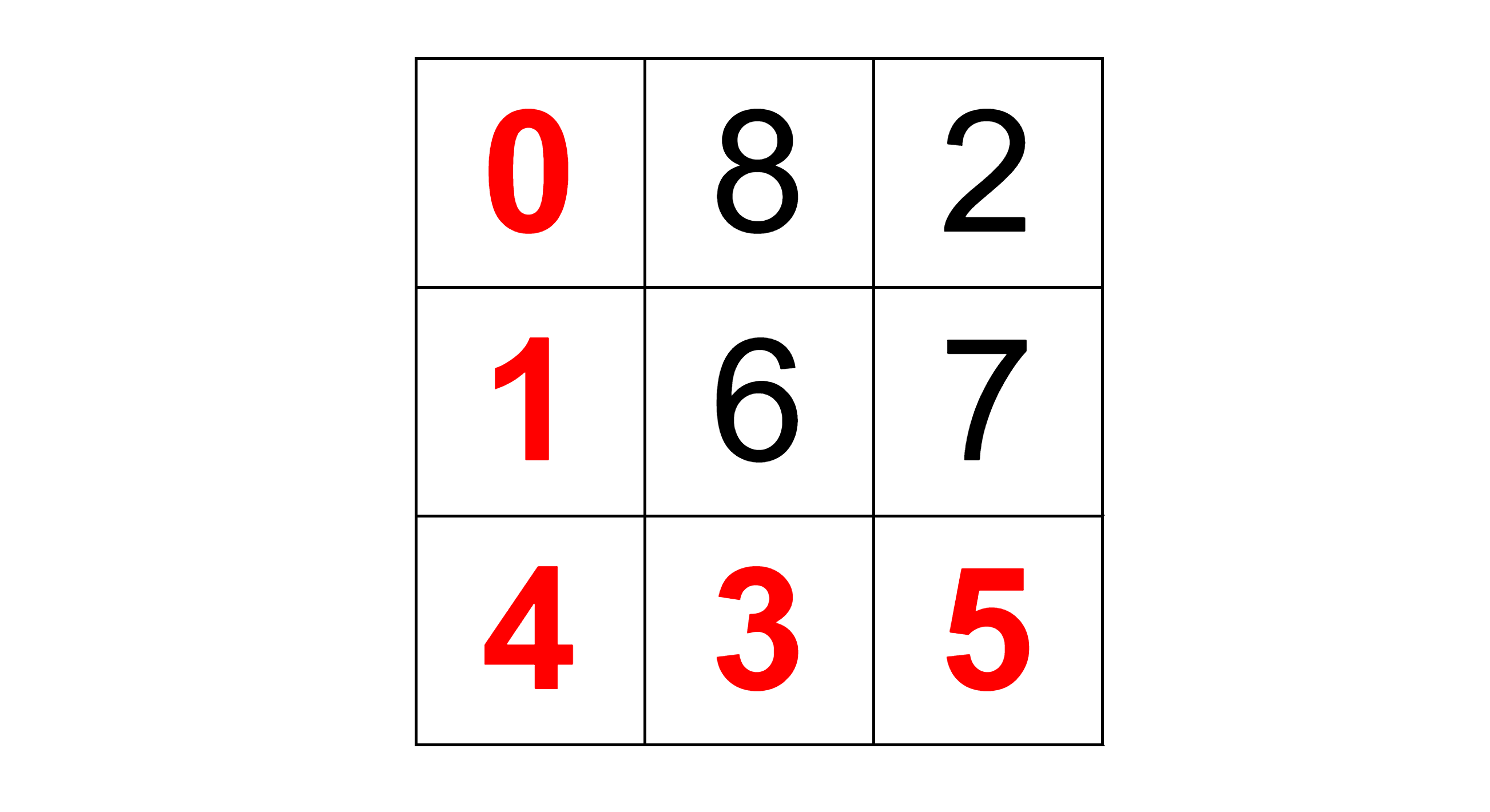
We cannot reach the cell ‘(2, 2)’ until the time is ‘5’. When the time is ‘5’, we move along the path:
0 -> 1 -> 4 -> 3 -> 5

The cell with value ‘1’ will be unlocked when the time is ‘1’.
At time = 1: 0 -> 1

Similarly, the cell with value ‘4’ is unlocked when the time is ‘4’. At that time the cell with value ‘3’ will also be unlocked, as it unlocks at time ‘3’.
At time = 4: 0 -> 1 -> 4 -> 3

The cell with value ‘5’ will be unlocked when the time is ‘5’.
At time = 5: 0 -> 1 -> 4 -> 3 -> 5

So, the least time to reach cell ‘(2, 2)’ is ‘5’.
Note:
1. All elements in the ‘GRID’ are unique.

2. ‘GRID[i][j]’ is a permutation of [0, 1, … , (N ^ 2) - 1].
Problem approach
I came up with the O(nˆ2) approach initially then optimised it using DP and did it in O(n)
3. Jump Game
Moderate
15m average time
85% success
0/80
Asked in companies

You have been given an array 'ARR' of ‘N’ integers. You have to return the minimum number of jumps needed to reach the last index of the array i.e ‘N - 1’.
From index ‘i’, we can jump to an index ‘i + k’ such that 1<= ‘k’ <= ARR[i] .
'ARR[i]' represents the maximum distance you can jump from the current index.
If it is not possible to reach the last index, return -1.
Note:
Consider 0-based indexing.
Example:
Consider the array 1, 2, 3, 4, 5, 6
We can Jump from index 0 to index 1
Then we jump from index 1 to index 2
Then finally make a jump of 3 to reach index N-1

There is also another path where
We can Jump from index 0 to index 1
Then we jump from index 1 to index 3
Then finally make a jump of 2 to reach index N-1

So multiple paths may exist but we need to return the minimum number of jumps in a path to end which here is 3.
03
Round
Easy
Video Call
Duration60 minutes
Interview date18 Jul 2022
Coding problem2
1. Kth Smallest and Largest Element of Array
Easy
15m average time
70% success
0/40
Asked in companies


You are given an array ‘Arr’ consisting of ‘N’ distinct integers and a positive integer ‘K’. Find out Kth smallest and Kth largest element of the array. It is guaranteed that K is not greater than the size of the array.
Example:
Let ‘N’ = 4,  ‘Arr’ be [1, 2, 5, 4] and ‘K’ = 3.
then the elements of this array in ascending order is [1, 2, 4, 5].  Clearly, the 3rd smallest and largest element of this array is 4 and 2 respectively.
2. Data Structure Supporting Insert Delete And GetRandom
Easy
15m average time
85% success
0/40
Asked in companies



Design and implement a data structure which supports the following operations:
insert(X): Inserts an element X in the data structure and returns true if the element was not present, and false otherwise.

remove(X): Removes the element X from the data structure, if present. Returns true if the element was present and false otherwise.

search(X): Search the element X in the data structure. Returns true if the element was present and false otherwise.

getRandom(): Return a random element present in the data structure.
Four types of queries denote these operations:
Type 1: for insert(X) operation.
Type 2: for remove(X) operation.
Type 3: for search(X) operation.
Type 4: for getRandom() operation.
Note:
It is guaranteed that at least one element will be present in the data structure when getRandom() operation is performed.
Follow Up:
Can you implement every operation such that it works in O(1) time?


Here's your problem of the day 
Solving this problem will increase your chance to get selected in this company
Skill covered: Programming
How do you remove whitespace from the start of a string?
Choose another skill to practice
Similar interview experiences
SDE - 1
3 rounds | 5 problems
Interviewed by Amazon
Rejected

3085 views

0 comments

0 upvotes
SDE - 1
4 rounds | 8 problems
Interviewed by Amazon
Rejected
2294 views
1 comments
0 upvotes
SDE - 1
3 rounds | 6 problems
Interviewed by Amazon
Rejected
1593 views
0 comments
0 upvotes
SDE - 1
4 rounds | 8 problems
Interviewed by Amazon
Selected 8962 views
0 comments
0 upvotes
Companies with similar interview experiences
SDE - 1
4 rounds | 5 problems
Interviewed by Microsoft
Selected 58238 views
5 comments
0 upvotes

SDE - 1
4 rounds | 8 problems
Interviewed by Samsung
Selected 12649 views
2 comments
0 upvotes
SDE - 1
4 rounds | 8 problems
Interviewed by Microsoft
Selected 5983 views
5 comments
0 upvotes