





Amazon interview experience Real time questions & tips from candidates to crack your interview

Software Developer
Amazon


3 rounds | 6 Coding
problems

Rejected
Interview preparation journey

Preparation
Duration: 5 months
Topics: Data Structures, Algorithms, System Design, Aptitude, OOPS

Tip 1 : Must do Previously asked Interview as well as Online Test Questions.
Tip 2 : Go through all the previous interview experiences from Codestudio and Leetcode.
Tip 3 : Do at-least 2 good projects and you must know every bit of them.
Application process
Where: Campus
Eligibility: Above 7 CGPA
Tip 1 : Have at-least 2 good projects explained in short with all important points covered.
Tip 2 : Every skill must be mentioned.
Tip 3 : Focus on skills, projects and experiences more.

Interview rounds
01
Round
Easy
Online Coding Interview
Duration90 minutes
Interview date21 Aug 2017
Coding problem2
Experience in Competitive Programming might help in solving coding questions. No constraints were mentioned and detailed Instructions related to problem were stated vaguely. So code carefully.
1. Find a pair with the given sum in a BST
Problem approach
This problem can be solved using hashing. The idea is to traverse the tree in an inorder fashion and insert every node’s value into a set. Also check if, for any node, the difference between the given sum and node’s value is found in the set, then the pair with the given sum exists in the tree.
Time Complexity :O(n).
2. Merge Overlapping Intervals
Problem approach
A simple approach is to start from the first interval and compare it with all other intervals for overlapping, if it overlaps with any other interval, then remove the other interval from the list and merge the other into the first interval. Repeat the same steps for remaining intervals after first. This approach cannot be implemented in better than O(n^2) time.
An efficient approach is to first sort the intervals according to the starting time. Once we have the sorted intervals, we can combine all intervals in a linear traversal. The idea is, in sorted array of intervals, if interval[i] doesn’t overlap with interval[i-1], then interval[i+1] cannot overlap with interval[i-1] because starting time of interval[i+1] must be greater than or equal to interval[i].
Algorithm :
1. Sort the intervals based on increasing order of starting time.
2. Push the first interval on to a stack.
3. For each interval do the following
a. If the current interval does not overlap with the stack top, push it.
b. If the current interval overlaps with stack top and ending time of current interval is more than that of stack top,
update stack top with the ending time of current interval.
4. At the end stack contains the merged intervals.
02
Round
Medium
Face to Face
Duration45 minutes
Interview date21 Aug 2017
Coding problem2
The interviewer asked me to introduce myself and a brief introduction of the projects that I have done. She first asked me questions related to my project. After that she moved on to the data structures part.
Tips : Take your time to approach the problems and if the question is not clear ask the interviewer to explain it again.
1. Merge Sort
Easy
15m average time
85% success

0/40
Asked in companies



Given a sequence of numbers ‘ARR’. Your task is to return a sorted sequence of ‘ARR’ in non-descending order with help of the merge sort algorithm.
Example :
Merge Sort Algorithm -

Merge sort is a Divide and Conquer based Algorithm. It divides the input array into two-parts, until the size of the input array is not ‘1’. In the return part, it will merge two sorted arrays a return a whole merged sorted array.
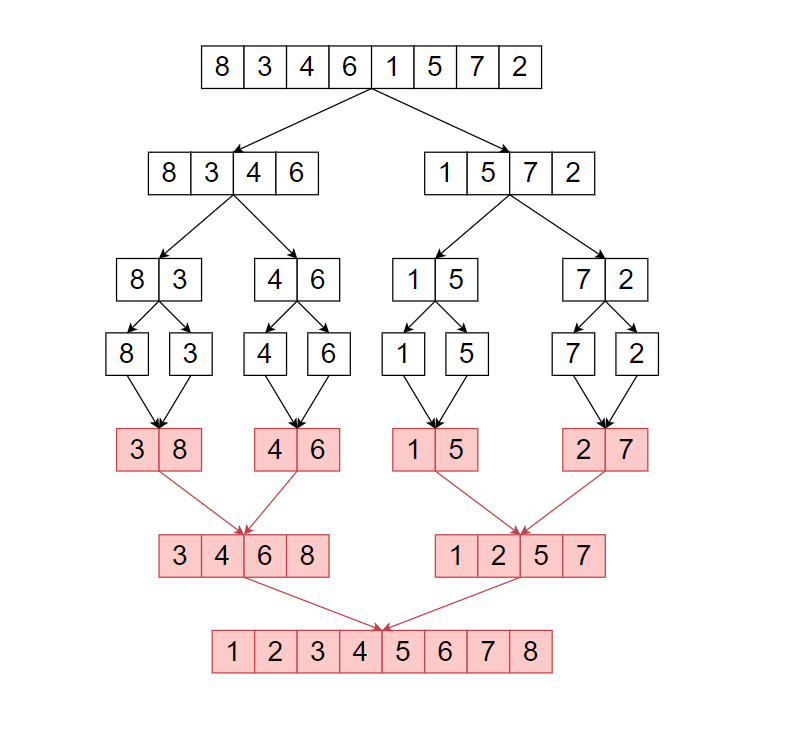
The above illustrates shows how merge sort works.
Note :
It is compulsory to use the ‘Merge Sort’ algorithm.
Problem approach
It works on the principle of Divide and Conquer. Merge sort repeatedly divides the array into several arrays until each array consists of a single element and merging those arrays in a manner that results into a sorted array.
Pseudocode :
MergeSort(A, p, r):
if p > r
return
q = (p+r)/2
mergeSort(A, p, q)
mergeSort(A, q+1, r)
merge(A, p, q, r)
Merge function : The task is to merge two subarrays A[p..q] and A[q+1..r] to create a sorted array A[p..r].
Steps :
Create copies of the subarrays L ← A[p..q] and M ← A[q+1..r].
Create three pointers i, j and k
i indicates current index of L, starting at 1
j indicates current index of M, starting at 1
k indicates the current index of A[p..q], starting at p.
Until we reach the end of either L or M, pick the larger among the elements from L and M and place them in the correct position at A[p..q]
When we run out of elements in either L or M, pick up the remaining elements and put in A[p..q]
Time complexity : O(nlogn)
2.
Problem approach
Start from 1 and go to a number whose square is smaller than or equals n. For every number x, we recur for n-x. The recursive formula is: If n = 1 and x*x <= n
The time complexity of the above solution is exponential.
This solution can be optimized using dynamic programming.
03
Round
Easy
Face to Face
Duration50 minutes
Interview date21 Aug 2017
Coding problem2
he interviewer asked me about how my previous round went. After that, he asked me to introduce myself and a brief introduction of the projects that I have done. He first asked me a few questions related to my project. Then he moved on to the data structures part. In this round the interviewer gave me strict time limit for coding the solution on paper for each problem and as soon as I was done coding he gave me 2-3 minutes every time to find errors and debug my code.
Tips: Do not panic even if the interviewer sets time limit while solving problems. If the question is not clear ask the interviewer to explain it again.
1. Insertion Sort in Linked List
Easy
10m average time
90% success
0/40
Asked in companies


You are given an arbitrary linked list consisting of 'N' nodes having integer values. You need to perform insertion sort on the linked list and print the final list in sorted order.
In other words, you are given a singly linked list, you need to perform insertion sort on it.
Insertion Sort is a sorting algorithm that removes one element from the input data, finds the location it belongs within the sorted list and inserts it there. It repeats until no input elements remain.
Problem approach
1) Create an empty sorted (or result) list
2) Traverse the given list, do following for every node.
......a) Insert current node in sorted way in sorted or result list.
3) Change head of given linked list to head of sorted (or result) list.
2. DSA based question
What are the different types of hash functions?
Problem approach
Division Method : This is the most simple and easiest method to generate a hash value. The hash function divides the value k by M and then uses the remainder obtained.
Formula: h(K) = k mod M
Here,
k is the key value, and
M is the size of the hash table.
Mid Square Method : The mid square method is a very good hashing method. It involves two steps to compute the hash value-
Square the value of the key k i.e. k2
Extract the middle r digits as the hash value.
Formula: h(K) = h(k x k)
Here,
k is the key value.
Folding Method : This method involves two steps:
Divide the key-value k into a number of parts i.e. k1, k2, k3,….,kn, where each part has the same number of digits except for the last part that can have lesser digits than the other parts.
Add the individual parts. The hash value is obtained by ignoring the last carry if any.
Formula:
k = k1, k2, k3, k4, ….., kn
s = k1+ k2 + k3 + k4 +….+ kn
h(K)= s
Here,
s is obtained by adding the parts of the key k.
Multiplication Method. This method involves the following steps:
Choose a constant value A such that 0 < A < 1.
Multiply the key value with A.
Extract the fractional part of kA.
Multiply the result of the above step by the size of the hash table i.e. M.
The resulting hash value is obtained by taking the floor of the result obtained in step 4.
Formula: h(K) = floor (M (kA mod 1))
Here,
M is the size of the hash table.
k is the key value.
A is a constant value.


Here's your problem of the day 
Solving this problem will increase your chance to get selected in this company
Skill covered: Programming
How do you remove whitespace from the start of a string?
Choose another skill to practice
Similar interview experiences
Software Developer
2 rounds | 4 problems
Interviewed by Amazon
Rejected

1117 views

0 comments

0 upvotes
Software Developer
4 rounds | 6 problems
Interviewed by Amazon
 Selected
 1082 views
0 comments
0 upvotes
Software Developer
3 rounds | 5 problems
Interviewed by Amazon
Selected 1148 views
0 comments
0 upvotes
Software Developer
2 rounds | 4 problems
Interviewed by Amazon
Rejected
1034 views
0 comments
0 upvotes
Companies with similar interview experiences

Software Developer
5 rounds | 14 problems
Interviewed by Microsoft
 Selected
 4029 views
1 comments
0 upvotes

Software Developer
6 rounds | 12 problems
Interviewed by SAP Labs
Selected 2912 views
0 comments
0 upvotes
Software Developer
4 rounds | 6 problems
Interviewed by SAP Labs
Selected 1075 views
0 comments
0 upvotes