





Amdocs interview experience Real time questions & tips from candidates to crack your interview

SDE - 1
Amdocs


4 rounds | 14 Coding
problems

 Selected
 Interview preparation journey

Preparation
Duration: 4 Months
Topics: Data Structures, Algorithms, System Design, Aptitude, OOPS

Tip 1 : Must do Previously asked Interview as well as Online Test Questions.
Tip 2 : Go through all the previous interview experiences from Codestudio and Leetcode.
Tip 3 : Do at-least 2 good projects and you must know every bit of them.
Application process
Where: Campus
Eligibility: Above 7 CGPA
Tip 1 : Have at-least 2 good projects explained in short with all important points covered.
Tip 2 : Every skill must be mentioned.
Tip 3 : Focus on skills, projects and experiences more.

Interview rounds
01
Round
Medium
Online Coding Test
Duration90 minutes
Interview date21 May 2021
Coding problem2
This was an online coding round where we had 2 questions to solve under 90 minutes . Both the questions were of easy to medium difficulty .
1. Nth Fibonacci Number
Easy

0/40
Asked in companies



The n-th term of Fibonacci series F(n), where F(n) is a function, is calculated using the following formula -
    F(n) = F(n - 1) + F(n - 2),
    Where, F(1) = 1, F(2) = 1
Provided 'n' you have to find out the n-th Fibonacci Number. Handle edges cases like when 'n' = 1 or 'n' = 2 by using conditionals like if else and return what's expected.
"Indexing is start from 1"
Example :
Input: 6

Output: 8

Explanation: The number is ‘6’ so we have to find the “6th” Fibonacci number.
So by using the given formula of the Fibonacci series, we get the series:
[ 1, 1, 2, 3, 5, 8, 13, 21]
So the “6th” element is “8” hence we get the output.
Problem approach
This problem is a simple recursive problem. But time complexity of simple recursive calls is exponential. In O(log(n))
this problem can be solved using a simple trick.
If n is even then k = n/2:
F(n) = [2*F(k-1) + F(k)]*F(k)
If n is odd then k = (n + 1)/2
F(n) = F(k)*F(k) + F(k-1)*F(k-1)
This method will solve this question in O(log(n)).
2. Subarray with equal occurrences
Moderate
15m average time
80% success
0/80
Asked in companies

You have been given an array/list ARR of length N consisting of 0s and 1s only. Your task is to find the number of subarrays(non-empty) in which the number of 0s and 1s are equal.
Problem approach
Approach :
1) Convert all 0's to -1's .
2) Now , the questions boils down to finding the number of subarrays with sum=0
3) This is a very standard problem which can be solved in O(N) using Hashing .
4) Maintain a Hash Map which keeps a track of all the prefix sums encountered so far
5) Maintain an answer variable and at each step do : ans+=map[prefixSum]
6) Finally return ans
02
Round
Medium
Video Call
Duration60 Minutes
Interview date22 May 2021
Coding problem6
This round consisted of 1 question from DSA with medium level of difficulty and then the rest of the questions were asked from DBMS and OOPS. I was also made to execute a SQL query in my laptop .
1. Cycle Detection in a Singly Linked List
Moderate
15m average time
80% success
0/80
Asked in companies



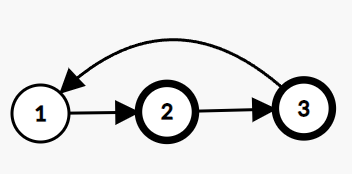
You are given a Singly Linked List of integers. Return true if it has a cycle, else return false.
A cycle occurs when a node's next points back to a previous node in the list.
Example:
In the given linked list, there is a cycle, hence we return true.
Problem approach
Approach 1 (Using Hashing ) :
1) Traverse the list one by one and keep putting the node addresses in a Hash Table.
2) At any point, if NULL is reached then return false, and if the next of the current nodes points to any of the previously stored nodes in Hash then return true.
TC : O(N) where N=length of the Linked List
SC : O(N)
Approach 2 (Using Slow and Fast Pointers) :
1) Traverse linked list using two pointers.
2) Move one pointer(slow_p) by one and another pointer(fast_p) by two.
3) If these pointers meet at the same node then there is a loop. If pointers do not meet then linked list doesn’t have a loop.
TC : O(N)
SC : O(1)
2. DBMS Question
What is Inner Join in SQL?
Problem approach
Answer :
The INNER JOIN selects all rows from both participating tables as long as there is a match between the columns. An SQL INNER JOIN is same as JOIN clause, combining rows from two or more tables.
Syntax :
SELECT *
FROM table1 INNER JOIN table2
ON table1.column_name = table2.column_name;
3. DBMS Question
Table my_numbers contains many numbers in column num including duplicated ones. Can you write a SQL query to find the biggest number, which only appears once.
Problem approach
Answer :
Using subquery and MAX() function Use subquery to select all the numbers appearing just one time. Then choose the biggest one using MAX().
Query :
SELECT
MAX(num) AS num
FROM
(SELECT
num
FROM
my_numbers
GROUP BY num
HAVING COUNT(num) = 1) AS t;
4. OOPS Question
What is the difference between Overloading and Overriding?
Problem approach
Answer :
Method Overloading :
1) Method overloading is a compile time polymorphism.
2) It is occur within the class.
3) Method overloading may or may not require inheritance.
4) In this, methods must have same name and different signature.
5) In method overloading, return type can or can not be be same, but we must have to change the parameter.
Method Overriding :
1) Method overriding is a run time polymorphism.
2) It is performed in two classes with inheritance relationship.
3) Method overriding always needs inheritance.
4) In this, methods must have same name and same signature.
5) In this, return type must be same or co-variant.
5. OOPS Question
What is Pure Virtual function? Why we need it?
Problem approach
A pure virtual function (or abstract function) in C++ is a virtual function for which we can have implementation, but we must override that function in the derived class, otherwise the derived class will also become abstract class. A pure virtual function is implemented by classes which are derived from a Abstract class.
Uses :
1) A pure virtual function is useful when we have a function that we want to put in the base class, but only the derived classes know what it should return.
2) A pure virtual function makes it so the base class can not be instantiated, and the derived classes are forced to define these functions before they can be instantiated.
3) This helps ensure the derived classes do not forget to redefine functions that the base class was expecting them to.
6. OOPS Question
Explain Singleton Class in Java
Problem approach
Answer :
1) In object-oriented programming, a singleton class is a class that can have only one object (an instance of the class) at a time.
2) After first time, if we try to instantiate the Singleton class, the new variable also points to the first instance created.
3) So whatever modifications we do to any variable inside the class through any instance, it affects the variable of the single instance created and is visible if we access that variable through any variable of that class type defined.
The key points while defining class as singleton class are :
1) Make constructor private.
2) Write a static method that has return type object of this singleton class. Here, the concept of Lazy initialization is used to write this static method.
03
Round
Medium
Video Call
Duration60 Minutes
Interview date22 May 2021
Coding problem4
This was a mixed round where I was asked to code 1 basic Programming question and later I was asked some important
concepts from Operating Systems/Linux and the famous SOLID principles from Object Oriented Design .
1. Merge Sort
Easy
15m average time
85% success
0/40
Asked in companies


Given a sequence of numbers ‘ARR’. Your task is to return a sorted sequence of ‘ARR’ in non-descending order with help of the merge sort algorithm.
Example :
Merge Sort Algorithm -

Merge sort is a Divide and Conquer based Algorithm. It divides the input array into two-parts, until the size of the input array is not ‘1’. In the return part, it will merge two sorted arrays a return a whole merged sorted array.
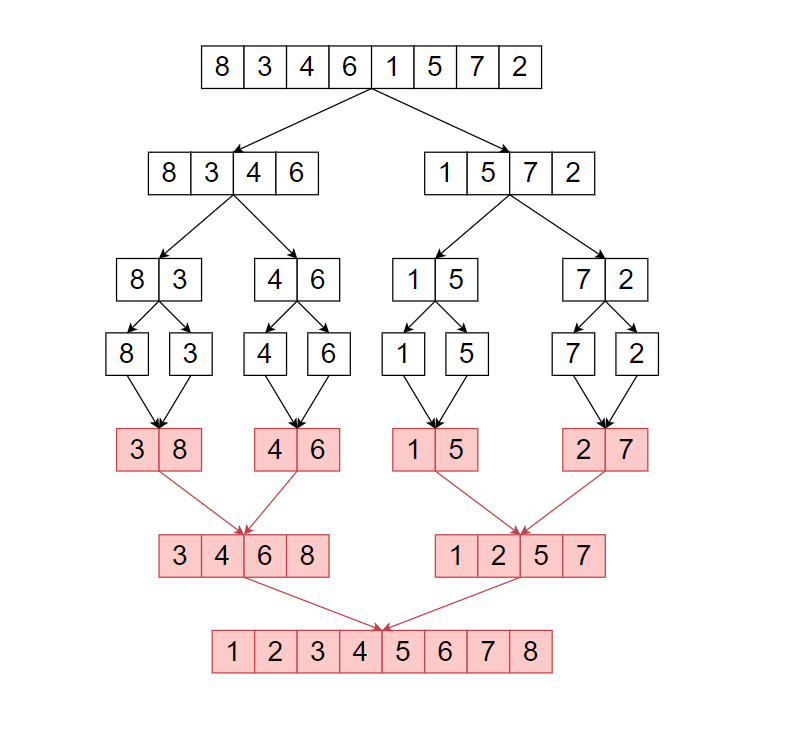
The above illustrates shows how merge sort works.
Note :
It is compulsory to use the ‘Merge Sort’ algorithm.
Problem approach
Steps :
1 )Declare left and right var which will mark the extreme indices of the array
2) Left will be assigned to 0 and right will be assigned to n-1
3) Find mid = (left+right)/2
4 )Call mergeSort on (left,mid) and (mid+1,rear)
5) Above will continue till left right
return
mid = (left+right)/2
mergeSort(arr, left, mid)
mergeSort(arr, mid+1, right)
merge(arr, left, mid, right)
end
TC : Best Case - O(N*log(N)) where N=lenght of the array to be sorted
Avg Case - O(N*log(N))
Worst Case - O(N*log(N))
SC : O(N)
2. OS Question
Print 1 to 100 using more than two threads.
Problem approach
Prerequisite to solve this problem : Multithreading
The idea is to create two threads and print even numbers with one thread and odd numbers with another thread.
Below are the steps:
1) Create two threads T1 and T2 , where T1 and T2 are used to print odd and even numbers respectively.
2) Maintain a global counter variable and start both threads.
3) If the counter is even in the Thread T1, then wait for the thread T2 to print that even number. Otherwise, print that
odd number, increment the counter and notify to the Thread T2 .
4)If the counter is odd in the Thread T2, then wait for the thread T1 to print that even number. Otherwise, print that
even number, increment the counter and notify the Thread T1.
3. OS Question
Explain Piping in Unix/Linux
Problem approach
Answer :
1) A pipe is a form of redirection (transfer of standard output to some other destination) that is used in Linux and other Unix-like operating systems to send the output of one command/program/process to another command/program/process for further processing.
2) The Unix/Linux systems allow stdout of a command to be connected to stdin of another command. We can make it do so by using the pipe character ‘|’.
3) Pipe is also used to combine two or more commands, and in this, the output of one command acts as input to another command, and this command’s output may act as input to the next command and so on.
4) It can also be visualized as a temporary connection between two or more commands/ programs/ processes. The command line programs that do the further processing are referred to as filters.
Examples :
1) Listing all files and directories and give it as input to more command.
$ ls -l | more
2) Use sort and uniq command to sort a file and print unique values.
$ sort record.txt | uniq
3) Use head and tail to print lines in a particular range in a file.
$ cat sample2.txt | head -7 | tail -5
4. OOPS Question
Explain SOLID principles in Object Oriented Design .
Problem approach
Answer :
The SOLID principle is an acronym of the five principles which is given below :
1) Single Responsibility Principle (SRP)
2) Open/Closed Principle
3) Liskov’s Substitution Principle (LSP)
4) Interface Segregation Principle (ISP)
5) Dependency Inversion Principle (DIP)
Uses of SOLID design principles :
1) The SOLID principle helps in reducing tight coupling.
2) Tight coupling means a group of classes are highly dependent on one another which we should avoid in our code.
3) Opposite of tight coupling is loose coupling and our code is considered as a good code when it has loosely-coupled classes.
4) Loosely coupled classes minimize changes in your code, helps in making code more reusable, maintainable, flexible and stable.
Explaining the 5 SOLID principles one by one :
1) Single Responsibility Principle : This principle states that “a class should have only one reason to change” which means every class should have a single responsibility or single job or single purpose.
Use layers in your application and break God classes into smaller classes or modules.
2) Open/Closed Principle : This principle states that “software entities (classes, modules, functions, etc.) should be open for extension, but closed for modification” which means you should be able to extend a class behavior, without modifying it. Using this principle separates the existing code from the modified code so it provides better stability, maintainability and minimizes changes as in your code.
3) Liskov’s Substitution Principle : According to this principle “Derived or child classes must be substitutable for their base or parent classes“. This principle ensures that any class that is the child of a parent class should be usable in place of its parent without any unexpected behavior.
One of the classic examples of this principle is a rectangle having four sides. A rectangle’s height can be any value and width can be any value. A square is a rectangle with equal width and height. So we can say that we can extend the properties of the rectangle class into square class. In order to do that you need to swap the child (square) class with parent (rectangle) class to fit the definition of a square having four equal sides but a derived class does not affect the behavior of the parent class so if you will do that it will violate the Liskov Substitution Principle.
4) Interface Segregation Principle : This principle is the first principle that applies to Interfaces instead of classes in SOLID and it is similar to the single responsibility principle. It states that “do not force any client to implement an interface which is irrelevant to them“. Here your main goal is to focus on avoiding fat interface and give preference to many small client-specific interfaces.
5) Dependency Inversion Principle : Two key points are here to keep in mind about this principle
a) High-level modules/classes should not depend on low-level modules/classes. Both should depend upon abstractions.
b) Abstractions should not depend upon details. Details should depend upon abstractions.
04
Round
Easy
HR Round
Duration30 Minutes
Interview date22 May 2021
Coding problem2
This is a cultural fitment testing round .HR was very frank and asked standard questions. Then we discussed about my role.
1. Basic HR Question
Why do you want to work at amdocs?
Problem approach
Answer :
a) It is an IT company that caters to the telecommunication domain. The business involved in the telecommunication domain is interesting and can widen your chances of switching into various fields be it in software, hardware or networking profiles. Also, Amdocs carries a good brand name in its domain.
b) Amdocs employees get to enjoy a positive and happy work environment.
c) It is truly an employee friendly organisation.I say this because Amdocs policies are employee oriented above anything else.
2. Basic HR Question
Why should we hire you ?
Problem approach
Tip 1 : The cross questioning can go intense some time, think before you speak.
Tip 2 : Be open minded and answer whatever you are thinking, in these rounds I feel it is important to have opinion.
Tip 3 : Context of questions can be switched, pay attention to the details. It is okay to ask questions in these round, like what are the projects currently the company is investing, which team you are mentoring. How all is the work environment etc.
Tip 4 : Since everybody in the interview panel is from tech background, here too you can expect some technical questions. No coding in most of the cases but some discussions over the design can surely happen.


Here's your problem of the day 
Solving this problem will increase your chance to get selected in this company
Skill covered: Programming
How do you remove whitespace from the start of a string?
Choose another skill to practice
Similar interview experiences
SDE - 1
3 rounds | 4 problems
Interviewed by Amdocs
 Selected
2058 views

0 comments

0 upvotes
SDE - 1
1 rounds | 2 problems
Interviewed by Amdocs
Rejected
1308 views
0 comments
0 upvotes
SDE - 1
3 rounds | 4 problems
Interviewed by Amdocs
Selected 1906 views
0 comments
0 upvotes
SDE - 1
3 rounds | 5 problems
Interviewed by Amdocs
Selected 1410 views
0 comments
0 upvotes
Companies with similar interview experiences
SDE - 1
5 rounds | 12 problems
Interviewed by Amazon
 Selected
 115096 views
24 comments
0 upvotes

SDE - 1
4 rounds | 5 problems
Interviewed by Microsoft
Selected 58237 views
5 comments
0 upvotes
SDE - 1
3 rounds | 7 problems
Interviewed by Amazon
 Selected
 35146 views
7 comments
0 upvotes