





Arcesium interview experience Real time questions & tips from candidates to crack your interview

SDE - 1
Arcesium


4 rounds | 4 Coding
problems

 Selected
 Interview preparation journey

Preparation
Duration: 3 Months
Topics: Data Structures, Algorithms, Operating System, SQL, Computer Networks, Aptitude, OOPS,

Tip 1 : Practice as much DSA as you can.
Tip 2 : Some algorithms must be on your tips
Tip 3 : Time bound question solving
Tip 4 : Mock Interviews to learn how to explain
Tip 5 : Prepare for HR questions well so that you dont make up answers on the spot.
Application process
Where: Campus
Eligibility: 7.5 CGPA
Tip 1 : Highlight the keywords and achievements
Tip 2 : Projects in STAR format

Interview rounds
01
Round
Medium
Online Coding Test
Duration50 minutes
Interview date28 Jul 2019
Coding problem1
Round1: Online coding + aptitude
1. LRU Cache Implementation
Moderate
25m average time
65% success

0/80
Asked in companies



Design and implement a data structure for Least Recently Used (LRU) cache to support the following operations:
1. get(key) - Return the value of the key if the key exists in the cache, otherwise return -1.

2. put(key, value), Insert the value in the cache if the key is not already present or update the value of the given key if the key is already present. When the cache reaches its capacity, it should invalidate the least recently used item before inserting the new item.
You will be given ‘Q’ queries. Each query will belong to one of these two types:
Type 0: for get(key) operation.
Type 1: for put(key, value) operation.
Note :
1. The cache is initialized with a capacity (the maximum number of unique keys it can hold at a time).

2. Access to an item or key is defined as a get or a put operation on the key. The least recently used key is the one with the oldest access time.
02
Round
Medium
Face to Face
Duration45 Minutes
Interview date29 Jul 2019
Coding problem1
Data structures, operating system
1. Tree Symmetricity
Easy
20m average time
82% success
0/40
Asked in companies



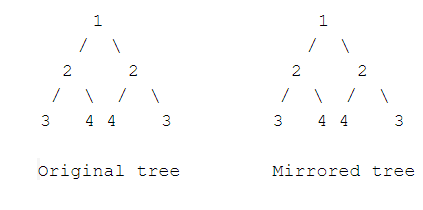
You are given a binary tree, where the data present in each node is an integer. You have to find whether the given tree is symmetric or not.
Symmetric tree is a binary tree, whose mirror image is exactly the same as the original tree.
For Example:
03
Round
Medium
Face to Face
Duration30 Minutes
Interview date29 Jul 2019
Coding problem1
DBMS and OS
1. DBMS Question
SQL query using joins among 3 tables
Problem approach
Tip 1 : Ask to clarify the questions
Tip 2 : Take an example
Tip 3 : Explain the approach clearly
04
Round
Hard
Face to Face
Duration45 minutes
Interview date29 Jul 2019
Coding problem1
Coding question
1. Snake and Ladder
Moderate
30m average time
60% success
0/80
Asked in companies


You have been given a Snake and Ladder Board with 'N' rows and 'N' columns with the numbers written from 1 to (N*N) starting from the bottom left of the board, and alternating direction each row.
For example
For a (6 x 6) board, the numbers are written as follows:
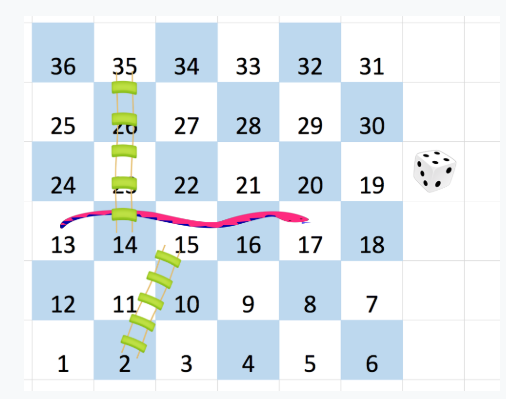
You start from square 1 of the board (which is always in the last row and first column). On each square say 'X', you can throw a dice which can have six outcomes and you have total control over the outcome of dice throw and you want to find out the minimum number of throws required to reach the last cell.
Some of the squares contain Snakes and Ladders, and these are possibilities of a throw at square 'X':
You choose a destination square 'S' with number 'X+1', 'X+2', 'X+3', 'X+4', 'X+5', or 'X+6', provided this number is <= N*N.
If 'S' has a snake or ladder, you move to the destination of that snake or ladder.  Otherwise, you move to S.
A board square on row 'i' and column 'j' has a "Snake or Ladder" if board[i][j] != -1. The destination of that snake or ladder is board[i][j].
Note :
You can only take a snake or ladder at most once per move: if the destination to a snake or ladder is the start of another snake or ladder, you do not continue moving - you have to ignore the snake or ladder present on that square.

For example, if the board is:
-1 1 -1
-1 -1 9
-1 4 -1
Let's say on the first move your destination square is 2  [at row 2, column 1], then you finish your first move at 4 [at row 1, column 2] because you do not continue moving to 9 [at row 0, column 0] by taking the ladder from 4.

A square can also have a Snake or Ladder which will end at the same cell.
For example, if the board is:
-1 3 -1
-1 5 -1
-1 -1 9
Here we can see Snake/Ladder on square 5 [at row 1, column 1] will end on the same square 5.


Here's your problem of the day 
Solving this problem will increase your chance to get selected in this company
Skill covered: Programming
How do you remove whitespace from the start of a string?
Choose another skill to practice
Similar interview experiences
SDE - 1
4 rounds | 3 problems
Interviewed by Arcesium
Selected 
1366 views

0 comments

0 upvotes
SDE - 1
2 rounds | 3 problems
Interviewed by Arcesium
Selected 0 views
0 comments
0 upvotes
SDE - 1
3 rounds | 3 problems
Interviewed by Arcesium
 Selected
 0 views
0 comments
0 upvotes
SDE - 1
3 rounds | 4 problems
Interviewed by Arcesium
Rejected
1339 views
0 comments
0 upvotes
Companies with similar interview experiences

SDE - 1
2 rounds | 3 problems
Interviewed by BNY Mellon
 Selected
 6366 views
3 comments
0 upvotes
SDE - 1
3 rounds | 6 problems
Interviewed by BNY Mellon
 Selected
 0 views
0 comments
0 upvotes

SDE - 1
3 rounds | 5 problems
Interviewed by CIS - Cyber Infrastructure
Selected 2198 views
0 comments
0 upvotes