





Arcesium interview experience Real time questions & tips from candidates to crack your interview

SDE - 1
Arcesium


5 rounds | 12 Coding
problems

 Selected
 Interview preparation journey

Preparation
Duration: 1 month
Topics: Data Structures, OOPS, Operating System, DBMS, PUZZLE

Tip 1 : Do Competitive Programming continuously
Tip 2 : Practice DS Algo questions on regular basis.
Tip 3 : Do at least one good project.
Application process
Where: Campus
Eligibility: 7.5 CGPA
Tip 1 : Have some projects on your resume
Tip 2 : You must have in-depth knowledge of the project

Interview rounds
01
Round
Hard
Online Coding Interview
Duration80 minutes
Interview date24 Jun 2021
Coding problem2
Aptitude section (consisting of 15 questions and duration was 20 minutes).
CS fundamental section (consisting of 15 questions and duration was 15 minutes)
The last one was the coding section which was consisted of 2 coding questions and duration was 45 minutes.
1. Allocate Books
Hard

0/120
Asked in companies


You are the Librarian of the Ninja library. There are ‘N’ books available in the library and ‘B’ ninjas want to read the books. You know the number of pages in each book and you have to allocate the books to the ‘B’ ninjas in such a way that the maximum number of pages allocated to a ninja is minimum.
Note
A book will be allocated to exactly one ninja.
At least one book has to be allocated to a ninja.
Allotment of the books should be done in a contiguous manner. For example, a ninja can not be allocated book 2 and book 4, skipping book 3.
The task is to return the minimum of the maximum number of pages allocated to a ninja.
Problem approach
I solve it using Binary Search
2. Minimum Removals
Moderate
15m average time
85% success
0/80
Asked in companies


You have been given an array/list "ARR" consisting of 'N' integers. You have also given an integer 'K'.
Your task is to find the minimum number of elements that should be removed from "ARR" (possibly zero) such that the difference between the maximum element and the minimum element of the remaining "ARR" is less than or equal to 'K', i.e. ARRmax - ARRmin <= K.
Note :
1. "ARR" can contain duplicates.
For Example :
Input: 'N' = 4 , "ARR" =  [5, 10 , 2] and 'K' = 3.
Output: 1

Explanation : Currently, the difference between the maximum and minimum element in the array is 10 - 2 = 8, which is greater than K (3).
So, we need to remove some elements. The optimal way to get our result is to remove 10. After removing 10, the difference between maximum and minimum is 5 - 2 = 3, which is less than or equal to K.
Problem approach
The idea was to pick an element from the array in such a way that in each step at most two elements from the array will be removed.
02
Round
Medium
Video Call
Duration60 minutes
Interview date28 Jun 2021
Coding problem2
2 coding questions
1. Connect Nodes at Same Level
Moderate
30m average time
70% success
0/80
Asked in companies


A binary tree is a tree where each node has at most two children i.e left child and right child.
You are given a binary tree, where the structure of the node is as follow -:
class BinaryTreeNode {
 int data;      // Value of the node.
 BinaryTreeNode *left;  // Pointer to left child node.
 BinaryTreeNode *right; // Pointer to right child node.
 BinaryTreeNode *next;  // Pointer to next right node at same level.
}
Your task is to connect all the adjacent nodes at the same level in the given binary tree. You can do this by populating each 'next' pointer to point to its next right node. If there is no next right node, the next pointer should be set to NULL. Initially, all the next pointers are set to NULL.
For Example:
Consider the figure shown below. The left part represents the initial binary tree and right part represents the binary tree after connecting adjacent nodes at the same level.
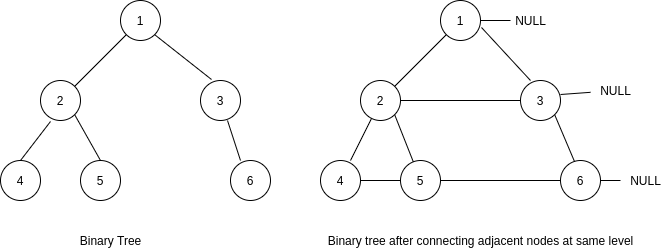
In the tree shown in the picture above -:
The ‘next’ pointer of the node having value 2 is connected to the node having value 3.
The ‘next’ pointer of the node having value 4 is connected to the node having value 5.
The ‘next’ pointer of the node having value 5 is connected to the node having value 6.
The ‘next’ pointer of nodes having value 1, 3, 6 will have a value NULL as there are no next right nodes in their cases.
Note:
1. The structure of the ‘Node’ of a binary tree is already defined. You should not change it.
2. The root of the binary tree is known to you.
3. There is at least one node in the given binary tree.
4. You may only use constant extra space.
Problem approach
Firstly I solve the problem using O(N) extra space but he was only interested in constant space solutions, he does not allow me to even use recursion stack space. Finally, I was able to write the complete iterative solution. He checks my solution for some custom inputs and then checks for all corner cases, and he was very satisfied with my solution.
2. Search In A Row Wise And Column Wise Sorted Matrix
Moderate
15m average time
80% success
0/80
Asked in companies



You are given an 'N * N' matrix of integers where each row and each column is sorted in increasing order. You are given a target integer 'X'.
Find the position of 'X' in the matrix. If it exists then return the pair {i, j} where 'i' represents the row and 'j' represents the column of the array, otherwise return {-1,-1}
For example:
If the given matrix is:
[ [1, 2, 5],
  [3, 4, 9],
  [6, 7, 10]]
We have to find the position of 4. We will return {1,1} since A[1][1] = 4.
Problem approach
The second question was an easy one that why he asked me to code the problem in just five minutes. I was able to write the code in the given time frame and the interviewer seems to be very satisfied.
03
Round
Medium
Video Call
Duration60 minutes
Interview date28 Mar 2022
Coding problem3
2 coding question from DS
Questions from OS and DBMS and OOPS
1. Trapping Rain Water
Moderate
15m average time
80% success
0/80
Asked in companies



You have been given a long type array/list 'arr’ of size 'n’.
It represents an elevation map wherein 'arr[i]’ denotes the elevation of the 'ith' bar.
Print the total amount of rainwater that can be trapped in these elevations.
Note :
The width of each bar is the same and is equal to 1.
Example:
Input: ‘n’ = 6, ‘arr’ = [3, 0, 0, 2, 0, 4].

Output: 10

Explanation: Refer to the image for better comprehension:

Note :
You don't need to print anything. It has already been taken care of. Just implement the given function.
Problem approach
Two Pointer Approach
At every index, The amount of rainwater stored is the difference between the current index height and a minimum of left max height and right max-height
2. Course Schedule
Easy
15m average time
85% success
0/40
Asked in companies



You are a student of Netaji Subhas Institute of Technology. You have to take ‘N’ number of courses labelled from 1 to N to complete your B.Tech Degree.
Some courses may have prerequisites, for example, to take course 1 you have to first take course 2, which is expressed as a pair: [1, 2]. Now, your task is to find is it possible for you to finish all courses.
Note: There are no duplicate pairs in the prerequisites array.
For example-
If N = 2 and prerequisite = [[1, 2]]. Then, there are a total of 2 courses you need to take. To take course 1 you need to finish course 2. So, it is possible to complete all courses.
Problem approach
I try to find the order of courses using topological sorting and then give various approaches to the interviewer to find the minimum number of semesters, but she does not seem to be satisfied.
3. Theory Questions
What is LRU and how you can implement it?
What is MRU and ask for real-time examples of MRU in practical life?
Ask me to write code for this problem.
How we can make search and insert operations efficient in Data Bases queries.
Various scheduling algorithms in Operating System.
She gives me some test cases and then asks me for the output (Project-based test cases).
04
Round
Medium
Video Call
Duration30 minutes
Interview date3 Jul 2021
Coding problem4
2 coding question and one puzzle
1. Minimum Number of Platform Needed
Easy
23m average time
85% success
0/40
Asked in companies



You are given the arrival and departure times of N trains at a railway station in a day. You need to find the minimum of platforms required for the railway station such that no train waits i.e No train should wait for the platform to be clear or free.
Problem approach
I solve problem using memorization
2. Form the Biggest Number
Moderate
25m average time
70% success
0/80
Asked in companies


Given an array “A” of positive integers. Your task is to make the largest number possible formed by concatenating each of the array elements exactly once.
Example:
Let's say the given array is [ 9, 98, 7].

All the possible numbers formed by concatenating each of the array elements are 7989,7998,9879,9897,9987,9798. Among the six numbers, 9987 is the greatest number. Hence the answer is 9987.
Problem approach
I solve problem using coustom sorting
3. Puzzle
There are 25 horses among which you need to find out the fastest 3 horses. You can conduct race among at most 5 to find out their relative speed. At no point you can find out the actual speed of the horse in a race. Find out the minimum no. of races which are required to get the top 3 horses.
4. Theory Questions
Difference between thread and process.
Can two threads access the same data at the same time?
Deadlock and necessary conditions for deadlock.
05
Round
Easy
HR Round
Duration15 minutes
Interview date7 Jul 2022
Coding problem1
Normal behavioral questions
1. Basic HR Questions
- Introduce yourself
- Where do you see yourself in 5 years?
- Why should we hire you?


Here's your problem of the day 
Solving this problem will increase your chance to get selected in this company
Skill covered: Programming
How do you remove whitespace from the start of a string?
Choose another skill to practice
Similar interview experiences
SDE - 1
4 rounds | 4 problems
Interviewed by Arcesium
 Selected
961 views

0 comments

0 upvotes
SDE - 1
2 rounds | 3 problems
Interviewed by Arcesium
Selected 0 views
0 comments
0 upvotes
SDE - 1
3 rounds | 3 problems
Interviewed by Arcesium
 Selected
 0 views
0 comments
0 upvotes
SDE - 1
3 rounds | 4 problems
Interviewed by Arcesium
Rejected
1339 views
0 comments
0 upvotes
Companies with similar interview experiences

SDE - 1
2 rounds | 3 problems
Interviewed by BNY Mellon
 Selected
 6365 views
3 comments
0 upvotes
SDE - 1
3 rounds | 6 problems
Interviewed by BNY Mellon
 Selected
 0 views
0 comments
0 upvotes

SDE - 1
3 rounds | 5 problems
Interviewed by CIS - Cyber Infrastructure
Selected 2197 views
0 comments
0 upvotes