





Aricent Technologies (Holdings) Limited interview experience Real time questions & tips from candidates to crack your interview
SDE - 1
Aricent Technologies (Holdings) Limited


3 rounds | 12 Coding
problems

 Selected
 Interview preparation journey

Preparation
Duration: 5 months
Topics: Data Structures, Algorithms, Operating Systems, DBMS, Networking, Aptitude, OOPS

Tip 1 : Must do Previously asked Interview as well as Online Test Questions.
Tip 2 : Go through all the previous interview experiences from Codestudio and Leetcode.
Tip 3 : Do at-least 2 good projects and you must know every bit of them.
Application process
Where: Referral
Eligibility: Above 7 CGPA
Tip 1 : Have at-least 2 good projects explained in short with all important points covered.
Tip 2 : Every skill must be mentioned.
Tip 3 : Focus on skills, projects and experiences more.

Interview rounds
01
Round
Easy
Face to Face
Duration45 minutes
Interview date1 Jun 2015
Coding problem5
Technical interview round with questions on DSA, OS and DBMS.
1. Quick Sort
Moderate
10m average time
90% success

0/80
Asked in companies



You are given an array of integers. You need to sort the array in ascending order using quick sort.
Quick sort is a divide and conquer algorithm in which we choose a pivot point and partition the array into two parts i.e, left and right. The left part contains the numbers smaller than the pivot element and the right part contains the numbers larger than the pivot element. Then we recursively sort the left and right parts of the array.
Example:
Let the array = [ 4, 2, 1, 5, 3 ]
Let pivot to be the rightmost number.
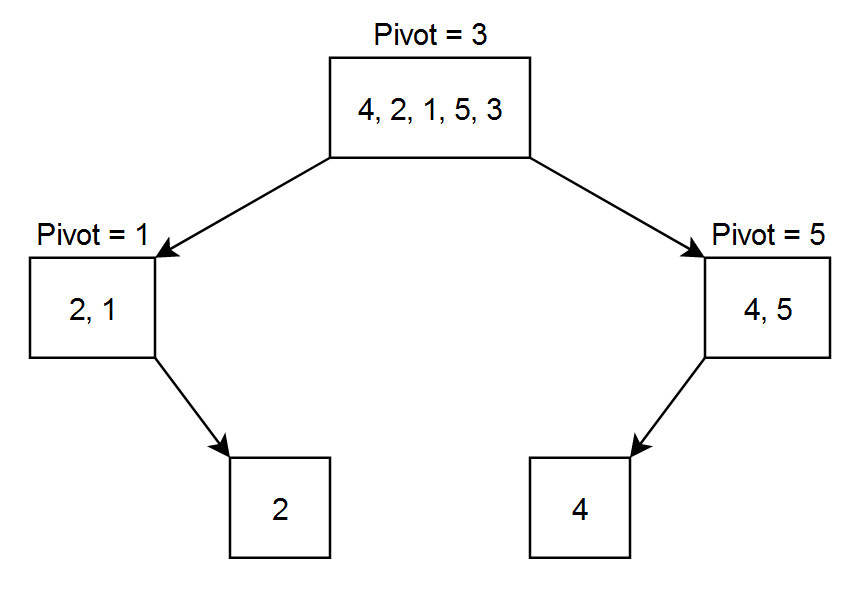
After the 1st level partitioning the array will be { 2, 1, 3, 4, 5 } as 3 was the pivot. After 2nd level partitioning the array will be { 1, 2, 3, 4, 5 } as 1 was the pivot for the left part and 5 was the pivot for the right part. Now our array is sorted and there is no need to divide it again.
Problem approach
Algorithm :
QUICKSORT (array A, start, end)
{
	if (start < end)
	{
		p = partition(A, start, end)
		QUICKSORT (A, start, p - 1)
		QUICKSORT (A, p + 1, end)
	}
}
Partition Algorithm :
The partition algorithm rearranges the sub-arrays in a place.
PARTITION (array A, start, end)
{
	pivot = A[end]
	i = start-1
	for j = start to end -1
	{
		do if (A[j] < pivot)
		{
			then i = i + 1
			swap A[i] with A[j]
		}
	}
	swap A[i+1] with A[end]
	return i+1
}2. Operating System Question
What is paging?
Problem approach
Paging is a memory management scheme that eliminates the need for contiguous allocation of physical memory. This scheme permits the physical address space of a process to be non – contiguous.
Logical Address or Virtual Address (represented in bits): An address generated by the CPU
Logical Address Space or Virtual Address Space( represented in words or bytes): The set of all logical addresses generated by a program
Physical Address (represented in bits): An address actually available on memory unit
Physical Address Space (represented in words or bytes): The set of all physical addresses corresponding to the logical addresses.
3. System Design Question
Design banking management system and Railway management System.
Problem approach
Tip 1 : Firstly, remember that the system design round is extremely open-ended and there’s no such thing as a standard answer. Even for the same question, you’ll have a totally different discussion with different interviewers.
Tip 2 : Before you jump into the solution always clarify all the assumptions you’re making at the beginning of the interview. Ask questions to identify the scope of the system. This will clear the initial doubt, and you will get to know what are the specific detail interviewer wants to consider in this service.
Tip 3 : Design your structure and functions according to the requirements and try to convey your thoughts properly to the interviewer so that you do not mess up while implementing the idea .
4. Operating System Question
What is virtual memory?
Problem approach
A computer can address more memory than the amount physically installed on the system. This extra memory is actually called virtual memory and it is a section of a hard disk that's set up to emulate the computer's RAM. The main visible advantage of this scheme is that programs can be larger than physical memory. Virtual memory serves two purposes. First, it allows us to extend the use of physical memory by using disk. Second, it allows us to have memory protection, because each virtual address is translated to a physical address.
5. Operating System Question
What is segmentation?
Problem approach
In Operating Systems, Segmentation is a memory management technique in which the memory is divided into the variable size parts. Each part is known as a segment which can be allocated to a process. The details about each segment are stored in a table called a segment table. Segment table is stored in one (or many) of the segments.
Segment table contains mainly two information about segment:
Base: It is the base address of the segment
Limit: It is the length of the segment.
02
Round
Easy
Face to Face
Duration45 minutes
Interview date1 Jun 2015
Coding problem6
Technical Interview round with questions on Networking, Software Engineering etc.
1. Computer Network Question
Explain the leaky bucket algorithm.
Problem approach
Leaky Bucket Algorithm mainly controls the total amount and the rate of the traffic sent to the network.
Step 1 − Let us imagine a bucket with a small hole at the bottom where the rate at which water is poured into the bucket is not constant and can vary but it leaks from the bucket at a constant rate.
Step 2 − So (up to water is present in the bucket), the rate at which the water leaks does not depend on the rate at which the water is input to the bucket.
Step 3 − If the bucket is full, additional water that enters into the bucket that spills over the sides and is lost.
Step 4 − Thus the same concept applied to packets in the network. Consider that data is coming from the source at variable speeds. Suppose that a source sends data at 10 Mbps for 4 seconds. Then there is no data for 3 seconds. The source again transmits data at a rate of 8 Mbps for 2 seconds. Thus, in a time span of 8 seconds, 68 Mb data has been transmitted.
2. Computer Network Question
Difference between Switch and Hub
Problem approach
A Hub is a networking device that allows you to connect multiple PCs to a single network, whereas a Switch connects various devices together on a single computer network.
A Hub operates on the physical layer, whereas Switch operates on the data link layer.
Hub uses Half-duplex cable on the other hand Switch uses Full duplex cables
Hub is a passive device while the switch is an active device
Hub uses electrical signal orbits while switch uses frame & packet
Hub and switch are both used in LAN
3. Computer Network Question
Difference between TCP and UDP
Problem approach
1. Connection status :
TCP requires an established connection to transmit data (connection should be closed once transmission is complete)
UDP is a connectionless protocol with no requirements for opening, maintaining, or terminating a connection
2. Data sequencing :
TCP is able to sequence.
UDP is unable to sequence.
3. Guaranteed delivery :
TCP can guarantee delivery of data to the destination router
UDP cannot guarantee delivery of data to the destination
4. Retransmission of data
In TCP, Retransmission of lost packets is possible
In UDP, no retransmission of lost packets
5. Error checking
In TCP, there is Extensive error checking and acknowledgment of data
In UDP, there is Basic error checking mechanism using checksums
4. Computer Network Question
How many bits make up IPv4 and IPv6 addresses?
Problem approach
IPv4 is made up of 32 bits and IPv6 is made up of 64 bits.
5. Software Engineering Question
Steps involved in a software engineering process.
Problem approach
Step 1: Understanding Customer Requirements
This step is also known as the ''requirements collection'' step. It's all about communicating with the customer before building a software, so you get to know their requirements thoroughly. It's usually conducted by a business analyst or product analyst. A Customer Requirement Specification (CRS) document is written from a customer's perspective and describes, in a simple way, what the software is going to do.
Step 2: Requirement Analysis: Is the Project Feasible?
This stage involves exploring issues related to the financial, technical, operational, and time management aspects of software development. It's an essential step towards creating functional specifications and design. It's usually done by a team of product managers, business analysts, software architects, developers, HR, and finance managers.
Step 3: Creating a Design
Once the analysis stage is over, it's time to create a blueprint for the software. Architects and senior developers create a high-level design of the software architecture, along with a low-level design describing how each and every component in the software should work.
Step 4: Coding, Testing, and Installation
Next, software developers implement the design by writing code. After all the code developed by different teams is integrated, test engineers check if the software meets the required specifications, so that developers can debug code. The release engineer then deploys the software on a server.
Step 5: Keeping it Going: Maintenance
Maintenance is the application of each of the previous steps to the existing modules in the software in order to modify or add new features, depending on what the customer needs.
6. Software Engineering Question
What are the principles of testing?
Problem approach
Principles of Testing:-
(i) All the test should meet the customer requirements
(ii) To make our software testing should be performed by a third party
(iii) Exhaustive testing is not possible. As we need the optimal amount of testing based on the risk assessment of the application.
(iv) All the test to be conducted should be planned before implementing it
(v) It follows the Pareto rule(80/20 rule) which states that 80% of errors come from 20% of program components.
(vi) Start testing with small parts and extend it to large parts.
03
Round
Easy
HR Round
Duration30 minutes
Interview date1 Jun 2015
Coding problem1
HR round with typical behavioral problems.
1. Basic HR Questions
1. Tell me about yourself?
2. Tell an incident when you helped anybody.(how, why, when)?
3. Tell me a situation when you were right about the things but you were forced to do according to others suggestions. (how, why, when)?
4. Tell an incident when you organized something and leaded the team?
Problem approach
Tip 1 : The cross questioning can go intense some time, think before you speak.
Tip 2 : Be open minded and answer whatever you are thinking, in these rounds I feel it is important to have opinion.
Tip 3 : Context of questions can be switched, pay attention to the details. It is okay to ask questions in these round, like what are the projects currently the company is investing, which team you are mentoring. How all is the work environment etc.


Here's your problem of the day 
Solving this problem will increase your chance to get selected in this company
Skill covered: Programming
How do you remove whitespace from the start of a string?
Choose another skill to practice
Similar interview experiences
SDE - 1
1 rounds | 4 problems
Interviewed by Aricent Technologies (Holdings) Limited
Rejected

912 views

0 comments

0 upvotes
SDE - 1
3 rounds | 13 problems
Interviewed by Aricent Technologies (Holdings) Limited
Selected 896 views
0 comments
0 upvotes
SDE - 1
2 rounds | 9 problems
Interviewed by Aricent Technologies (Holdings) Limited
Rejected
819 views
0 comments
0 upvotes
SDE - 1
3 rounds | 8 problems
Interviewed by Aricent Technologies (Holdings) Limited
Selected 0 views
0 comments
0 upvotes
Companies with similar interview experiences

SDE - 1
5 rounds | 12 problems
Interviewed by Amazon
 Selected
 117552 views
24 comments
0 upvotes

SDE - 1
4 rounds | 5 problems
Interviewed by Microsoft
Selected 60143 views
5 comments
0 upvotes
SDE - 1
3 rounds | 7 problems
Interviewed by Amazon
 Selected
 36138 views
7 comments
0 upvotes