





Atlassian interview experience Real time questions & tips from candidates to crack your interview

SDE - Intern
Atlassian


3 rounds | 6 Coding
problems

 Selected
 Interview preparation journey

Preparation
Duration: 3 months
Topics: Dynamic Programming, OOPs, Computer Network, Operating System, Game Theory

Tip 1 : Topics from Coding Ninjas of Course Competitive Programming. Practice atleast one question everyday from sites like Leetcode,Interviewbit and also took part in Codeforces Contest.
Tip 2 : Though Data Structure is the base for any tech interview, one must know some other subjects as well like Operating System, Networking, and Database Management System for which I took help from Coding Ninja’s notes and from GeeksforGeeks. Along with this stuff, read about puzzles on GeeksForGeeks. Overall, Coding Ninjas & Geeks For Geeks have a big hand in making me crack this interview.
Application process
Where: Campus
Eligibility: Above 8 CGPA
Tip 1 : Keep your resume up to date and mention 2-3 good level projects which will give a good impression to the interviewer .
Tip 2 : Don't put false things on the resume.

Interview rounds
01
Round
Easy
Online Coding Test
Duration90 minutes
Interview date9 Dec 2020
Coding problem2
This round had 2 coding problems and we had to code it on hackerearth only.
The use of Outside IDE was forbidden.
The timing of test was 12:00 PM to 1:30 PM.
1. Ninja and his meetings
Moderate
20m average time
80% success

0/80
Asked in companies



Ninja has recently started a startup. In his startup, there is only one conference room for a meeting. Ninja receives an array/list ‘MEETINGS’ of back-to-back appointment requests and is debating which ones to accept. Ninja needs a 15-minute break between appointments, and therefore he cannot accept any adjacent requests.
Ninja has to find the highest total booked minutes in the conference room for all meetings.
Note: All meeting timings are multiples of 15.
For example:
‘MEETINGS[]’ = {30, 15, 60}

Let us assume the meeting starts at 12:00 o’clock.
The first meeting takes 30 minutes so after the first meeting time is 12:30.
Then Ninja cannot attend the second meeting which is for 15 minutes because he needs 15 minutes break after every meeting.
After a 15 minutes break, he can attend the next meeting which is for 60 minutes.

So the total booked minutes for the meetings is 30 + 60 = 90.
2. Total unique paths
Moderate
25m average time
80% success
0/80
Asked in companies



You are present at point ‘A’ which is the top-left cell of an M X N matrix, your destination is point ‘B’, which is the bottom-right cell of the same matrix. Your task is to find the total number of unique paths from point ‘A’ to point ‘B’.In other words, you will be given the dimensions of the matrix as integers ‘M’ and ‘N’, your task is to find the total number of unique paths from the cell MATRIX[0][0] to MATRIX['M' - 1]['N' - 1].
To traverse in the matrix, you can either move Right or Down at each step. For example in a given point MATRIX[i] [j], you can move to either MATRIX[i + 1][j] or MATRIX[i][j + 1].
02
Round
Medium
Online Coding Test
Duration90 minutes
Interview date11 Jan 1921
Coding problem2
This round was coding round with discussion .
The interviewer tried to trick the questions and wanted to test how we respond if something is asked out of preparation.
The code we ran on Google Docs was checked on Online IDE if it ran for sample inputs.
Timing : 12:00 PM to 1:30 PM
1. Reorder edges
Moderate
30m average time
70% success
0/80
Asked in companies

You are given a connected directed acyclic graph of ‘N’ nodes and ‘N’ - 1 edges, such that there is only one edge between any two nodes. You can perform the below operation on the given graph zero or more times:
1) Choose two nodes, ‘X’ and ‘Y’, such that there exists an edge between ‘X’ and ‘Y’.
2) Change the direction of this edge, i.e., if this edge is directed from ‘X’ to ‘Y’, change the direction of this edge to be directed from ‘Y’ to ‘X’ and vice versa.
Your task is to reorder the edges of the given graph in such a way that there exists a directed path from each node to node 0, using the minimum number of operations.
2. Snake and Ladder
Moderate
30m average time
60% success
0/80
Asked in companies


You have been given a Snake and Ladder Board with 'N' rows and 'N' columns with the numbers written from 1 to (N*N) starting from the bottom left of the board, and alternating direction each row.
For example
For a (6 x 6) board, the numbers are written as follows:
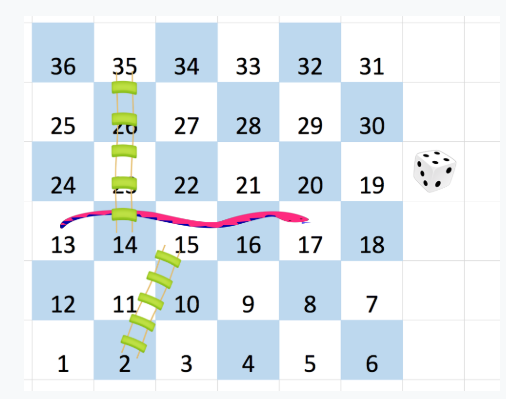
You start from square 1 of the board (which is always in the last row and first column). On each square say 'X', you can throw a dice which can have six outcomes and you have total control over the outcome of dice throw and you want to find out the minimum number of throws required to reach the last cell.
Some of the squares contain Snakes and Ladders, and these are possibilities of a throw at square 'X':
You choose a destination square 'S' with number 'X+1', 'X+2', 'X+3', 'X+4', 'X+5', or 'X+6', provided this number is <= N*N.
If 'S' has a snake or ladder, you move to the destination of that snake or ladder.  Otherwise, you move to S.
A board square on row 'i' and column 'j' has a "Snake or Ladder" if board[i][j] != -1. The destination of that snake or ladder is board[i][j].
Note :
You can only take a snake or ladder at most once per move: if the destination to a snake or ladder is the start of another snake or ladder, you do not continue moving - you have to ignore the snake or ladder present on that square.

For example, if the board is:
-1 1 -1
-1 -1 9
-1 4 -1
Let's say on the first move your destination square is 2  [at row 2, column 1], then you finish your first move at 4 [at row 1, column 2] because you do not continue moving to 9 [at row 0, column 0] by taking the ladder from 4.

A square can also have a Snake or Ladder which will end at the same cell.
For example, if the board is:
-1 3 -1
-1 5 -1
-1 -1 9
Here we can see Snake/Ladder on square 5 [at row 1, column 1] will end on the same square 5.
03
Round
Hard
Video Call
Duration75 minutes
Interview date14 Dec 2020
Coding problem2
This was a problem solving round and lasted for 75 minutes. The interviewer gave me a very complicated question.
The round was held on Google Meet and I was supposed to tell him the approach and write code on shared Google Docs.
Then it was followed with some HR questions.
1. Ninja And Geometry
Easy
15m average time
85% success
0/40
Asked in companies
Ninja has been given 2 points ‘A’ and ’B’ that corresponds to the line ‘AB’ and ‘P’, ’Q’ that corresponds to line ‘PQ’ on a 2D plane. Ninja wants to find the intersection point of the ‘AB’ and ‘PQ’ lines up to 6 decimal places. If there is no such intersection point print -1.000000 -1.000000.
Note:
1. You do not need to fix the output up to 6 decimal places. it has already been taken care of. Just return the output in the data type mentioned in the function.
2. Lines ‘AB’ and ‘PQ’ are two different lines.
For Example: For A(0, 3), B(3, 0) and P(0, 0), Q(5, 5) the point of intersection of line ‘AB’ and ‘PQ’ is (1.500000, 1.500000). As shown below:
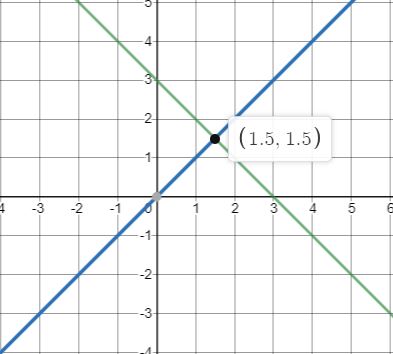
As Ninja is weak in Geometry, can you help him to find the intersection of these two lines?
2. Basic HR Questions
Why Atlassian over other companies ?
Tell one incident when you were not able to cooperate with your team member and how did you work together.


Here's your problem of the day 
Solving this problem will increase your chance to get selected in this company
Skill covered: Programming
How do you remove whitespace from the start of a string?
Choose another skill to practice
Similar interview experiences
SDE - Intern
3 rounds | 5 problems
Interviewed by Atlassian
 Selected
1412 views

0 comments

0 upvotes
SDE - Intern
3 rounds | 6 problems
Interviewed by Atlassian
 Selected
 1316 views
0 comments
0 upvotes
SDE - Intern
3 rounds | 5 problems
Interviewed by Atlassian
Selected 1163 views
0 comments
0 upvotes
SDE - Intern
2 rounds | 4 problems
Interviewed by Atlassian
Selected 1291 views
0 comments
0 upvotes
Companies with similar interview experiences
SDE - Intern
3 rounds | 6 problems
Interviewed by Amazon

Rejected
16212 views
4 comments
0 upvotes
SDE - Intern
4 rounds | 7 problems
Interviewed by Microsoft
 Selected
 16223 views
1 comments
0 upvotes
SDE - Intern
2 rounds | 4 problems
Interviewed by Amazon
Selected 10541 views
2 comments
0 upvotes