





Barclays interview experience Real time questions & tips from candidates to crack your interview

SDE
Barclays


3 rounds | 9 Coding
problems
 Selected
 Interview preparation journey

Preparation
Duration: 6 months
Topics: Data Structures, Algorithms, Java, OOPS, DBMS

Tip 1 : Do at least 1 new question daily
Tip 2 : Have a very clear idea about your resume
Tip 3 : Be consistent
Application process
Where: Campus
Eligibility: No backlog, Required atleast 60% throughout the academic journey
Tip 1 : Do not put any false thing on resume
Tip 2 : Be very clear and confident about whatever things you have mentioned.

Interview rounds
01
Round
Medium
Online Coding Interview
Duration90 minutes
Interview date27 Aug 2021
Coding problem2
1. Minimum Cost to Destination
Hard
41m average time
30% success

0/120
Asked in companies



You have been given an N*M matrix where there are 'N' rows and 'M' columns filled with '0s' and '1s'.
'1' means you can use the cell, and '0' means the cell is blocked. You can move in the 4 following directions from a particular position (i, j):
1. Left - (i, j-1)
2. Right - (i, j+1)
3. Up - (i-1, j)
4. Down - (i+1, j)
Now, for moving in the up and down directions, it costs you $1, and moving to the left and right directions are free of cost.
You have to calculate the minimum cost to reach (X, Y) from (0, 0) where 'X' is the row number and 'Y' is the column number of the destination cell. If it is impossible to reach the destination, print -1.
Problem approach
This was a 20 marks question of easy level that I solved using HashSet
2. Shortest Safe Route In A Field With Landmine
Moderate
20m average time
80% success
0/80
Asked in companies


Recently Ninja has been learning about a new Ninja Technique to cross a field with landmines. The field is in the form of a rectangular matrix of size M x N, having few landmines, which are placed arbitrarily. The landmine gets triggered if a person is any closer than one cell from the position where it is placed. So Ninja must avoid the landmines and any of the four adjacent cells (left, right, above and below), as they are also unsafe.
Initially Ninja is on one side of the field and has to move to the other side. You need to help Ninja apply the new Ninja Technique by providing him with the length of the shortest safe route possible from any cell in the first column to any cell in the last column of the field.
Note that Ninja is only allowed to move only in the direction left, right, above and below i.e., he cannot move diagonally to the next cell.
Note :
The length of the path is the number of steps required to reach from the first column of the field to the last column i.e., one less than the number of cells in the path.
For Example :
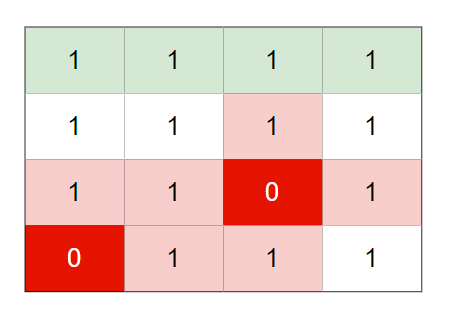
Consider the field of size 4*4, shown below. The cells containing landmine are marked with 0 and red colour. The cells near the landmine which are unsafe are marked with a light red colour.

The shortest safe route for Ninja, starting from any cell in the first column to any cell in the last column of the field is marked with green colour. The length of the path is 3.
Problem approach
I gave around 30 mins to this problem alone.
I used backtracking to solve it.
First I marked all adjacent cells of the landmines as unsafe, then for each safe cell of first column of the matrix, moved fwd in all allowed directions and recursively checks if it leads to the destination.. Update the value of shortest path, if destination is found, else return false.
02
Round
Medium
Video Call
Duration60 minutes
Interview date31 Aug 2021
Coding problem5
This was a thorough technical round that lasted for around an hour. It was a mixup of data structures, oops, DBMS and OS. I was asked questions about my resume very deeply.
1. Operating System Question
What is thread in OS?
Problem approach
Tip 1 : To the point description
Tip 2 : Use easy language to give answers of theoretical questions
2. OOPS Question
Difference between runtime and compile time polymorphism
Problem approach
Tip 1 : One line description of both types
Tip 2 : Real life example so that it can be easily related
3. DBMS Question
Different types of languages in DBMS and its uses
Problem approach
Tip 1 : Don't give long answers (Be to the point)
Tip 2 : After giving name of each type, try giving one small example.
eg: DML is acronym for data manipulation language. select, update, insert, delete etc comes under this type.
It is used as "select * from table"
4. Reverse the Array
Easy
0/40
Asked in companies



Given an array with N elements, the task is to reverse all the array elements and print the reversed array.
Problem approach
The interviewer basically wants to know your concept and in how optimised way can you solve the question.
I just used a loop from n to 0 to print array in reverse order. It took O(N) complexity with no space complexity.
I was asked, if I know any other approach to solve this question.
I said, we can use a stack to store all the elements of array in it and then pop each element to get reverse array, but it would increase space compelxity.
5. Resume related
All the skills mentioned in the resume were touched
I was asked which project I would like to talk about, I gave the name of the one about which I was most confident about.
I was then asked about my past experience. DevOps, Ansible, loadbalancer were mentioned in my resume so I was asked questions on these topics.
he asked me about my fav programming language. I said I was most comfortable in java, so next few questions were about basics of java.
Problem approach
Tip 1 : The interviewer was a VP at barclays. All the interviewers are of Vice president level only in most of the cases. so, DO NOT LIE in your resume.
03
Round
Easy
HR Round
Duration30 minutes
Interview date3 Sep 2021
Coding problem2
1. Basic HR Question
RISES concept of Barclays.
Problem approach
Tip 1 : Go through each of the RISES value
Tip 2 : Have one real life example regarding each of these value ready.
Tip 3 : Be ready to answer questions like how would you react in a particular situation (If a colleague calls you during your vacation to ask about a problem only you could solve.)
2. Basic HR Question
Why are you a good fit for this role?
Problem approach
Tip 1 : Have points ready highlighting your achievements that include your skill, coding profile and interest.
Tip 2 : Mention your skills and how that skills are useful for the company. (My specialization is in Big data Analytics and as Barclays is a financial institution, it deals with a lot of data on daily basis, so I think I will be an asset to the company)


Here's your problem of the day 
Solving this problem will increase your chance to get selected in this company
Skill covered: Programming
How do you remove whitespace from the start of a string?
Choose another skill to practice
Similar interview experiences
SDE - 1
2 rounds | 3 problems
Interviewed by Barclays
 Selected
3320 views

0 comments

0 upvotes
Business Analyst
2 rounds | 3 problems
Interviewed by Barclays
 Selected
 2928 views
0 comments
0 upvotes
SDE - Intern
2 rounds | 2 problems
Interviewed by Barclays
 Selected
 3849 views
2 comments
0 upvotes
SDE - Intern
3 rounds | 9 problems
Interviewed by Barclays
Selected 552 views
0 comments
0 upvotes
Companies with similar interview experiences

SDE
3 rounds | 6 problems
Interviewed by PhonePe
Selected 0 views
0 comments
0 upvotes

SDE
5 rounds | 8 problems
Interviewed by Mathworks
Selected 1324 views
0 comments
0 upvotes
SDE
4 rounds | 7 problems
Interviewed by PhonePe
Selected 0 views
0 comments
0 upvotes