





Barclays interview experience Real time questions & tips from candidates to crack your interview

Business Analyst
Barclays


2 rounds | 3 Coding
problems

 Selected
 Interview preparation journey

Preparation
Duration: 5 Months
Topics: Data Structures and Algorithms, DBMS, OOPs, Computer Networks, JavaScript, Machine Learning, Deep Learning

Tip 1 : Should be comfortable with basic data structures and algorithms
Tip 2 : Prepare DBMS (specially normalization, terminologies, ACID, database design), OOPs and other core subjects
Tip 3 : Focus on RISES values. Read more about it on Barclays website
Application process
Where: Campus
Eligibility: B.Tech CSE 3rd year, with ≥ 60% score across class X, XII and engineering semesters.
Tip 1 : Should be able to justify everything on Resume
Tip 2 : Include at least 2 good projects

Interview rounds
01
Round
Medium
Online Coding Interview
Duration90 Minutes
Interview date17 Dec 2021
Coding problem2
It was an online round hosted on Hackerearth and had a window of 12;00PM - 12:30PM. It was video proctored.
1. Query And Matrix
Moderate
50m average time
50% success

0/80
Asked in companies


You are given a binary matrix with ‘M’ rows and ‘N’ columns initially consisting of all 0s. 'Q' queries follow. The queries can be of 4 types:
Query 1: 1 R index
Query 2: 1 C index
Query 3: 2 R index
Query 4: 2 C index

In each query, the first input is the type of the query, the second input is whether we have to consider the row ('R') or the column ('C') and the third input is the index of the row/column.

For each type 1 query, we need to flip the elements of the row/column having the given index.

For each type 2 query, we have to output the number of zeros present in the row/column having the given index.
Note:
Note that the matrix is a binary matrix, meaning that it only contains either 0 or 1.
Example :
Given M = 3, N = 3,
Queries : 1R1, 1R2, 2C1

So, in the above example the change in the matrix would look like this:
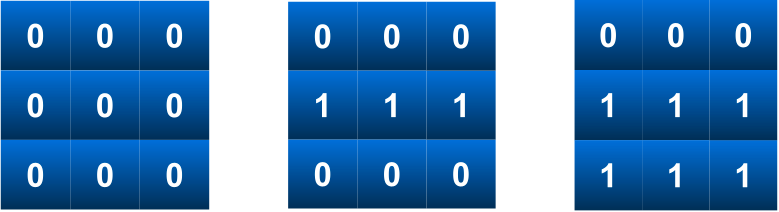
Next query 2C1 will return the count of the number of zeroes in the 1st column: 1
2. Flip The Bits
Easy
25m average time
75% success
0/40
Asked in companies


Ninja has a binary string ‘S’ of length ‘N’. Initially, all the characters in a string are ‘1’, i.e.
S[i] = ‘1’ for each 1 <= ‘i’ <= ‘N’.
An operation is defined as choosing a number between 1 to 4, and doing the following steps accordingly.
1. If the chosen number is 1, then flip all the characters in string.

2. If the chosen number is 2, then flip all the characters at odd indexes.

3. If the chosen number is 3, then flip all the characters at even indexes.

4. If the chosen number is 4, then flip all the characters at (3k + 1) indexes.
You need to find out that after performing operations exactly ‘M’ number of times, how many distinct final strings can be there.
Note :
1. A binary string is a string in which all characters are either ‘1’ or ‘0’.

2. Flipping a character means that if the character is ‘1’ then change it to 0, or if it is ‘0’ then change it to ‘1’.
Problem approach
We want to swap ith bit which is turned on in a but not in b to the nearest turned on bit in b. We can use bubble sort like approach here because it's easier to implement. For rest we can simply use 2nd operation.
02
Round
Medium
Video Call
Duration45 minutes
Interview date21 Dec 2021
Coding problem1
- Barclays conduct only one interview round i.e. (Tech+HR) on Cisco WebEx. In Barclays, the interviews are taken by Vice Presidents (VPs). It was held at 5:30am for me
- It started with “Tell me about yourself.” and I gave a brief description about my profile in general
- He started with a basic question of detect cycle in a Linked List, proceeded with one more array manipulation questions (adhoc-ish type)
- He asked questions from core subjects like OS(Deadlocks, Scheduling Algorithms, Paging), DBMS(Types of joins, why we use Normalization)
- Some questions about SVM and how can we interpret hyperplane in SVM
- Then he concluded by asking if I had any questions
- Overall round difficulty was easy-medium is one with clear with his/her basics
1. Cycle Detection in a Singly Linked List
Moderate
15m average time
80% success
0/80
Asked in companies



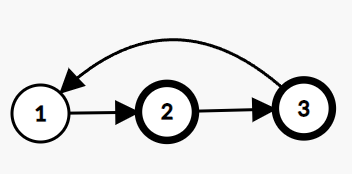
You are given a Singly Linked List of integers. Return true if it has a cycle, else return false.
A cycle occurs when a node's next points back to a previous node in the list.
Example:
In the given linked list, there is a cycle, hence we return true.


Here's your problem of the day 
Solving this problem will increase your chance to get selected in this company
Skill covered: Programming
An AI invents a fake court case to support its legal answer. This is a:
Choose another skill to practice
Similar interview experiences
SDE - 1
2 rounds | 3 problems
Interviewed by Barclays
 Selected
3175 views

0 comments

0 upvotes
SDE
3 rounds | 9 problems
Interviewed by Barclays
Selected 1592 views
0 comments
0 upvotes
SDE - Intern
2 rounds | 2 problems
Interviewed by Barclays
 Selected
 3718 views
2 comments
0 upvotes
SDE - Intern
3 rounds | 9 problems
Interviewed by Barclays
Selected 332 views
0 comments
0 upvotes