





BirdEye interview experience Real time questions & tips from candidates to crack your interview

Software Backend Engineer
BirdEye


3 rounds | 7 Coding
problems
 Selected
 Interview preparation journey

Preparation
Duration: 7 months
Topics: DSA, OOPS, DBMS, Html, CSS, JavaScript, Bootstrap, Spring & SpringBoot, Git

Tip 1 : Practice at least 250 Unique Qs. and try to understand the intuition behind its logic. At the end, it's always your consistency and willingness to learn.
Tip 2 : You should have 2 to 3 good projects in your resume and internship are also important since they tells interviewer that you have hands-on experience.
Tip 3 : Ability to represent yourself with confidence in the interview can compensate for your lacking in the technical knowledge
Application process
Where: Referral
Eligibility: B.tech Degree and relevant skills for the profile you are applying
Tip 1 : Keep it simple and readable and don't bluff
Tip 2 : Not more than 1 page

Interview rounds
01
Round
Medium
Online Coding Interview
Duration90 minutes
Interview date6 May 2022
Coding problem2
There were a total of 16 questions which includes 1 DSA(medium) and 1 SQL query both intermediate level. The candidate was free to use language of their choice. Others questions were based on topic- OOPS, Spring, Core Java and DBMS
1. Find the N-th term
Hard
50m average time
50% success

0/120
Asked in companies


You want to get tutelage under the Ultimate Ninja Ankush, but for that you have to pass his test. His test is simple: he has given you a relation function, F(n) = 2*F(n-1) + 3*F(n-2),where F(0) = F(1) = 1 and wants you to find the ‘N’th term for the function.
The 'N'th term can be very large, return it after modulus 10^9 + 7.
For example:
Given ‘N’ = 3,
F(3) = 13,This is because F(0) = 1, F(1) = 1, Therefore F(2) = 2*F(1) + 3*F(1), therefore F(2) = 5, and F(3) = 2*F(2) + 3*F(1), therefore F(3) = 13.
2. SQL Question
There was an SQL query asked in which we are given 2 tables and we need to write a nested query for finding the required answers. (Medium Level)
02
Round
Medium
Face to Face
Duration60 minutes
Interview date11 Jul 2022
Coding problem2
The interviewer asked about the projects I did. After an introductory discussion on my internship, He also asked me some DSA related theory based questions.
Then I was asked 2 DSA questions, and was supposed to code them while my screen was shared. Thankfully, I was able to code all of them.
1. Merge Sort
Easy
15m average time
85% success
0/40
Asked in companies



Given a sequence of numbers ‘ARR’. Your task is to return a sorted sequence of ‘ARR’ in non-descending order with help of the merge sort algorithm.
Example :
Merge Sort Algorithm -

Merge sort is a Divide and Conquer based Algorithm. It divides the input array into two-parts, until the size of the input array is not ‘1’. In the return part, it will merge two sorted arrays a return a whole merged sorted array.
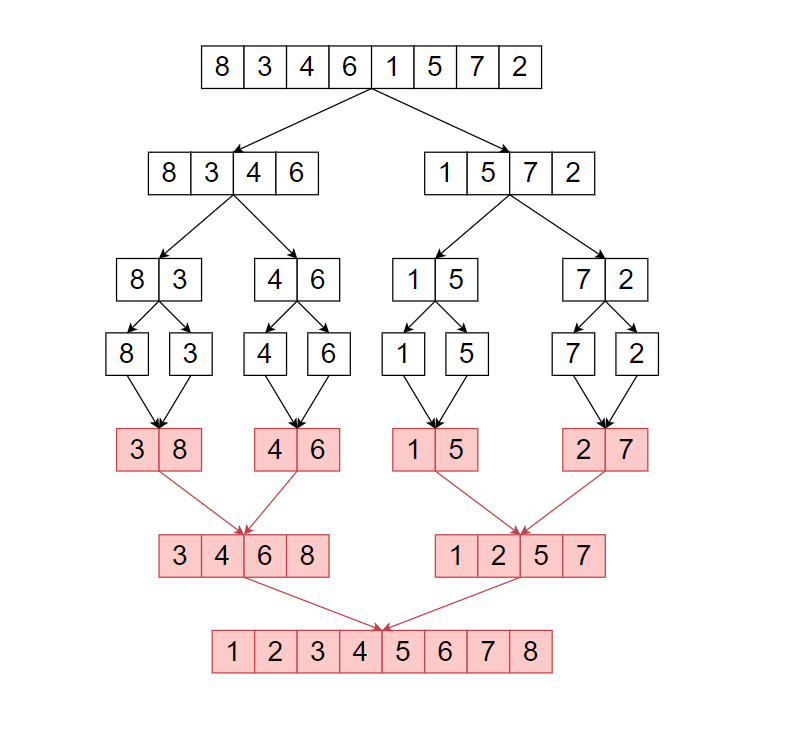
The above illustrates shows how merge sort works.
Note :
It is compulsory to use the ‘Merge Sort’ algorithm.
Problem approach
I just followed the standard procedure of recursion.
2. Count Frequency
Easy
15m average time
85% success
0/40
Asked in companies


You are given a string 'S' of length 'N', you need to find the frequency of each of the characters from ‘a’ to ‘z’ in the given string.
Example :
Given 'S' : abcdg
Then output will be : 1 1 1 1 0 0 1 0 0 0 0 0 0 0 0 0 0 0 0 0 0 0 0 0 0 0
Problem approach
I used LinkedHashMap for solving this questions in O(N) time with a single For Loop.
03
Round
Medium
Face to Face
Duration60 minutes
Interview date25 Jul 2022
Coding problem3
This was the hiring manager round. 1 data structures question was asked in this round. There was discussion around the projects that I had done and my resume and the core java and oops questions. As I am from MAE branch, I was asked why I want to get into software. I was asked to make a class Immutable. Interviewer was very calm and supportive.
1. Implementation: HashMap
Easy
30m average time
90% success
0/40
Asked in companies



Design a data structure that stores a mapping of a key to a given value and supports the following operations in constant time.
1. INSERT(key, value): Inserts an integer value to the data structure against a string type key if not already present. If already present, it updates the value of the key with the new one. This function will not return anything.

2. DELETE(key): Removes the key from the data structure if present. It doesn't return anything.

3. SEARCH(key): It searches for the key in the data structure. In case it is present, return true. Otherwise, return false.

4. GET(key): It returns the integer value stored against the given key. If the key is not present, return -1.

5. GET_SIZE(): It returns an integer value denoting the size of the data structure.

6. IS_EMPTY(): It returns a boolean value, denoting whether the data structure is empty or not.
Note :
1. Key is always a string value.
2. Value can never be -1.
Operations Performed :
First(Denoted by integer value 1):  Insertion to the Data Structure. It is done in a pair of (key, value).

Second(Denoted by integer value 2):  Deletion of a key from the Data Structure.

Third(Denoted by integer value 3): Search a given key in the Data Structure.

Fourth(Denoted by integer value 4): Retrieve the value for a given key from the Data Structure.

Fifth(Denoted by integer value 5): Retrieve the size of the Data Structure.

Sixth(Denoted by integer value 6): Retrieve whether the Data Structure is empty or not.
2. DBMS Questions
Many sql queries were asked including nested queries and then some question around DBMS like ACID property, indexing were asked.
3. OOPS Question
How would you make a class Immutable?
Problem approach
I used oops concept


Here's your problem of the day 
Solving this problem will increase your chance to get selected in this company
Skill covered: Programming
How do you remove whitespace from the start of a string?
Choose another skill to practice
Similar interview experiences
Backend Developer
4 rounds | 7 problems
Interviewed by BirdEye
 Selected
2756 views

1 comments

0 upvotes
Software Engineer
4 rounds | 4 problems
Interviewed by BirdEye
Selected 1564 views
0 comments
0 upvotes
Software Backend Engineer
3 rounds | 4 problems
Interviewed by BirdEye
 Selected
 3070 views
0 comments
0 upvotes
Software Backend Engineer
3 rounds | 6 problems
Interviewed by BirdEye
Selected 995 views
0 comments
0 upvotes