





BLINKIT PVT LTD interview experience Real time questions & tips from candidates to crack your interview
SDE - 1
BLINKIT PVT LTD


3 rounds | 3 Coding
problems

 Selected
 Interview preparation journey

Journey
I was already working at TATA 1mg, but at some point, I felt the need to challenge myself and grow further. While I was fairly comfortable with DSA, system design was something I wasn’t very familiar with. I also didn’t have a strong foundation or a clear roadmap when I started. On top of that, I had to manage all of this alongside a full-time job, which made the journey even more demanding.
I decided to begin by strengthening my basics. I started with DSA, following a well-known 450 DSA sheet and covering topics one by one. It took me around two months to complete it with discipline and consistency. Alongside this, I regularly participated in coding contests and upsolved past contest problems. This habit significantly improved my problem-solving skills and helped me quickly identify whether a question belonged to topics like graphs, DP, or greedy algorithms, which is crucial during interviews.
At the same time, I began investing focused time in backend system design. I followed Alex Xu’s System Design books (Part 1 and Part 2) to understand how real-world systems are built. For building strong fundamentals in topics like caching, consistent hashing, and scalability, I found the Hello Interview YouTube channel to be one of the best resources.
Then came a turning point—I received a call from HR at Blinkit (Eternal) for an SDE-1 position. Before the interviews, I thoroughly revised my DSA sheet and practiced a few problems from each major topic to stay sharp and confident. Thanks to consistent preparation and hands-on learning, I was able to clear all the interview rounds and eventually received the offer.
If there’s one takeaway I’d like to share, it’s this: you don’t need to know everything—you just need to keep moving forward, one topic and one problem at a time.
Application story
Since I was already exploring a career switch, I received a call from the Blinkit HR team, who were interested in my profile for a Backend SDE-1 role. After the initial discussion, the interview process was quickly scheduled, and I had less than a week to prepare.
The entire process was well-structured and conducted over three rounds, all of which were elimination-based. The interviews were scheduled smoothly, with clear communication from the HR team at each stage, making the overall experience professional and streamlined.
Why selected/rejected for the role?
All the interview rounds went well from my side, except the second one, where I felt I could have performed better. Nevertheless, I was selected.
Preparation
Duration: 7 Months
Topics: Dynamic Programming, Graphs, Low-Level System Design, High-Level System Design, OOPS

Tip 1: Do not take DP and Graphs lightly. They appear in the majority of DSA rounds at product-based companies.
Tip 2: Actively participate in coding contests. They significantly improve problem-solving speed and pattern recognition.
Tip 3: For experienced candidates, investing time in large projects with real impact is crucial, as most companies include a separate round to assess project depth and ownership.
Application process
Where: Other
Eligibility: 1- 2 years prior Experience. (Salary Package: 33 LPA)
Tip 1: Always include links to your coding profiles in your resume.
Tip 2: Experienced candidates should highlight significant, high-impact projects they have worked on within their organization.

Interview rounds
01
Round
Medium
Face to Face
Duration60 minutes
Interview date6 Oct 2025
Coding problem1
My interview round was scheduled from 4:00–5:00 PM. The first few minutes were spent on basic introductions. This was followed by around 30 minutes of discussion on a project I led at TATA 1mg, during which the interviewer asked several follow-up questions that I was able to answer confidently.
After that, I was given a DSA problem to solve on a Google Sheet, with roughly 25–30 minutes allotted. The problem was graph-based, fell into the medium-to-hard category, and was conceptually similar to Path Sum III. I started by explaining the brute-force approach and then reasoned my way toward a more optimized solution using prefix sums. Due to time constraints, the interviewer asked me to skip writing the complete code and instead focused on follow-up questions. One of them was whether negative node values would affect the solution, which I was able to explain clearly.
Overall, I felt confident throughout the discussion, and the round went well from my side.
1. Path Sum lll
Hard
50m average time
50% success

0/120
Asked in companies


You have been given a labelled binary tree having integer value (except zero) corresponding to all its nodes. You have to find the number of possible ways to make the sum of nodes (in a particular path) exactly equal to ‘k’.
Note:
i) Nodes considered for the sum should be from parent to child.
ii) For a particular way, you can only consider nodes having the common path.
iii) Two ways are different from each other if they have an unequal number of nodes (for making sum equal to k) or at least one node is different between both the ways.
For example :
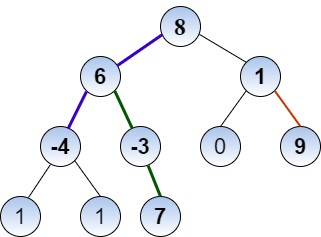
For the binary tree shown in the figure, the possible ways/paths are [8, 6, -4], [6, -3, 7], and [1, 9] for a sum of nodes equal to 10.
Problem approach
Brute Force Approach:
- Traverse each node in the tree.
- For each node, start a DFS.
- Keep subtracting the node value from targetSum.
- Maintain a vector at each step and append the current node value.
- If at any point targetSum == 0, add that path to a global 2D vector.
- Continue the DFS for the left and right children.
- Repeat this process for all nodes.
Optimized Approach:
Instead of recalculating sums for every node, maintain a prefix sum map while traversing the tree and perform a DFS traversal:
- Keep adding the node value to currentSum.
- Check how many times (currentSum - targetSum) has appeared in the prefix sum map.
- Add that count to the answer.
02
Round
Medium
Face to Face
Duration60 minutes
Interview date12 Aug 2025
Coding problem2
The second interview round was scheduled from 4:00–5:00 PM and focused on a deep dive into my projects. I was asked to design and explain the high-level architecture, including how different services interacted with each other within the system.
The discussion then moved to backend fundamentals, where I was asked questions related to caching strategies and distributed locks. This was followed by general system design and database concepts, such as what happens behind the scenes when you type google.com and press Enter, an explanation of various database isolation levels, and the dirty read problem.
Overall, the round was of medium difficulty.
1. Web Request
What happens behind the scenes when you type google.com and hit Enter?
2. Isolation Levels
What are the various isolation levels? (Learn)
03
Round
Easy
HR Round
Duration30 minutes
Interview date12 Sep 2025
Coding problem0
This round primarily focused on behavioral questions and salary discussions. I was asked scenario-based questions, such as how I would handle and resolve conflicts within a team.


Here's your problem of the day 
Solving this problem will increase your chance to get selected in this company
Skill covered: Programming
Which data structure is used in the implementation of recursion?
Choose another skill to practice
Similar interview experiences
SDE - 1
3 rounds | 3 problems
Interviewed by BLINKIT PVT LTD
 Selected
6076 views

0 comments

0 upvotes
Full Stack Engineer
3 rounds | 3 problems
Interviewed by BLINKIT PVT LTD
Selected 0 views
0 comments
0 upvotes
SDE - 1
3 rounds | 4 problems
Interviewed by BLINKIT PVT LTD
Selected 1343 views
0 comments
0 upvotes
SDE - 1
2 rounds | 5 problems
Interviewed by BLINKIT PVT LTD
Rejected
1517 views
0 comments
0 upvotes
Companies with similar interview experiences
SDE - 1
5 rounds | 12 problems
Interviewed by Amazon
 Selected
 116866 views
24 comments
0 upvotes

SDE - 1
4 rounds | 5 problems
Interviewed by Microsoft
Selected 59590 views
5 comments
0 upvotes
SDE - 1
3 rounds | 7 problems
Interviewed by Amazon
 Selected
 35852 views
7 comments
0 upvotes