





BNY Mellon interview experience Real time questions & tips from candidates to crack your interview

SDE - Intern
BNY Mellon


3 rounds | 6 Coding
problems
 Selected
 Interview preparation journey

Preparation
Duration: 6 Months
Topics: Data Structure, Algorithms, OOPS(Java or C++), Dynamic Programming, Graph, Trees, DBMS, OS.

Tip 1 : Try to have a firm base on the basics.
Tip 2 : Practice good questions not waste time on the easy questions.
Tip 3 : Try at least to have 2-3 projects with latest Tech stack used.
Tip 4 : If you have free time start practicing puzzles.
Application process
Where: Campus
Eligibility: 7 CGPA (CSE,IT,ECE,EE)
Tip 1 : One Page Resume, Do not put false things in a resume.
Tip 2 : Mention 2 -3 projects

Interview rounds
01
Round
Medium
Online Coding Interview
Duration90 Minutes
Interview date3 Sep 2021
Coding problem4
1. Pair Sum
Easy
15m average time
90% success

0/40
Asked in companies



You are given an integer array 'ARR' of size 'N' and an integer 'S'. Your task is to return the list of all pairs of elements such that each sum of elements of each pair equals 'S'.
Note:
Each pair should be sorted i.e the first value should be less than or equals to the second value.

Return the list of pairs sorted in non-decreasing order of their first value. In case if two pairs have the same first value, the pair with a smaller second value should come first.
2. Maximum Size Rectangle Sub-matrix With All 1's
Hard
10m average time
80% success
0/120
Asked in companies



You are given an 'N' * 'M' sized binary-valued matrix 'MAT, where 'N' is the number of rows and 'M' is the number of columns. You need to return the maximum size (area) of the submatrix which consists of all 1’s i.e. the maximum area of a submatrix in which each cell has only the value ‘1’.
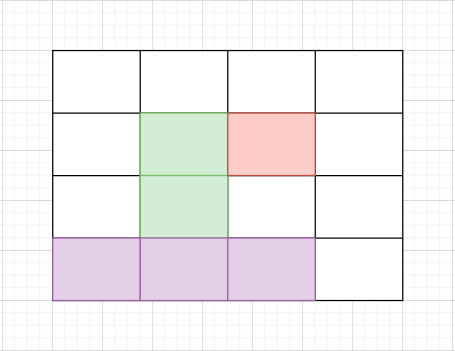
In the above image, areas in green, red, and violet color are all submatrices of the original 4x4 matrix.
Note:
1. Binary valued matrix has only two values in each cell : 0 and 1.
2. A submatrix is a matrix formed by selecting certain rows and columns from a larger matrix.
3. The area of a matrix with 'h' rows and 'w' columns is equal to 'h' * 'w'.
Problem approach
I have used the dyanmic programming to solve this problem here is a quick approach
1) Construct a sum matrix S[R][C] for the given M[R][C].
a) Copy first row and first columns as it is from M[][] to S[][]
b) For other entries, use following expressions to construct S[][]
If M[i][j] is 1 then
S[i][j] = min(S[i][j-1], S[i-1][j], S[i-1][j-1]) + 1
Else /*If M[i][j] is 0*/
S[i][j] = 0
2) Find the maximum entry in S[R][C]
3) Using the value and coordinates of maximum entry in S[i], print
sub-matrix of M[][]
3. Unique Paths
Moderate
25m average time
80% success
0/80
Asked in companies



You are present at point ‘A’ which is the top-left cell of an M X N matrix, your destination is point ‘B’, which is the bottom-right cell of the same matrix. Your task is to find the total number of unique paths from point ‘A’ to point ‘B’.In other words, you will be given the dimensions of the matrix as integers ‘M’ and ‘N’, your task is to find the total number of unique paths from the cell MATRIX[0][0] to MATRIX['M' - 1]['N' - 1].
To traverse in the matrix, you can either move Right or Down at each step. For example in a given point MATRIX[i] [j], you can move to either MATRIX[i + 1][j] or MATRIX[i][j + 1].
Problem approach
INTUITION :
When you are at a cell, you have to option to go, either right or down(if possible). So we have to explore at each step, that in how many ways we can reach to (m-1, n-1) cell from that given cell.
4. Sum Of Node Distances
Moderate
15m average time
85% success
0/80
Asked in companies


You have been given an array/list ‘EDGES’ of size (N - 1) x 2 representing the undirected connected tree with ‘N’ nodes from 0…’N’ - 1 and ‘N’ - 1 edges such that the i’th edge connects ‘EDGES[i][0]’ node with ‘EDGES[i][1]’ node.
You need to print an array/list ‘ANS’, where ANS[i] is the sum of the distances between node ‘i’ and all other nodes.
For example:
For ‘N’ = 6 and ‘EDGES’ = [ [0,1], [0, 2], [2, 3], [2, 4], [2, 5] ], see the below picture for reference:

1. For node 0:
   a. Distance from node 0 to node 1 is 1.
   b. Distance from node 0 to node 2 is 1.
   c. Distance from node 0 to node 3 is 2.
   d. Distance from node 0 to node 4 is 2.
   e. Distance from node 0 to node 5 is 2.
   So the sum of all the distances is 8.

2. For node 1:
   a. Distance from node 1 to node 0 is 1.
   b. Distance from node 1 to node 2 is 2.
   c. Distance from node 1 to node 3 is 3.
   d. Distance from node 1 to node 4 is 3.
   e. Distance from node 1 to node 5 is 3.
   So the sum of all the distances is 12.

3. For node 2:
   a. Distance from node 2 to node 0 is 1.
   b. Distance from node 2 to node 1 is 2.
   c. Distance from node 2 to node 3 is 1.
   d. Distance from node 2 to node 4 is 1.
   e. Distance from node 2 to node 5 is 1.
   So the sum of all the distances is 6.

4. For node 3:
   a. Distance from node 3 to node 0 is 2.
   b. Distance from node 3 to node 1 is 3.
   c. Distance from node 3 to node 2 is 1.
   d. Distance from node 3 to node 4 is 2.
   e. Distance from node 3 to node 5 is 2.
   So the sum of all the distances is 6.

5. For node 4:
   a. Distance from node 4 to node 0 is 2.
   b. Distance from node 4 to node 1 is 3.
   c. Distance from node 4 to node 2 is 1.
   d. Distance from node 4 to node 3 is 2.
   e. Distance from node 4 to node 5 is 2.
   So the sum of all the distances is 6.

6. For node 5:
   a. Distance from node 5 to node 0 is 2.
   b. Distance from node 5 to node 1 is 3.
   c. Distance from node 5 to node 2 is 1.
   d. Distance from node 5 to node 3 is 2.
   e. Distance from node 5 to node 4 is 2.
   So the sum of all the distances is 6.

So, ‘ANS’ for the above example will be [8, 12, 6, 10, 10, 10].
Problem approach
The simplest approach to solve the given problem is to perform the Depth First Search Traversal from every node and find the sum of distance every other node from the current source node. After checking from all the nodes as the source node print the maximum sum among all the sum of values obtained.
After we can optimised the above proposed solution.
02
Round
Medium
Video Call
Duration60 Minutes
Interview date6 Sep 2021
Coding problem1
Technical Interview
1. Minimum Operations
Easy
20m average time
82% success
0/40
Asked in companies


You are given an array 'ARR' of 'N' positive integers. You need to find the minimum number of operations needed to make all elements of the array equal. You can perform addition, multiplication, subtraction or division with any element on an array element.
Addition, Subtraction, Multiplication or Division on any element of the array will be considered as a single operation.
Example:
If the given array is [1,2,3] then the answer would be 2. One of the ways to make all the elements of the given array equal is by adding 1 to the array element with value 1 and subtracting 1 from the array element with value 3. So that final array would become [2,2,2].
03
Round
Medium
Video Call
Duration60 Minutes
Interview date6 Sep 2021
Coding problem1
Managerial cum HR
1. Pairs with difference K
Moderate
0/80
Asked in companies



You are given with an array of integers and an integer K. You have to find and print the count of all such pairs which have difference K.
Note: Take absolute difference between the elements of the array.
Problem approach
I have used hashing to achieve the average time complexity as O(n) for many cases.
1) Initialize count as 0.
2) Insert all distinct elements of arr[] in a hash map. While inserting,
ignore an element if already present in the hash map.
3) Do following for each element arr[i].
a) Look for arr[i] + k in the hash map, if found then increment count.
b) Look for arr[i] - k in the hash map, if found then increment count.
c) Remove arr[i] from hash table.
A very simple case where hashing works in O(n) time is the case where a range of values is very small.


Here's your problem of the day 
Solving this problem will increase your chance to get selected in this company
Skill covered: Programming
How do you remove whitespace from the start of a string?
Choose another skill to practice
Similar interview experiences
SDE - Intern
3 rounds | 5 problems
Interviewed by BNY Mellon
 Selected
2348 views

0 comments

0 upvotes
SDE - Intern
4 rounds | 6 problems
Interviewed by BNY Mellon
 Selected
 0 views
0 comments
0 upvotes
SDE - Intern
3 rounds | 5 problems
Interviewed by BNY Mellon
Selected 1160 views
0 comments
0 upvotes
SDE - Intern
3 rounds | 3 problems
Interviewed by BNY Mellon
Selected 0 views
1 comments
0 upvotes
Companies with similar interview experiences

SDE - Intern
2 rounds | 4 problems
Interviewed by Arcesium
 Selected
 3739 views
0 comments
0 upvotes
SDE - Intern
3 rounds | 5 problems
Interviewed by Arcesium
Selected 2683 views
0 comments
0 upvotes

SDE - Intern
4 rounds | 8 problems
Interviewed by NCR Corporation
Selected 2288 views
0 comments
0 upvotes