





British Telecommunications interview experience Real time questions & tips from candidates to crack your interview
SDE - Intern
British Telecommunications


4 rounds | 5 Coding
problems
 Selected
 Interview preparation journey

Preparation
Duration: 6 months
Topics: Dynamic Programming, Graphs, Linked Lists, Pointers, OOPS

Tip 1 : Focus more on understanding the approach while solving a question rather than mugging up the solutions
Tip 2 : Keep giving regular contests as it helps in doing questions under timed environment.
Application process
Where: Campus
Eligibility: Branches Allowed : CSE, ECE, EE
Tip 1 : Stay true to your resume. Mention only things you know and are confident about.
Tip 2 : Mention a position of responsibility as it will help you in the HR round.

Interview rounds
01
Round
Medium
Online Coding Interview
Duration75 minutes
Interview date19 Dec 2022
Coding problem2
The test consisted of 2 coding questions and 10 MCQs. Everyone had different sets of questions. Of the 2 coding questions I got, one was easy and one was of moderate difficulty.
1. 1-3 Palindrome
Easy
5m average time
95% success

0/40
Asked in company

You are given a string 'S'. You perform the following operations:
1. Split 'S' into three non-empty substrings such that each character of 'S' should present in exactly one substring.
2. Create a new string by concatenating 1st and 3rd parts.
Return 1 if you can make this new string a palindrome otherwise return 0.
For Example:-
Let 'N' = 6, 'S' = "abccba".
Three substrings are "ab", "cc", and "ba" and by concatenating 1st and 3rd parts we get "abba" which is a palindrome.
So our answer is 1.
Problem approach
I solved it in O(26*N) time complexity.
2. Buildings Projection
Moderate
15m average time
85% success
0/80
Asked in companies


Ninja Land can be represented as a N * N grid in the XY plane. Each cell of this grid can have a building of some height.
You are given a matrix ‘GRID[][]’ of size ‘N’ * ‘N’, where ‘GRID[i][j]’ gives the height of the building at cell (i, j) in XY plane. Note, building at any cell (i, j) is represented as a cuboid that is an axis aligned with the axis ‘X’, ‘Y’, ‘Z’ and has the dimension 1 * 1 * GRID[i][j] along X, Y, Z-axis respectively.
Ninja views the projection of these buildings onto the XY, YZ, and ZX planes. A projection is like a shadow, that maps a 3-dimensional figure to a 2-dimensional plane. We are viewing the "shadow" when looking from the top, the side, and the front, in XY, YZ, ZX plane respectively.
Your task is to find and return the total area of all three projections. See the example for more clarity.
Note:
‘GRID[i][j]’ = 0, if there is no building at cell (i, j).
Example:
Consider the following 2*2 ‘GRID[][]’:
                [1, 2]
                [3, 4]

Its projection in XY, YZ, XZ plane is shown below -:
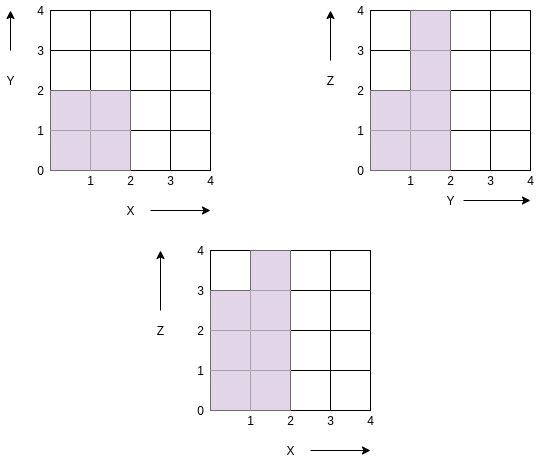
Area covered in XY plane is 4, Area covered in YZ plane is 6, Area covered in ZX plane is 7, Thus the total area is 4 + 6 + 7 = 17.
Problem approach
It was a simple problem which could be done by dividing A[i] by B[i] and checking the number of buildings that could be made.
02
Round
Easy
Video Call
Duration30 minutes
Interview date21 Dec 2022
Coding problem1
16 people were shortlisted for this round. This was a technical interview round. The interviewer first asked me about my projects. I had made a project on implementation of Huffman Coding. Then he presented me with a coding question.
1. Minimum Swaps To Make Identical Array
Moderate
0/80
Asked in companies



You are given two arrays, ‘A’ and ‘B’, with the same elements in a different order. Your task is to make ‘B’ identical to the ‘A’ by swapping the elements in array ‘B’. You have to find out the minimum number of swaps required.
For Example:
For the first test case, ‘A’ = [5, 6, 4, 10], ‘B’ = [4, 6, 10, 5], here in the ‘B’ we can swap 4 with 10 to form [10, 6, 4, 5] and we can then swap 10 with 5 to form the array [5, 6, 4, 10] which is identical to ‘A’. Hence the answer is 2.
03
Round
Easy
Video Call
Duration40 minutes
Interview date21 Dec 2022
Coding problem1
Of the 16 students shortlisted for the previous round, only 4 were shortlisted for this round. My interview was scheduled first in this round. This round was very different from the interviews I had given earlier.
1. Logical Questions
How customers can raise a ticket/complaint?
How would you implement such an interface?
How a technician would be allocated?
What if there are some urgent problems?
Problem approach
Since this was a telecom company, the interviewer presented me with a situation about how customers raise a ticket/complaint. He asked me how would I implement such a interface. I told him that we could make a form on the website where they could raise their complaint and on the backend there could be a database storing everything.
Next he asked me about how a technician would be allocated. I provided an approach that we could allot on the basis of time of complaint registered. Then there were a lot of follow up questions like what if a customer is not available on that slot, what if there is some urgent complaint that needs to be adhered first.
There was no exact answer to the problem and the interviewer wanted to check my thinking abilities. He later told me that we would be working on such kinds of problem in the company and appreciated my thinking skills.
04
Round
Easy
HR Round
Duration20 minutes
Interview date21 Dec 2022
Coding problem1
I was the only one who was shortlisted for this round so I was confident that I would be able to crack it. This was a basic HR round where the interviewer first told me about himself then asked me some simple questions.
1. Basic HR Questions
Tell me about yourself
Tell me about your college.
What are your views of team building, leadership experiences.


Here's your problem of the day 
Solving this problem will increase your chance to get selected in this company
Skill covered: Programming
How do you remove whitespace from the start of a string?
Choose another skill to practice
Similar interview experiences

SDE - 1
3 rounds | 7 problems
Interviewed by OYO
 Selected
6182 views

0 comments

0 upvotes
SDE - Intern
2 rounds | 3 problems
Interviewed by Amazon
Rejected
1566 views
0 comments
0 upvotes

SDE - 1
2 rounds | 5 problems
Interviewed by Meesho
Rejected
7246 views
0 comments
0 upvotes

SDE - 1
3 rounds | 9 problems
Interviewed by Salesforce
 Selected
 4552 views
0 comments
0 upvotes
Companies with similar interview experiences

SDE - Intern
2 rounds | 4 problems
Interviewed by Arcesium
 Selected
 3916 views
0 comments
0 upvotes
SDE - Intern
3 rounds | 5 problems
Interviewed by Arcesium
Selected 2888 views
0 comments
0 upvotes

SDE - Intern
3 rounds | 5 problems
Interviewed by BNY Mellon
 Selected
 2484 views
0 comments
0 upvotes