





Capegemini Consulting India Private Limited interview experience Real time questions & tips from candidates to crack your interview
Senior Software Engineer
Capegemini Consulting India Private Limited


3 rounds | 13 Coding
problems

 Selected
 Interview preparation journey

Preparation
Duration: 4 Months
Topics: Data Structures, Algorithms, System Design, Aptitude,Java, OOPS

Tip 1 : Must do Previously asked Interview as well as Online Test Questions.
Tip 2 : Go through all the previous interview experiences from Codestudio and Leetcode.
Tip 3 : Do at-least 2 good projects and you must know every bit of them.
Application process
Where: Referral
Eligibility: Above 2 years of experience
Tip 1 : Have at-least 2 good projects explained in short with all important points covered.
Tip 2 : Every skill must be mentioned.
Tip 3 : Focus on skills, projects and experiences more.

Interview rounds
01
Round
Medium
Video Call
Duration60 Minutes
Interview date16 Jun 2021
Coding problem6
This round had 1 simple question related to Basic Programming and Maths and then I was asked some concepts revolving around Java , Spring Boot and OOPS.
1. Pascal's Triangle
Easy
20m average time
80% success

0/40
Asked in companies



You are given an integer N. Your task is to return a 2-D ArrayList containing the pascal’s triangle till the row N.
A Pascal's triangle is a triangular array constructed by summing adjacent elements in preceding rows. Pascal's triangle contains the values of the binomial coefficient. For example in the figure below.
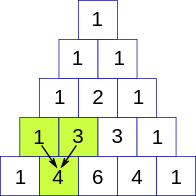
For example, given integer N= 4 then you have to print.
1
1 1
1 2 1
1 3 3 1

Here for the third row, you will see that the second element is the summation of the above two-row elements i.e. 2=1+1, and similarly for row three 3 = 1+2 and 3 = 1+2.
Problem approach
Approach : This was a preety simple question so I was directly asked to code it using any of my preferred IDE.
Pascal’s triangle is a triangular array of the binomial coefficients.
//Pseudo Code
void PascalTriangle(int n)
{
for (int j = 1; j <= n; j++)
{
int C = 1;
for (int i = 1; i <= j; i++)
{
cout<< C<<" ";
C = C * (j - i) / i;
}
cout<<"\n";
}
}
TC : O(n^2)
SC : O(1)
2. OOPS Question
What is meant by Interface?
Problem approach
Answer : Multiple inheritances cannot be achieved in java. To overcome this problem the Interface concept is introduced. An interface is a template which has only method declarations and not the method implementation.
Some imp. points about Interface :
1) All the methods in the interface are internally public abstract void.
2) All the variables in the interface are internally public static final that is constants.
3) Classes can implement the interface and not extends.
4) The class which implements the interface should provide an implementation for all the methods declared in the interface.
3. OOPS Question
Difference between Abstract class and Interface.
Problem approach
Answer :
The differences between Abstract Class and Interface are as follows:
Abstract Class:
1) Abstract classes have a default constructor and it is called whenever the concrete subclass is instantiated.
2) It contains Abstract methods as well as Non-Abstract methods.
3) The class which extends the Abstract class shouldn’t require the implementation of all the methods, only Abstract methods need to be implemented in the concrete sub-class.
4) Abstract class contains instance variables.
Interface:
1 )It doesn’t have any constructor and couldn’t be instantiated.
2) The abstract method alone should be declared.
3) Classes that implement the interface should provide the implementation for all the methods.
4) The interface contains only constants.
4. SpringBoot Question
What is the starter dependency of the Spring boot module?
Problem approach
Spring boot provides numbers of starter dependency, here are the most commonly used -
1) Data JPA starter.
2) Test Starter.
3) Security starter.
4) Web starter.
5) Mail starter.
6) Thymeleaf starter.
5. SpringBoot Question
What does the @SpringBootApplication annotation do internally?
Problem approach
Answer : The @SpringBootApplication annotation is equivalent to using @Configuration, @EnableAutoConfiguration, and @ComponentScan with their default attributes. Spring Boot enables the developer to use a single annotation instead of using multiple. But, as we know, Spring provided loosely coupled features that we can use for each annotation as per our project needs.
6. SpringBoot Question
Can we override or replace the Embedded tomcat server in Spring Boot?
Problem approach
Answer : Yes, we can replace the Embedded Tomcat server with any server by using the Starter dependency in the pom.xml file. Like you can use spring-boot-starter-jetty as a dependency for using a jetty server in your project.
02
Round
Medium
Video Call
Duration60 Minutes
Interview date16 Jun 2021
Coding problem5
This round focused more on concepts from DBMS , OOPS and Selenium. The interviewer was more aligned towards the fundamentals and asked the core concepts rather than some advanced questions.
1. DBMS Question
What is the difference between Cluster and Non-Cluster Index?
Problem approach
Answer :
Clustered index is used for easy retrieval of data from the database by altering the way that the records are stored. Database sorts out rows by the column which is set to be clustered index.
A nonclustered index does not alter the way it was stored but creates a complete separate object within the table. It point back to the original table rows after searching.
2. DBMS Question
Difference between the DELETE and TRUNCATE command in a DBMS.
Problem approach
Answer :
DELETE command:
1) This command is needed to delete rows from a table based on the condition provided by the WHERE clause.
2) It can be rolled back if required.
3) It maintains a log to lock the row of the table before deleting it and hence it’s slow.
TRUNCATE command:
1) This command is needed to remove complete data from a table in a database. It is like a DELETE command which has no WHERE clause.
2) It removes complete data from a table in a database.
3) It can be rolled back even if required.
4) It doesn’t maintain a log and deletes the whole table at once and hence it’s fast.
3. Selenium Question
Explain the difference between driver.close() and driver.quit() command in Selenium?
Problem approach
Answer :
driver.close() command closes the currently active window on which the user is working or the window being currently accessed by the web driver.
driver.quit() command, unlike the driver.close() command closes all the windows opened by the program and hence should be used with care.
Both the commands don’t take any parameter and don’t return any value either.
4. Selenium Question
Explain the difference between findElement() and findElements() in Selenium.
Problem approach
Answer :
findElement(): command is used for finding a particular element on a web page, it is used to return an object of the first found element by the locator.
Eg: WebElement element = driver.findElement(By.id(example));
findElements(): command is used for finding all the elements in a web page specified by the locator value. The return type of this command is the list of all the matching web elements.
Eg: List elementList = driver.findElements(By.id(example));
5. OOPS Question
What is Garbage collector in JAVA?
Problem approach
Answer :
1) Garbage Collection in Java is a process by which the programs perform memory management automatically.
2) The Garbage Collector(GC) finds the unused objects and deletes them to reclaim the memory. I
3) In Java, dynamic memory allocation of objects is achieved using the new operator that uses some memory and the memory remains allocated until there are references for the use of the object.
4) When there are no references to an object, it is assumed to be no longer needed, and the memory, occupied by the object can be reclaimed.
5) There is no explicit need to destroy an object as Java handles the de-allocation automatically.
The technique that accomplishes this is known as Garbage Collection. Programs that do not de-allocate memory can eventually crash when there is no memory left in the system to allocate. These programs are said to have memory leaks.
Garbage collection in Java happens automatically during the lifetime of the program, eliminating the need to de-allocate memory and thereby avoiding memory leaks.
In C language, it is the programmer’s responsibility to de-allocate memory allocated dynamically using free() function.This is where Java memory management leads.
03
Round
Easy
HR Round
Duration30 Minutes
Interview date16 Jun 2021
Coding problem2
This was a typical HR round with some standard Behavioral questions .
1. Basic HR Question
Tell me something not there in your resume.
Problem approach
If you get this question, it's an opportunity to choose the most compelling information to share that is not obvious from your resume.
Example :
Strength -> I believe that my greatest strength is the ability to solve problems quickly and efficiently, which makes me unique from others.
Ability to handle Pressure -> I enjoy working under pressure because I believe it helps me grow and become more efficient .
Tip : Emphasize why you were inspired to apply for the job. You can also explain that you are willing to invest a great deal of energy if hired.
These are generally very open ended questions and are asked to test how quick wit a candidate is. So there is nothing to worry about if you have a good cammand over your communication skills and you are able to propagate your thoughts well to the interviewer.
2. Basic HR Question
Why should we hire you ?
Problem approach
Tip 1 : The cross questioning can go intense some time, think before you speak.
Tip 2 : Be open minded and answer whatever you are thinking, in these rounds I feel it is important to have opinion.
Tip 3 : Context of questions can be switched, pay attention to the details. It is okay to ask questions in these round, like what are the projects currently the company is investing, which team you are mentoring. How all is the work environment etc.
Tip 4 : Since everybody in the interview panel is from tech background, here too you can expect some technical questions. No coding in most of the cases but some discussions over the design can surely happen.


Here's your problem of the day 
Solving this problem will increase your chance to get selected in this company
Skill covered: Programming
How do you remove whitespace from the start of a string?
Choose another skill to practice
Similar interview experiences
Senior Software Engineer
3 rounds | 13 problems
Interviewed by Capegemini Consulting India Private Limited
Selected 
840 views

0 comments

0 upvotes
Senior Software Engineer
2 rounds | 5 problems
Interviewed by Capegemini Consulting India Private Limited

Rejected
1173 views
0 comments
0 upvotes
Senior Software Engineer
2 rounds | 3 problems
Interviewed by Capegemini Consulting India Private Limited
 Selected
 967 views
0 comments
0 upvotes
Senior Software Engineer
1 rounds | 3 problems
Interviewed by Capegemini Consulting India Private Limited

Rejected
1104 views
0 comments
0 upvotes
Companies with similar interview experiences

Senior Software Engineer
1 rounds | 6 problems
Interviewed by Arcesium
Rejected
3920 views
0 comments
0 upvotes

Senior Software Engineer
3 rounds | 3 problems
Interviewed by Ernst & Young (EY)
Selected 5173 views
0 comments
0 upvotes

Senior Software Engineer
3 rounds | 3 problems
Interviewed by HCL Technologies
 Selected
 3156 views
3 comments
0 upvotes