





CARGO FLASH INFOTECH PRIVATE LIMITED interview experience Real time questions & tips from candidates to crack your interview
SDE - 1
CARGO FLASH INFOTECH PRIVATE LIMITED


3 rounds | 5 Coding
problems

Rejected
Interview preparation journey

Journey
I joined my Btech after giving the Jee exam. At first, I was unaware of coding then after two years, my seniors told me this was the only way to crack big companies. Then I started practicing coding from the different websites.
Application story
This company visited our campus for placement. It allowed the first to take an online assessment and, on that basis, make the selection.
Why selected/rejected for the role?
I was rejected because i was not able to solve the last question asked in 2 nd round .
Preparation
Duration: 4 months
Topics: Data Structures, Algorithms, OOPs, DBMS, SQL, Web Development

Do not rush into things. Learning takes time. Focus should be on the concepts and not just on leaving topics half-prepared. Devote 70% of both time and effort to DSA. I solved a total of around 500 questions on sites like GFG and Leetcode. Do not repeat similar questions just to increase the count of the number of questions
Application process
Where: Campus
Eligibility: Above 7 CGPA
Tip 1 : Have some projects on resume.
Tip 2 : Do not put false things on resume.

Interview rounds
01
Round
Easy
Video Call
Duration60 minutes
Interview date28 Oct 2022
Coding problem2
1. 3Sum
Moderate
15m average time
85% success

0/80
Asked in companies



You are given an array/list ARR consisting of N integers. Your task is to find all the distinct triplets present in the array which adds up to a given number K.
An array is said to have a triplet {ARR[i], ARR[j], ARR[k]} with sum = 'K' if there exists three indices i, j and k such that i!=j, j!=k and i!=j and ARR[i] + ARR[j] + ARR[k] = 'K'.
Note:
1. You can return the list of values in any order. For example, if a valid triplet is {1, 2, -3}, then {2, -3, 1}, {-3, 2, 1} etc is also valid triplet. Also, the ordering of different triplets can be random i.e if there are more than one valid triplets, you can return them in any order.
2. The elements in the array need not be distinct.
3. If no such triplet is present in the array, then return an empty list, and the output printed for such a test case will be "-1".
Problem approach
You are given an array/list ARR consisting of N integers. Your task is to find all the distinct triplets present in the array which adds up to a given number K.
2. Convert Bst To The Greater Sum Tree
Moderate
30m average time
70% success
0/80
Asked in companies



You have been given a Binary Search Tree of integers. You are supposed to convert it to a greater sum tree such that the value of every node in the given BST is replaced with the sum of the values of all the nodes which are greater than the value of the current node in the tree.
A Binary Search Tree is a tree, whose internal nodes each store a value greater than all the values in the node's left subtree and less than those in its right subtree.
Note :
You need to modify the given tree only. You are not allowed to create a new tree.
For example:
For the given binary search tree
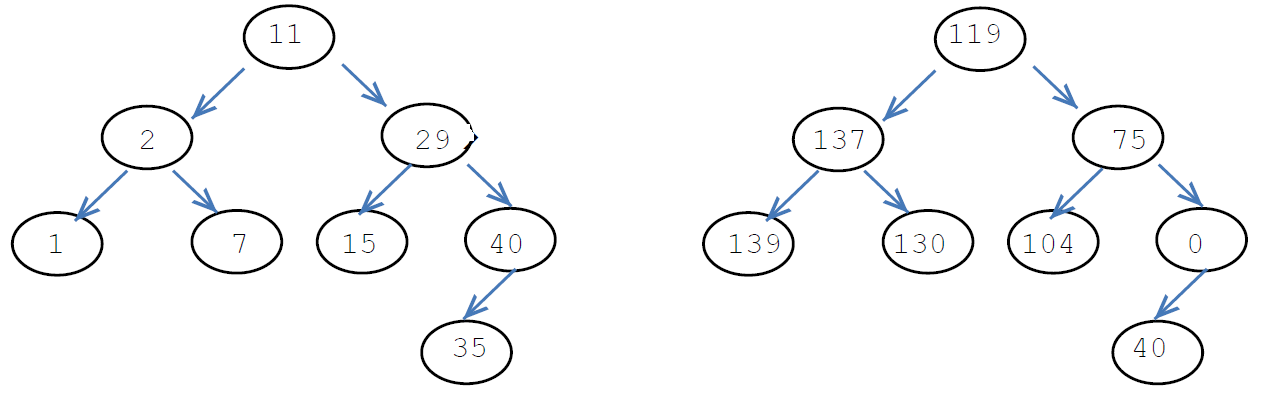
11 will be replaced by {15 + 29 + 35 + 40}, i.e. 119.
2 will be replaced by {7 + 11 + 15 + 29 + 35 + 40}, i.e. 137.
29 will be replaced by {35 + 40}, i.e. 75.
1 will be replaced by {2 + 7 + 11 + 15 + 29 + 35 + 40}, i.e. 139.
7 will be replaced by {11 + 15 + 29 + 35 + 40}, i.e. 130.
15 will be replaced by {15 + 29 + 35 + 40}, i.e. 104.
40 will be replaced by 0 {as there is no node with a value greater than 40}.
35 will be replaced by {40}, i.e. 40.
Problem approach
Given a binary tree with 'N' number of nodes, convert it to a Greater Tree such that data of every node of the original BST is changed to the original node’s data plus the sum of all node’s data greater than or equal to the original data of the node in the BST.
02
Round
Hard
Video Call
Duration60 minutes
Interview date28 Oct 2022
Coding problem2
1. M - Coloring Problem
Easy
15m average time
85% success
0/40
Asked in companies



You are given an undirected graph with N nodes in the form of an adjacency matrix. You are also given an integer M.
Your task is to find if you can color the vertices of the graph using at most M colors such that no two adjacent vertices are of the same color.
For example:
If the given adjacency matrix is:
[0 1 0]
[1 0 1]
[0 1 0] and M = 3.

The given adjacency matrix tells us that node 1 is connected to node 2 and node 2 is connected to node 3.

So if we color vertex 1 with ‘red’, vertex 2 with ‘blue’, and vertex 3 with ‘red’, it is possible to color the given graph with two colors which is less than or equal to M.
Problem approach
You are given an undirected graph with N nodes in the form of an adjacency matrix. You are also given an integer M.
2. Implement Trie
Hard
41m average time
0/120
Asked in companies

Implement Trie Data Structure to support these operations:
insert(word) - To insert a string "word" in Trie
search(word) - To check if string "word" is present in Trie or not.
startsWith(word) - To check if there is any string in the Trie that starts with the given prefix string "word".
Three type of queries denote these operations:
Type 1: To insert a string "word" in Trie.
1 word

Type 2: To check if the string "word" is present in Trie or not.
2 word

Type 3: To check if there is any string in the Trie that starts with the given prefix string "word".
3 word
Problem approach
Implement Trie Data Structure to support these operations:
insert(word) - To insert a string "word" in Trie
search(word) - To check if string "word" is present in Trie or not.
startsWith(word) - To check if there is any string in the Trie that starts with the given prefix string "word".
03
Round
Easy
HR Round
Duration60 minutes
Interview date28 Oct 2022
Coding problem1
1. Basic HR Questions
What did you like most about the job description?
Describe yourself.
What's the most difficult challenge you had to face and how did you handle it?
Why are you looking for a new job?
Problem approach
Tip 1:
Tip 2:
Tip 3:


Here's your problem of the day 
Solving this problem will increase your chance to get selected in this company
Skill covered: Programming
How do you remove whitespace from the start of a string?
Choose another skill to practice
Similar interview experiences

SDE - 1
3 rounds | 7 problems
Interviewed by OYO
 Selected
6182 views

0 comments

0 upvotes
SDE - Intern
2 rounds | 3 problems
Interviewed by Amazon
Rejected
1566 views
0 comments
0 upvotes

SDE - 1
2 rounds | 5 problems
Interviewed by Meesho
Rejected
7245 views
0 comments
0 upvotes

SDE - 1
3 rounds | 9 problems
Interviewed by Salesforce
 Selected
 4552 views
0 comments
0 upvotes
Companies with similar interview experiences
SDE - 1
5 rounds | 12 problems
Interviewed by Amazon
 Selected
 117552 views
24 comments
0 upvotes

SDE - 1
4 rounds | 5 problems
Interviewed by Microsoft
Selected 60143 views
5 comments
0 upvotes
SDE - 1
3 rounds | 7 problems
Interviewed by Amazon
 Selected
 36138 views
7 comments
0 upvotes