





Centilytics | Intelligent Cloud Management interview experience Real time questions & tips from candidates to crack your interview
Backend Developer
Centilytics | Intelligent Cloud Management


2 rounds | 7 Coding
problems

Rejected
Interview preparation journey

Journey
In my second year, I took a course in competitive programming from Coding Ninjas, which helped me dive deep into DSA. After that, I started practicing problems on different coding platforms.
Application story
It was an on-campus drive. There were four rounds, including a technical interview round and an HR interview.
Why selected/rejected for the role?
I didn't prepare CS fundamentals in depth. So, focus on preparing OOP, OS, DBMS, and networking in depth, and make sure to know about SDLC.
Preparation
Duration: 3 months
Topics: Dynamic Programming, Graph, DSA, OS, Networking, OOPS

Tip 1: DSA
Tip 2: CS fundamentals (mainly OOP and DBMS)
Application process
Where: Campus
Eligibility: 60% throughout (Salary: 5 LPA)
Tip 1: Don’t include false information in your resume.
Tip 2: Be well-prepared with your resume.

Interview rounds
01
Round
Easy
Online Coding Interview
Duration60 minutes
Interview date23 Jan 2023
Coding problem5
2 coding questions and 15 MCQs.
1. Number Of Pairs With Given Sum
Moderate
39m average time
60% success

0/80
Asked in companies



You have been given an integer array/list(arr) and a number 'Sum'. Find and return the total number of pairs in the array/list which when added, results equal to the 'Sum'.
Note:
Given array/list can contain duplicate elements.

(arr[i],arr[j]) and (arr[j],arr[i]) are considered same.
2. Linked List Cycle II
Moderate
10m average time
90% success
0/80
Asked in companies



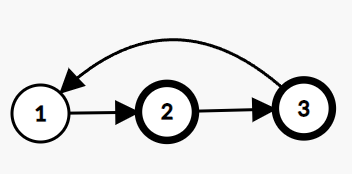
You are given a singly linked list that may or may not contain a cycle. You are supposed to return the node where the cycle begins, if a cycle exists, else return 'NULL'.
A cycle occurs when a node's next pointer returns to a previous node in the list.
Example:
In the given linked list, there is a cycle starting at position 0, hence we return 0.
Problem approach
It's a classic algorithm for detecting cycles in a linked list. We use two pointers to traverse the list: the first moves one node at a time, and the second moves two nodes at a time. If there is a cycle, the pointers will eventually meet, and we return true. If the fast pointer reaches the end of the list, it means there is no cycle, and we return false.
3. Operating System
Which of the following is NOT true of deadlock prevention and deadlock avoidance schemes?
(A) In deadlock prevention, the request for resources is always granted if the resulting state is safe
(B) In deadlock avoidance, the request for resources is always granted if the result state is safe
(C) Deadlock avoidance is less restrictive than deadlock prevention
(D) Deadlock avoidance requires knowledge of resource requirements a priori
4. Puzzle
Look at this series: 7, 10, 8, 11, 9, 12, ... What number should come next?
5. Puzzle
The cost price of 20 articles is the same as the selling price of x articles. If the profit is 25%, then the value of x is:
02
Round
Medium
Video Call
Duration40 minutes
Interview date23 Feb 2023
Coding problem2
2 Coding Questions
1. Remove Duplicates from Sorted Array
Easy
15m average time
85% success
0/40
Asked in companies

You are given a sorted integer array 'arr' of size 'n'.
You need to remove the duplicates from the array such that each element appears only once.
Return the length of this new array.
Note:
Do not allocate extra space for another array. You need to do this by modifying the given input array in place with O(1) extra memory.
For example:
'n' = 5, 'arr' = [1 2 2 2 3].
The new array will be [1 2 3].
So our answer is 3.
Problem approach
Intuition:
The intuition is to use two pointers, i and j, to iterate through the array. The variable j keeps track of the current index where a unique element should be placed. The initial value of j is set to 1 because the first element in the array is always unique and does not need to be changed.
2. Second largest element in the array
Easy
15m average time
80% success
0/40
Asked in companies

You have been given an array/list 'ARR' of integers. Your task is to find the second largest element present in the 'ARR'.
Note:
a) Duplicate elements may be present.

b) If no such element is present return -1.
Example:
Input: Given a sequence of five numbers 2, 4, 5, 6, 8.

Output:  6

Explanation:
In the given sequence of numbers, number 8 is the largest element, followed by number 6 which is the second-largest element. Hence we return number 6 which is the second-largest element in the sequence.
Problem approach
The idea is to sort the array in descending order and then return the second element that is not equal to the largest element in the sorted array.


Here's your problem of the day 
Solving this problem will increase your chance to get selected in this company
Skill covered: Programming
How do you remove whitespace from the start of a string?
Choose another skill to practice
Similar interview experiences

SDE - 1
3 rounds | 7 problems
Interviewed by OYO
 Selected
4898 views

0 comments

0 upvotes
Backend Developer
2 rounds | 5 problems
Interviewed by Centilytics | Intelligent Cloud Management
Rejected
1298 views
0 comments
0 upvotes

SDE - 1
3 rounds | 9 problems
Interviewed by Salesforce
 Selected
 3639 views
0 comments
0 upvotes
Software Engineer
3 rounds | 8 problems
Interviewed by Centilytics | Intelligent Cloud Management
Selected 322 views
0 comments
0 upvotes