





CIS - Cyber Infrastructure interview experience Real time questions & tips from candidates to crack your interview

SDE - Intern
CIS - Cyber Infrastructure


3 rounds | 6 Coding
problems

 Selected
 Interview preparation journey

Preparation
Duration: 3.5 Months
Topics: Data Structures, Algorithms, Dynamic Programming, Graphs, Trees, OOPS, OS, DBMS

Tip 1 : Practice atleast 300-400 DSA questions of medium to hard difficulty. You can practice some easy problems in the start phase but after solving some easy problems you should focus more on solving medium-hard difficulty problems as mostly these type of questions are asked in coding and technical rounds.
Tip 2 : Give 1-2 DSA contests in a week that have a time limit so that it would help in increasing your speed of problem solving and it will give an idea on what are you weak topics and which topics you should focus more.
Tip 3 : Before any coding/interview rounds of a company, go through the previous year questions/experiences that were asked in the coding/interview rounds of the company, which would give an idea on what topics are more important for that company.
Application process
Where: Campus
Eligibility: Above 7 CGPA
Tip 1 : Always keep your resume of 1 page and keep the points that you have mentioned in each heading to be precised
Tip 2 : Be confident on each point that you have mentioned in your resume. Never mention any wrong information in resume as if would get into notice then it will have a negative impact in the interview.

Interview rounds
01
Round
Medium
Online Coding Interview
Duration75 Minutes
Interview date16 Aug 2021
Coding problem2
The coding round was in the evening and the platform used for taking the coding round was very good.
1. Find Center of Star Graph
Easy

0/40
Asked in companies

You have been given an undirected star graph in the form of Adjacency List 'EDGES', consisting of ‘N’ nodes labelled from 1 to ‘N’. A star graph is a graph where there is one centre node and exactly ‘N’ - 1 edges that connect the centre node to every other node.
You are given a matrix ‘EDGES’ storing the information about the edges, where each row, ‘EDGES[i]’ contains two integers ‘U’ and ‘V’, which implies that there is an undirected edge between ‘U’ and ‘V’.
For Example :
For the given graph:
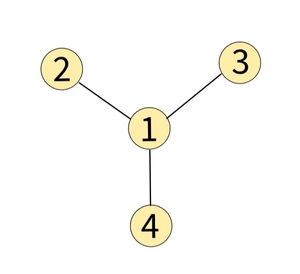
Node 1 is connected to all other nodes. Hence node 1 is the centre of this star graph.
Problem approach
Step 1 : I represented the graph as adjaceny list
Step 2 : Then i iterated through all the nodes, and calculated the maximum k-star value that can be achieved if i keep the current node as the center.
Step 3 : For calculating a k-star value from a node, i added the values of the neighbours of the current node in a vector and sorted them in descending order. Then i took the first k values, which would be the maximum value that can be achieved if i take the current node as center.
Step 4 : Then i calculated the maximum of all the K-star values from the nodes and returned the answer.
2. Longest Subsequence With Difference One
Moderate
30m average time
70% success
0/80
Asked in companies


You are given an array “nums” of size N. Your task is to find the length of the longest subsequence of array “nums” such that the absolute difference between every adjacent element in the subsequence is one.
For Example:
If “nums” = {2, 1, 3}.

The valid non-empty subsequences of the array are {2}, {1}, {3}, {2, 1}, {1, 3}, {2, 3} and {2, 1, 3}. So, the longest subsequence satisfying the given conditions are {2, 1} and {2, 3}. The length of the longest subsequence is 2. So, the answer is 2.
The subsequence of an array is a sequence of numbers that can be formed by deleting some or no elements without changing the order of the remaining elements. For example, if the given array “nums” = {1, 2, 5, 4, 8}, then {1, 2, 5, 4, 8}, {1, 5, 8}, {2} are some of the valid subsequences whereas the sequence {4, 2} is not a valid subsequence as the order of the elements differ from the original array.
Note:
Any subsequence of length = 1 is also a valid subsequence.
Problem approach
Step 1 : First, I sorted the array and kept a variable to store the maximum answer and a variable idx to store the current index.
Step 2 : Then, I iterated the array and checked how many numbers can be included in the current iteration and incremented the value of idx at each step and check till idx is less than the size of array.
Step 3 : Then, I calculated the answer at each iteration and returned the maximum answer.
02
Round
Medium
Video Call
Duration60 Minutes
Interview date23 Aug 2021
Coding problem3
The interview was in the morning and it was taken on Microsoft Teams.
1. LRU Cache Implementation
Moderate
25m average time
65% success
0/80
Asked in companies


Design and implement a data structure for Least Recently Used (LRU) cache to support the following operations:
1. get(key) - Return the value of the key if the key exists in the cache, otherwise return -1.

2. put(key, value), Insert the value in the cache if the key is not already present or update the value of the given key if the key is already present. When the cache reaches its capacity, it should invalidate the least recently used item before inserting the new item.
You will be given ‘Q’ queries. Each query will belong to one of these two types:
Type 0: for get(key) operation.
Type 1: for put(key, value) operation.
Note :
1. The cache is initialized with a capacity (the maximum number of unique keys it can hold at a time).

2. Access to an item or key is defined as a get or a put operation on the key. The least recently used key is the one with the oldest access time.
2. Technical Questions
We had a detailed discussion on the project that i mentioned in my resume like what technologies I used, why I choose these technologies, what difficulties i faced etc. I was also asked to present my project and they some questions regarding the platforms on which i have deployed my website and the other options on which I can deploy it.
Problem approach
Tip 1 : Have a deep insights of the projects that you are mentioning in resume.
Tip 2 : Try to practice some commonly asked questions before the interview so that you don't get nervous in interview.
3. OOPS Questions
What are 4 pillars of OOPS and explain them?
What are different types of inheritance?
What is the role of access specifiers in encapsulation?
Problem approach
Tip 1 : Properly go through the different concepts of OOPS, OS and DBMS.
Tip 2 : Do practice some common questions on OOPS before appearing in the interview.
Tip 3 : Make your own notes and revise them from time to time.
03
Round
Easy
HR Round
Duration20 Minutes
Interview date23 Aug 2021
Coding problem1
It was in the afternoon and the interviewer was very friendly and cooperative.
1. Basic HR Questions
Give a introduction of yourself.
Tell about some of the achievements in college?
Have you worked in a team project and if yes, please share the experience.
What are you strengths and weakness?
Do you have any questions for us?
Problem approach
Tip 1 : Always be confident while answering these questions.
Tip 2 : Always ask questions from the interviewer if they ask do you have any questions for us, as it shows that you are really interested in joining the company
Tip 3 : Do practice some commonly asked questions in HR round before appearing in this round.


Here's your problem of the day 
Solving this problem will increase your chance to get selected in this company
Skill covered: Programming
How do you remove whitespace from the start of a string?
Choose another skill to practice
Similar interview experiences
Junior Associate: Marketing Strategy and Analysis
3 rounds | 5 problems
Interviewed by CIS - Cyber Infrastructure
Rejected

902 views

0 comments

0 upvotes
Associate Technology
3 rounds | 4 problems
Interviewed by CIS - Cyber Infrastructure
Selected 1057 views
0 comments
0 upvotes
SDE - Intern
3 rounds | 4 problems
Interviewed by CIS - Cyber Infrastructure
Selected 732 views
0 comments
0 upvotes
SDE - Intern
3 rounds | 4 problems
Interviewed by CIS - Cyber Infrastructure
Selected 0 views
0 comments
0 upvotes
Companies with similar interview experiences

SDE - Intern
2 rounds | 4 problems
Interviewed by Arcesium
 Selected
 3738 views
0 comments
0 upvotes
SDE - Intern
3 rounds | 5 problems
Interviewed by Arcesium
Selected 2683 views
0 comments
0 upvotes

SDE - Intern
3 rounds | 5 problems
Interviewed by BNY Mellon
 Selected
 2348 views
0 comments
0 upvotes