





cisco systems pvt ltd interview experience Real time questions & tips from candidates to crack your interview
SDE - 1
cisco systems pvt ltd


3 rounds | 9 Coding
problems

 Selected
 Interview preparation journey

Preparation
Duration: 4 Months
Topics: Data Structures, Algorithms, System Design, Aptitude, OOPS

Tip 1 : Must do Previously asked Interview as well as Online Test Questions.
Tip 2 : Go through all the previous interview experiences from Codestudio and Leetcode.
Tip 3 : Do at-least 2 good projects and you must know every bit of them.
Application process
Where: Campus
Eligibility: Above 7 CGPA
Tip 1 : Have at-least 2 good projects explained in short with all important points covered.
Tip 2 : Every skill must be mentioned.
Tip 3 : Focus on skills, projects and experiences more.

Interview rounds
01
Round
Medium
Online Coding Interview
Duration70 Minutes
Interview date18 Aug 2021
Coding problem1
This was an Online Coding+MCQ round where we had a total of 50 MCQ questions and 1 coding problem. The coding problem was of easy to medium level but was a bit implementation heavy.
1. Intersection of Linked List
Easy
25m average time
73% success

0/40
Asked in companies



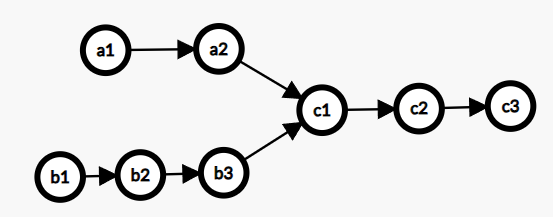
You are given two Singly Linked Lists of integers, which may have an intersection point.
Your task is to return the first intersection node. If there is no intersection, return NULL.
Example:-
The Linked Lists, where a1, a2, c1, c2, c3 is the first linked list and b1, b2, b3, c1, c2, c3 is the second linked list, merging at node c1.
Problem approach
Approach :
I) Using Hashing :
Basically, we need to find a common node of two linked lists. So we hash all nodes of the first list and then check the second list.
Note : Hash the nodes not the node value
1) Create an empty hash set.
2) Traverse the first linked list and insert all nodes' addresses in the hash set.
3) Traverse the second list. For every node check if it is present in the hash set. If we find a node in the hash set, return the node
TC : O(m+n)
SC : O(min(m,n))
II) Using Two pointers :
1) Initialize two pointers ptr1 and ptr2 at the head1 and head2.
2) Traverse through the lists,one node at a time.
3) When ptr1 reaches the end of a list, then redirect it to the head2.
4) Similarly when ptr2 reaches the end of a list, redirect it the head1.
5) Once both of them go through reassigning, they will be equidistant from the collision point
6) If at any node ptr1 meets ptr2, then it is the intersection node.
7) After second iteration if there is no intersection node it returns NULL.
TC : O(m+n) where m=Length of LL-1 and n=Length of LL-2
SC : O(1)
02
Round
Medium
Video Call
Duration60 Minutes
Interview date18 Aug 2021
Coding problem4
The interviewer asked 1 coding problem related to Sliding Window in this round and then the rest of the questions were preety much revolving around Computer Networks and OOPS.
1. Longest Substring Without Repeating Characters
Moderate
20m average time
80% success
0/80
Asked in companies



Given a string 'S' of length 'L', return the length of the longest substring without repeating characters.
Example:
Suppose given input is "abacb", then the length of the longest substring without repeating characters will be 3 ("acb").
Problem approach
Approach : I solved it using 2-pointers and keeping a track of the frequency of the elements encountered in a freq array of size 26.
Steps :
1) Initiliase a freq array of size 26 where a=0, b=1 ...,z=25 .
2) Let s be our string and n = s.size()
3) Do , freq[s[0]]++;
4) Keep 2 pointers start and end where initially start=0 and end=1 also maintain a answer variable ans where initially ans=0
5) Now run a loop till end=1 and start7) Update ans by ans=max(ans , end-start+1)
8) Finally return ans
TC : O(N)
SC : O(26)=O(1)
2. Networking Question
Explain what is DNS.
Problem approach
DNS is the Domain Name System. It is considered as the devices/services directory of the Internet. It is a decentralized and hierarchical naming system for devices/services connected to the Internet. It translates the domain names to their corresponding IPs.
3. Networking Question
Explain why MAC addresses are required despite having IP addresses
Problem approach
MAC addresses and IP addresses operate on different layers of the internet protocol suite. MAC addresses are used to identify machines within the same broadcast network on layer 2, while IP addresses are used on layer 3 to identify machines throughout different networks.
Even if your computer has an IP address, it still needs a MAC address to find other machines on the same network (especially the router/gateway to the rest of the network/internet), since every layer is using underlying layers.
4. OOPS Question
How does C++ support Polymorphism?
Problem approach
C++ is an Object-oriented programming language and it supports Polymorphism as well:
Compile Time Polymorphism: C++ supports compile-time polymorphism with the help of features like templates, function overloading, and default arguments.
Runtime Polymorphism: C++ supports Runtime polymorphism with the help of features like virtual functions. Virtual functions take the shape of the functions based on the type of object in reference and are resolved at runtime.
03
Round
Medium
Video Call
Duration60 minutes
Interview date18 Aug 2021
Coding problem4
This round had questions revolving around Computer Networks and Operating Systems.
Tip : Concepts related to Computer Networks is quite frequently asked in Cisco interviews . So its better to remain equipped with all the fundamental concepts. I prepared all the core subjects from my notes and for revision I would suggest the guided paths of Coding Ninjas , they are very useful for quick revision and also the questions over there are very frequently asked in interviews.
1. Networking Question
What is the ARP protocol?
Problem approach
ARP is Address Resolution Protocol. It is a network-level protocol used to convert the logical address i.e. IP address to the device's physical address i.e. MAC address. It can also be used to get the MAC address of devices when they are trying to communicate over the local network.
2. Networking Question
What happens when you enter Google.com on the web browser.
Problem approach
1) The browser extracts the domain name from the URL.
2) The browser queries DNS for the IP address of the URL. Generally, the browser will have cached domains previously visited, and the operating system will have cached queries from any number of applications. If neither the browser nor the OS have a cached copy of the IP address, then a request is sent off to the system's configured DNS server. The client machine knows the IP address for the DNS server, so no lookup is necessary.
3) The request sent to the DNS server is almost always smaller than the maximum packet size, and is thus sent off as a single packet. In addition to the content of the request, the packet includes the IP address it is destined for in its header. Except in the simplest of cases (network hubs), as the packet reaches each piece of network equipment between the client and server, that equipment uses a routing table to figure out what node it is connected to that is most likely to be part of the fastest route to the destination. The process of determining which path is the best choice differs between equipment and can be very complicated.
4) The data is either lost (in which case the request fails or is reiterated), or makes it to its destination, the DNS server.
5) If that DNS server has the address for that domain, it will return it. Otherwise, it will forward the query along to DNS server it is configured to defer to. This happens recursively until the request is fulfilled or it reaches an authoritative name server and can go no further.
6) Assuming the DNS request is successful, the client machine now has an IP address that uniquely identifies a machine on the Internet. The web browser then assembles an HTTP request, which consists of a header and optional content. The header includes things like the specific path being requested from the web server, the HTTP version, any relevant browser cookies, etc.
7) This HTTP request is sent off to the web server host as some number of packets, each of which is routed in the same was as the earlier DNS query. (The packets have sequence numbers that allow them to be reassembled in order even if they take different paths.) Once the request arrives at the webserver, it generates a response (this may be a static page, served as-is, or a more dynamic response, generated in any number of ways.) The web server software sends the generated page back to the client.
This is what happens when we type Google.com on our browser.
3. OS Question
What are the different types of semaphores ?
Problem approach
Answer :
There are two main types of semaphores i.e. counting semaphores and binary semaphores.
1) Counting Semaphores :
These are integer value semaphores and have an unrestricted value domain. These semaphores are used to coordinate the resource access, where the semaphore count is the number of available resources. If the resources are added, semaphore count automatically incremented and if the resources are removed, the count is decremented.
2) Binary Semaphores :
The binary semaphores are like counting semaphores but their value is restricted to 0 and 1. The wait operation only works when the semaphore is 1 and the signal operation succeeds when semaphore is 0. It is sometimes easier to implement binary semaphores than counting semaphores.
4. OS Question
What is thrashing in OS?
Problem approach
Answer :
1) It is generally a situation where the CPU performs less productive work and more swapping or paging work.
2) It spends more time swapping or paging activities rather than its execution.
3) By evaluating the level of CPU utilization, a system can detect thrashing.
4) It occurs when the process does not have enough pages due to which the page-fault rate is increased. 5) It inhibits much application-level processing that causes computer performance to degrade or collapse.


Here's your problem of the day 
Solving this problem will increase your chance to get selected in this company
Skill covered: Programming
Which collection class forbids duplicates?
Choose another skill to practice
Similar interview experiences
SDE - 1
4 rounds | 5 problems
Interviewed by cisco systems pvt ltd
Rejected

1014 views

0 comments

0 upvotes
SDE - 1
3 rounds | 6 problems
Interviewed by cisco systems pvt ltd
Rejected
0 views
0 comments
0 upvotes
SDE - 1
3 rounds | 5 problems
Interviewed by cisco systems pvt ltd
Rejected
930 views
0 comments
0 upvotes
SDE - 1
3 rounds | 5 problems
Interviewed by cisco systems pvt ltd
Selected 1111 views
0 comments
0 upvotes
Companies with similar interview experiences
SDE - 1
5 rounds | 12 problems
Interviewed by Amazon
 Selected
 116551 views
24 comments
0 upvotes

SDE - 1
4 rounds | 5 problems
Interviewed by Microsoft
Selected 59303 views
5 comments
0 upvotes
SDE - 1
3 rounds | 7 problems
Interviewed by Amazon
 Selected
 35700 views
7 comments
0 upvotes