





Cisco interview experience Real time questions & tips from candidates to crack your interview

SDE - 1
Cisco


4 rounds | 5 Coding
problems
Rejected
Interview preparation journey

Preparation
Duration: 4 Months
Topics: Data Structures Algorithms OOPS Computer Networks Operating Systems

Tip 1 : Be very good in Computer Networks fundamentals
Tip 2 : Optimized code is expected for the coding problems
Tip 3 : Better to have end to end/full stack projects in your resume
Application process
Where: Campus
Eligibility: 8 CGPA
Tip 1 : Better to have end to end/ full stack projects on the resume
Tip 2 : Better to mention your coding profile links
Interview rounds
01
Round
Easy
Online Coding Interview
Duration60 Minutes
Interview date2 Sep 2021
Coding problem2
The first round consisted of 15 MCQs out of which 10 of them were on Computer Networks and 5 of them were related to Aptitude.
1. Minimum Window Substring
Hard
15m average time
85% success

0/120
Asked in companies


You are given two strings ‘A’ and ‘B’. Your task is to return a substring ‘S’ of ‘A’ such that the following conditions hold true :
• You can make ‘B’ from ‘S’ by removing some characters and rearranging some characters zero or more times.

• Length of ‘S’ must be as minimum as possible.
Note :
Testcases are generated such that a substring always exists and is unique.
Example :
A = ninjas, B = sin

All possible substrings with which 'B' can be created are
"ninjas", "injas".

Hence the substring with minimum length is "injas".
Problem approach
We traverse the string with greater length.Then we check the number of characters which are not matching in the n's substring of length of smaller string (m). Declare the changes variable with INF and then keep storing and updating the minimum value of previous and the current mismatch in changes variable.
2. Count Distinct Element in Every K Size Window
Easy
15m average time
85% success
0/40
Asked in companies


You are given an array ‘ARR’ of size ‘N’ and an integer ‘K’. Your task is to find the total number of distinct elements present in every ‘K’ sized window of the array. A ‘K’ sized window can also be viewed as a series of continuous ‘K’ elements present in the sequence.
Note:
1. The size of ‘ARR’ will always be greater than or equal to the ‘K’.
2. Here window refers to a subarray of ‘ARR’. Hence ‘K’ sized window means a subarray of size ‘K’.
3. You are not required to print the output explicitly. It has already been taken care of. Just implement the function and return an array of the count of all distinct elements in the ‘K’ size window.
Example
Consider ARR = [ 1, 2, 1, 3, 4, 2, 3 ] and K = 3.
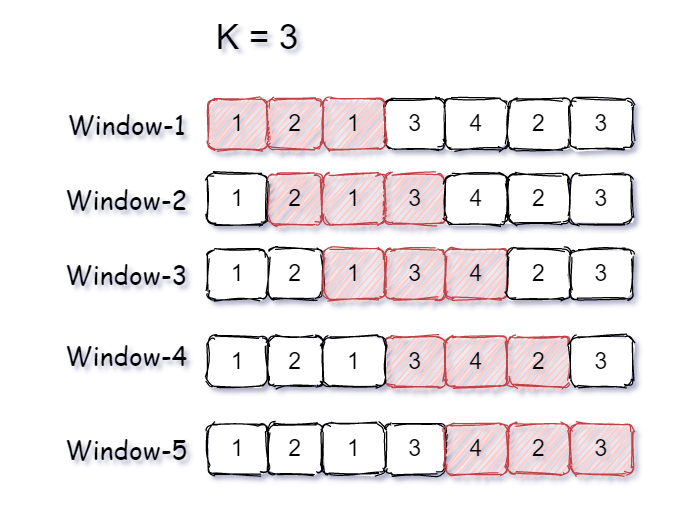
As per the given input, we have a sequence of numbers of length 7, and we need to find the number of distinct elements present in all the windows of size 3.

Window-1 has three elements { 1, 2, 1 } and only two elements { 1, 2 } are distinct because 1 is repeating two times.
Window-2 has three elements { 2, 1, 3 } and all three elements are distinct { 2, 1, 3 }.
Window-3 has three elements { 1, 3, 4 } and all three elements are distinct { 1, 3, 4 }.
Window-4 has three elements { 3, 4, 2 } and all three elements are distinct { 3, 4, 2 }.
Window-5 has three elements { 4, 2, 3 } and all three elements are distinct { 4, 2, 3 }.

Hence, the count of distinct elements in all K sized windows is { 2, 3, 3, 3, 3 }.
Problem approach
We use two pointer approach and make a sliding window of size k, we will also use a hashmap to keep the frequency count of the elements. We use a hashmap m to keep the frequency count of elements.
Whenever we insert a new element inside the window we see if it's frequency is 0 or not, if it is 0, then we increase the distinct count by 1. Whenever we pop an element, we see if it's frequency is 1 and if it is 1, then we decrease the distinct count as well. So at every instant, we will have the size of the hashmap and then store all the sizes into an array(after traversing through every element) and then finally return the array.
02
Round
Easy
Face to Face
Duration45 Minutes
Interview date4 Sep 2021
Coding problem1
This round mostly comprised of Computer Networks and Operating Systems related questions. As Cisco is a networking company its main focus is on CN. So most of the questions were standard CN questions, some questions which they have asked are:
Differences between TCP and UDP
Explain the 3 way handshake
Explain the life cycle of a request(all the layers, all the protocols and a very detailed answer was expected)
1. Operating System Questions
Explain the differences between process and thread. Also how do you differentiate between user level threads and kernel level threads.
Problem approach
Tip 1 : Be very good with Computer Networks fundamentals
03
Round
Easy
Face to Face
Duration30 Minutes
Interview date4 Sep 2021
Coding problem1
This was a managerial round where it was mostly focused on my projects and my resume, previous internships and experiences. He asked me to explain my projects and some questions which were asked are:
Which is this particular tech stack used?
What was the outcome of the project?
How did you overcome the difficulties?
How was the internship experience?
1. Operating System Questions
What is a deadlock?
What are the different conditions for deadlock?
What are some of the prevention techniques and solutions for deadlock?
Problem approach
Tip 1: Be prepared for OS and CN questions because those are the frequently asked questions in every round.
04
Round
Easy
HR Round
Duration15 Minutes
Interview date4 Sep 2021
Coding problem1
This round mostly consisted of my introduction, interests and the standard HR questions
1. Basic HR questions
Why do you want to join Cisco?
Have you done any projects related to Networking and Security before?
What are some products of Cisco and why is Cisco famous?
Problem approach
Tip 1: Research about the products of Cisco before hand, understand what is the company trying to do and what problems is it trying to solve


Here's your problem of the day 
Solving this problem will increase your chance to get selected in this company
Skill covered: Programming
To make an AI less repetitive in a long paragraph, you should increase:
Choose another skill to practice
Similar interview experiences
SDE - 1
2 rounds | 4 problems
Interviewed by Cisco

Rejected

2369 views

0 comments

0 upvotes
SDE - 1
2 rounds | 4 problems
Interviewed by Cisco
Rejected
1557 views
0 comments
0 upvotes
SDE - 1
3 rounds | 5 problems
Interviewed by Cisco
Rejected
835 views
0 comments
0 upvotes
SDE - 1
3 rounds | 5 problems
Interviewed by Cisco
 Selected
 968 views
0 comments
0 upvotes
Companies with similar interview experiences
SDE - 1
5 rounds | 12 problems
Interviewed by Amazon
 Selected
 114453 views
24 comments
0 upvotes

SDE - 1
4 rounds | 5 problems
Interviewed by Microsoft
Selected 57719 views
5 comments
0 upvotes
SDE - 1
3 rounds | 7 problems
Interviewed by Amazon
 Selected
 34914 views
7 comments
0 upvotes