





Cisco interview experience Real time questions & tips from candidates to crack your interview

SDE - 1
Cisco


4 rounds | 9 Coding
problems

Rejected
Interview preparation journey

Preparation
Duration: 10 Months
Topics: Data Structures, Algorithms, OOPs, Operating Systems, DBMS, Computer Networks

Tip 1 : For DSA questions in interviews, start explaining from the brute force approach and then move to the optimal one. Convey your thought process to the interviewers, so that they can help you out if you get stuck. Communication skills matter a lot, and I think that is what makes the difference!
Tip 2 : Do some research about the company you are interviewing for and prepare the answers to the questions like Why should we hire you? (frame your answer in such a way that shows that your career goals align with the goals of the company), Why XYZ company?, Competitors of XYZ, etc. beforehand. Read about some latest news related to the company so that you can ask questions based upon that when the interviewer allows you to ask any question. This shows that you are genuinely interested to work for the company.
Tip 3 : Spend proper time making your resume and get it reviewed by seniors. Do not write anything that you are not confident of. Even if you write something that you don’t know, just be prepared that how you will defend it. The interviewers are much much experienced than you and they’ll catch you easily if you lie. So don’t take risks here.
Application process
Where: Campus
Eligibility: Above 7 CGPA
Tip 1 : Try to include at least 1 development project in your resume.
Tip 2 : Do not write anything that you are not confident of. Even if you write something that you don’t know, just be prepared that how you will defend it.
Interview rounds
01
Round
Hard
Online Coding Interview
Duration60 minutes
Interview date12 Nov 2021
Coding problem2
There were 2 coding questions and 15 MCQs (related to OOPs, OS, DBMS, CN, DSA, and Aptitude).
1. Apple Pickup
Hard
15m average time
85% success

0/120
Asked in companies


Alice always loves to visit her garden and collect apples. The garden can be represented in the form of ‘N’ * ’N’ grid say ‘MATRIX’, where each cell of the grid can have one of the possible values:
1 -> The cell contains an apple that Alice can pick up and pass through it.

-1 -> The cell contains a bush and Alice can not visit this cell.

0 -> The cell is empty and Alice can pass through it.
Alice is present at the top left corner of the matrix or we can say at point (0,0).
Alice has to reach the bottom right corner of the matrix (‘N’-1,’N’-1) and return back to the starting point (0,0).
1. After picking an apple the cell will become empty.

2. While going towards the bottom right corner, Alice can either move Right or Down at each step.

3. While going towards the top left corner, Alice can either move Left or Up at each step.

4. If there is no path from (0,0) to (‘N’-1, ‘N’-1) then Alice will not pick any apple.
Your task is to help Alice to collect the maximum number of apples during her journey.
For example:
If the given matrix is :
[1, 1, -1, 1]
[1, 0, 1, 1]
[1, 1, 0, 1]
[0, -1, -1, 1]

One of the possible ways to collect maximum apples is :

Path for going towards bottom right corner:
(0,0) -> (0,1) -> (1,1) -> (1,2) -> (1,3) -> (2,3) -> (3,3)

Apples collected are equal to 6.

Path for going towards top left corner:
(3,3) -> (2,3) ->(2,2) -> (2,1) -> (2,0) -> (1,0) -> (0,0)

Apples collected are equal to 3.

So Alice can collect a maximum of 9 apples.
Problem approach
I solved this using dynamic programming.
2. Implement Stack With Linked List
Moderate
30m average time
73% success
0/80
Asked in companies


You must implement the Stack data structure using a Singly Linked List.
Create a class named 'Stack' which supports the following operations(all in O(1) time):
getSize: Returns an integer. Gets the current size of the stack

isEmpty: Returns a boolean. Gets whether the stack is empty

push: Returns nothing. Accepts an integer. Puts that integer at the top of the stack

pop: Returns nothing. Removes the top element of the stack. It does nothing if the stack is empty.

getTop: Returns an integer. Gets the top element of the stack. Returns -1 if the stack is empty
02
Round
Medium
Video Call
Duration40 minutes
Interview date1 Dec 2021
Coding problem2
It was a technical interview round where I was asked questions based on DSA.
1. Cycle Detection in a Singly Linked List
Moderate
15m average time
80% success
0/80
Asked in companies



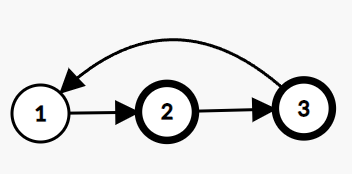
You are given a Singly Linked List of integers. Return true if it has a cycle, else return false.
A cycle occurs when a node's next points back to a previous node in the list.
Example:
In the given linked list, there is a cycle, hence we return true.
Problem approach
I explained to him the brute force approach as well as the optimal approach, after which he asked me to write the code for the optimal approach. He asked me to write the code from scratch, so first I wrote the code to insert the nodes in the linked list and then the code to detect a loop in the linked list.
2. Find the lone set bit
Easy
15m average time
85% success
0/40
Asked in companies


You are given a single non-negative integer ‘N’ who’s binary representation consists of a single ‘1’ digit and the rest of the digits are ‘0’s. Your task is to find the position of the only ‘1’ digit. In other words, your task is to find the position of the only set bit in the binary representation of the input integer ‘N’.
The position of the set bit must be counted from the LSB (Least Significant Bit) end of the Binary number. If the count of set bits in the Binary number is not equal to 1, then your function should return ‘-1’ as output.
Example:-
INPUT   : N = 4
OUTPUT  : 3

In the above example, N = 4, whose Binary representation is “0100”. It is clearly visible that the binary number contains a single set bit, at a position 3 from the LSB end. Hence the output is 3

INPUT : N = 8
OUTPUT: 4

In the above example, N = 8, whose Binary representation is “1000”. It is clearly visible that the binary number contains a single set bit, at a position 4 from the LSB end. Hence the output is 4

INPUT   : N = 9
OUTPUT  : -1

In the above example, N = 9, whose Binary representation is “1001”.  Now, the binary number contains 2 set bits, at a position 4 and 1 from LSB end. Hence the output is -1.

INPUT   : N = 0
OUTPUT  : -1

In the above example, N = 0, whose Binary representation is “0000”.  Now, the binary number contains no set bits at all. Hence the output will be -1.
Problem approach
This was quite an easy question. The interviewer asked me to write the code to check whether the kth bit of an integer is set or not, and then make some changes in that code to check whether the kth bit of an integer is unset or not.
03
Round
Medium
Video Call
Duration30 minutes
Interview date1 Dec 2021
Coding problem4
It was a technical interview round where I was asked questions based on DSA, OS, and Networking.
1. Two Sum
Easy
10m average time
90% success
0/40
Asked in companies



You are given an array of integers 'ARR' of length 'N' and an integer Target. Your task is to return all pairs of elements such that they add up to Target.
Note:
We cannot use the element at a given index twice.
Follow Up:
Try to do this problem in O(N) time complexity.
Problem approach
Step 1 : I explained the brute force approach to the interviewer.
Step 2 : I optimized the previous approach using a hashtable and explained the same to the interviewer.
2. Operating System Question
What is Priority Inversion?
3. Operating System Question
What happens when you boot your system?
4. Computer Networking Question
What is an IP address and how many bits are required to represent an IP address?
04
Round
Easy
HR Round
Duration10 minutes
Interview date1 Dec 2021
Coding problem1
This was an HR round. The interviewer asked me some questions.
Finally, she asked if I had any questions for her.
1. Basic HR Questions
Tell me about yourself.
Why do you want to join Cisco?
What are some products of Cisco that you know?
Who are the competitors of Cisco?
Then, she asked my location preference and told me about the CTC breakup.


Here's your problem of the day 
Solving this problem will increase your chance to get selected in this company
Skill covered: Programming
To make an AI less repetitive in a long paragraph, you should increase:
Choose another skill to practice
Similar interview experiences
SDE - 1
2 rounds | 4 problems
Interviewed by Cisco

Rejected

2369 views

0 comments

0 upvotes
SDE - 1
2 rounds | 4 problems
Interviewed by Cisco
Rejected
1556 views
0 comments
0 upvotes
SDE - 1
3 rounds | 5 problems
Interviewed by Cisco
Rejected
834 views
0 comments
0 upvotes
SDE - 1
3 rounds | 5 problems
Interviewed by Cisco
 Selected
 968 views
0 comments
0 upvotes
Companies with similar interview experiences
SDE - 1
5 rounds | 12 problems
Interviewed by Amazon
 Selected
 114453 views
24 comments
0 upvotes
SDE - 1
4 rounds | 5 problems
Interviewed by Microsoft
Selected 57719 views
5 comments
0 upvotes
SDE - 1
3 rounds | 7 problems
Interviewed by Amazon
 Selected
 34914 views
7 comments
0 upvotes