





Cisco interview experience Real time questions & tips from candidates to crack your interview

SDE - Intern
Cisco


2 rounds | 4 Coding
problems

Rejected
Interview preparation journey

Journey
I started my coding journey in the second year after being motivated by my seniors. Initially, I learned basic programming languages. Later, I started participating in contests and solving coding problems, striving to maintain consistency. After 2-3 months, I began to solve some questions. In my third year, I delved deeper into core subjects such as OS, DBMS, OOP, and CN. This preparation ensured that I was well-prepared before the placement season.
Application story
I applied through the company's career portal, where they requested a resume and then selected candidates using their software.
Why selected/rejected for the role?
I was rejected because I was not able to maintain the timing needed to answer the questions; I should have been faster.
Preparation
Duration: 6 months
Topics: Data Structures, Pointers, OOPS, System Design, Algorithms, Dynamic Programming

Tip 1: Practice coding on coding platforms, solving at least 100 questions.
Tip 2: Practice using any one automation framework that includes design patterns.
Application process
Where: Company Website
Eligibility: Above 7 CGPA
Tip 1: Restrict your resume to 1 page and include only your practical work.
Tip 2: Mention key topics such as Selenium, Rest Assured automation, and languages used (e.g., Java).
Interview rounds
01
Round
Easy
Video Call
Duration60 minutes
Interview date12 Nov 2022
Coding problem2
1. Palindrome Linked List
Easy
20m average time
90% success

0/40
Asked in companies



You are given a singly Linked List of integers. Your task is to return true if the given singly linked list is a palindrome otherwise returns false.
For example:
The given linked list is 1 -> 2 -> 3 -> 2-> 1-> NULL.
It is a palindrome linked list because the given linked list has the same order of elements when traversed forwards and backward.
Follow Up:
Can you solve the problem in O(N) time complexity and O(1) space complexity iteratively?
2. Count derangements
Moderate
35m average time
60% success
0/80
Asked in companies


A Derangement is a permutation of ‘N’ elements, such that no element appears in its original position. For example, an instance of derangement of {0, 1, 2, 3} is {2, 3, 1, 0}, because 2 present at index 0 is not at its initial position which is 2 and similarly for other elements of the sequence.
Given a number ‘N’, find the total number of derangements possible of a set of 'N’ elements.
Note:
The answer could be very large, output answer %(10 ^ 9 + 7).
Problem approach
There are n – 1 ways for element 0 (this explains multiplication with n – 1).
Let 0 be placed at index i. There are now two possibilities, depending on whether or not element i is placed at 0 in return.
02
Round
Easy
Video Call
Duration60 minutes
Interview date12 Nov 2022
Coding problem2
1. Smallest Window
Moderate
10m average time
90% success
0/80
Asked in companies



You are given two strings S and X containing random characters. Your task is to find the smallest substring in S which contains all the characters present in X.
Example:
Let S = “abdd” and X = “bd”.

The windows in S which contain all the characters in X are: 'abdd', 'abd', 'bdd', 'bd'.
Out of these, the smallest substring in S which contains all the characters present in X is 'bd'.
All the other substring have a length larger than 'bd'.
Problem approach
Approach 1 (Brute Force) :
1) Generate all substrings of string1.
2) For each substring, check whether the substring contains all characters of string2.
3) Finally, print the smallest substring containing all characters of string2.
TC : O(N^3), where N=length of the given string s1 and s2
SC : O(1)
2. K - Sum Path In A Binary Tree
Moderate
35m average time
65% success
0/80
Asked in companies



You are given a binary tree in which each node contains an integer value and a number ‘K’. Your task is to print every path of the binary tree with the sum of nodes in the path as ‘K’.
Note:
1. The path does not need to start or end at the root or a leaf, but it must go downwards (traveling only from parent nodes to child nodes).

2. Output the paths in the order in which they exist in the tree from left to right. Example: In the below example, path {1,3} is followed by {3,1} and so on.
Example:
For K = 4 and tree given below:
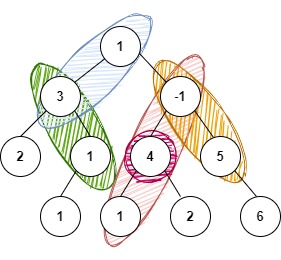
The possible paths are:
1 3
3 1
-1 4 1
4
-1 5

The sum of values of nodes of each of the above-mentioned paths gives a sum of 4.
Problem approach
The idea is simple: record all prefix sums in a hash table along the path. For current prefix sum x, check if (x - target)
appears in the hash table.
Steps :
1) We will be using an unordered map which will be filled with various path sums.
2) For every node we will check if the current sum and root’s value equal to k or not. If the sum equals k then
increment the required answer by one.
3) Then we will add all those path sums in map which differs from current sum+root->data value by a constant integer
k.
4) Then we will be inserting the current sum + root->data value in the map.
5) We will recursively check for left and right subtrees of current root
6) After the right subtree is also traversed we will remove the current sum + root->data value from the map so that it
is not taken into consideration in further traversals of other nodes other than the current root’s.


Here's your problem of the day 
Solving this problem will increase your chance to get selected in this company
Skill covered: Programming
To make an AI less repetitive in a long paragraph, you should increase:
Choose another skill to practice
Similar interview experiences
SDE - Intern
5 rounds | 6 problems
Interviewed by Cisco
 Selected
3050 views

0 comments

0 upvotes
SDE - Intern
3 rounds | 3 problems
Interviewed by Cisco
Selected 780 views
0 comments
0 upvotes
SDE - Intern
2 rounds | 4 problems
Interviewed by Cisco
Rejected
868 views
0 comments
0 upvotes
SDE - Intern
3 rounds | 3 problems
Interviewed by Cisco
Selected 881 views
0 comments
0 upvotes
Companies with similar interview experiences
SDE - Intern
3 rounds | 6 problems
Interviewed by Amazon

Rejected
15447 views
4 comments
0 upvotes
SDE - Intern
4 rounds | 7 problems
Interviewed by Microsoft
 Selected
 15307 views
1 comments
0 upvotes
SDE - Intern
2 rounds | 4 problems
Interviewed by Amazon
Selected 10120 views
2 comments
0 upvotes