





Cisco interview experience Real time questions & tips from candidates to crack your interview

System Engineer Specialist
Cisco


3 rounds | 6 Coding
problems

Rejected
Interview preparation journey

Journey
I came to know about this job from their official site. I applied for this job and was selected for the exam. I took the exam and was also selected for the interview.
Application story
I applied for this profile on the company website where i got the test link after applying for the jobs.
Why selected/rejected for the role?
I was not able to answer the optimal approach for a problem that's why i think i was rejected in the interview.
Preparation
Duration: 4 months
Topics: Data Structures, Pointers, OOPS, System Design, Algorithms, Dynamic Programming

Tip 1 : Graph should be on your tips.
Tip 2 : While explaining the solution to interviewer, don't just hop onto the most optimal solution. Start with the brute force one, give the cons of brute force solution, and then go step by step till you reach the optimal solution.
Tip 3 : Improve your communication skills as well.
Application process
Where: Company Website
Eligibility: Above 6 CGPA
Tip 1 : Mention only what is required for your profile, for e.g. do not stress too much on your co-curricular stuff. Rather, try explaining more of your technical stuff that is relevant for your job.
Tip 2 : Keep it limited to 1 page. And make sure it's a pdf and not an image.
Interview rounds
01
Round
Medium
Face to Face
Duration60 mins
Interview date25 Nov 2022
Coding problem2
1. Add One to Linked List
Easy
10m average time
90% success

0/40
Asked in companies



Ninja has been given a number that is represented in the form of a linked list such that each digit corresponds to a node. He has been asked to add 1 to it and return the updated list.
For Example:
1234 is represented as (1 -> 2 -> 3 -> 4) and adding 1 to it should change it to (1 -> 2 -> 3 -> 5).
Note:
The input Linked list does not have any trailing zeros.
Problem approach
We have been given a number that is represented in the form of a linked list such that each digit corresponds to a node. He has been asked to add 1 to it and return the updated list.
2. Smallest Window
Moderate
10m average time
90% success
0/80
Asked in companies



You are given two strings S and X containing random characters. Your task is to find the smallest substring in S which contains all the characters present in X.
Example:
Let S = “abdd” and X = “bd”.

The windows in S which contain all the characters in X are: 'abdd', 'abd', 'bdd', 'bd'.
Out of these, the smallest substring in S which contains all the characters present in X is 'bd'.
All the other substring have a length larger than 'bd'.
Problem approach
You are given two strings S and X containing random characters. Your task is to find the smallest substring in S which contains all the characters present in X.
02
Round
Easy
Face to Face
Duration60 minutes
Interview date25 Nov 2022
Coding problem2
1. All Paths From Source Lead To Destination
Moderate
30m average time
70% success
0/80
Asked in companies



There is a directed graph consisting of ‘N’ nodes numbered from 0 to ‘N’-1. You are given a list ‘EDGES’ of size ‘M’, consisting of all the edges of this directed graph, and two nodes ‘SRC’ and ‘DEST’ of this graph. Determine whether or not all paths starting from node ‘SRC’ eventually end at node ‘DEST’, that is -:
1. At least one path exists from node ‘SRC’ to node ‘DEST’.
2. If there exists a path from the node ‘SRC’ to a node with no outgoing edges, then that node must be ‘DEST’.
3. There should be a finite number of paths from ‘SRC’ to ‘DEST’.
You should return True if all paths starting from node ‘SRC’ eventually end at node ‘DEST’, Otherwise, return False. See the example for more clarity.
Note :
1. The given graph may have self-loops and parallel edges.
Example :
Consider ‘N’ = 4, ‘EDGES’ = [[0, 1], [0, 3], [1, 2], [3, 2]], ‘SRC’ = 0 and ‘DEST’ = 2. The given directed graph is shown below.
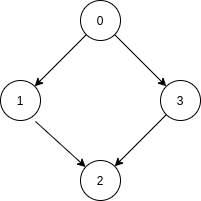
Here, all the paths that start from node 0 are -:
1. 0->1->2
2. 0->3->2
Both of these paths eventually end at node ‘2’ i.e node ‘DEST’. Thus we should return True.
Problem approach
The idea is to do Depth First Traversal of given directed graph.
Start the DFS traversal from source.
Keep storing the visited vertices in an array or HashMap say ‘path[]’.
If the destination vertex is reached, print contents of path[].
The important thing is to mark current vertices in the path[] as visited also so that the traversal doesn’t go in a cycle.
2. Check If Linked List Is Palindrome
Easy
15m average time
85% success
0/40
Asked in companies


You are given a Singly Linked List of integers. You have to return true if the linked list is palindrome, else return false.
A Linked List is a palindrome if it reads the same from left to right and from right to left.
Example:
The lists (1 -> 2 -> 1), (3 -> 4 -> 4-> 3), and (1) are palindromes, while the lists (1 -> 2 -> 3) and (3 -> 4) are not.
Problem approach
A simple solution is to use a stack of list nodes. This mainly involves three steps.
Traverse the given list from head to tail and push every visited node to stack.
Traverse the list again. For every visited node, pop a node from the stack and compare data of popped node with the currently visited node.
If all nodes matched, then return true, else false.
03
Round
Easy
Face to Face
Duration60 minutes
Interview date25 Nov 2022
Coding problem2
1. Convert a binary tree to its sum tree
Easy
15m average time
85% success
0/40
Asked in companies


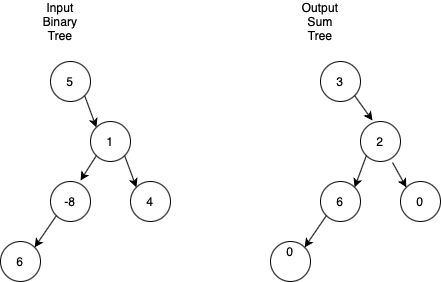
Given a binary tree of integers, you are supposed to modify the given binary tree to a sum tree where each node value is replaced by the sum of the values of both left and right subtrees in the given tree. The value of leaf nodes is changed to zero.
Example:
Below is the example showing the input tree and its sum tree.
Problem approach
Get the sum of nodes in the left subtree and right subtree. Check if the sum calculated is equal to the root’s data. Also, recursively check if the left and right subtrees are SumTrees.
2. Longest Common Subsequence
Moderate
0/80
Asked in companies


You have been given two Strings “STR1” and “STR2” of characters. Your task is to find the length of the longest common subsequence.
A String ‘a’ is a subsequence of a String ‘b’ if ‘a’ can be obtained from ‘b’ by deletion of several (possibly, zero or all) characters. A common subsequence of two Strings is a subsequence that is common to both Strings.
Problem approach
The idea is to use Hashing. We first insert all elements in a Set. Then check all the possible starts of consecutive subsequences.


Here's your problem of the day 
Solving this problem will increase your chance to get selected in this company
Skill covered: Programming
To make an AI less repetitive in a long paragraph, you should increase:
Choose another skill to practice
Similar interview experiences
Software Engineer
4 rounds | 7 problems
Interviewed by Cisco
 Selected
0 views

0 comments

0 upvotes
SDE - Intern
2 rounds | 4 problems
Interviewed by Cisco
Rejected
869 views
0 comments
0 upvotes
SDE - 1
3 rounds | 5 problems
Interviewed by Cisco
Rejected
834 views
0 comments
0 upvotes
SDE - 1
3 rounds | 5 problems
Interviewed by Cisco
Selected 968 views
0 comments
0 upvotes
Companies with similar interview experiences

System Engineer Specialist
4 rounds | 7 problems
Interviewed by Oracle
Rejected
0 views
0 comments
0 upvotes
System Engineer Specialist
3 rounds | 3 problems
Interviewed by Amazon
Rejected
955 views
0 comments
0 upvotes