





Citrix interview experience Real time questions & tips from candidates to crack your interview

Software Engineer
Citrix


4 rounds | 3 Coding
problems

 Selected
 Interview preparation journey

Preparation
Duration: 2 months
Topics: Data structures, Algorithms, Operating Systems, Database Management Systems, Object Oriented Programming

Tip 1 : Have good understanding of whatever is mentioned in your resume
Tip 2 : Have thorough knowledge in few subjects instead of superficial knowledge of many
Tip 3 : DSA questions in the test were of good level. Practise as much DSA as possible
Application process
Where: Campus
Eligibility: 7 CGPA
Tip 1 : Only keep those topics and projects in which you have good confidence
Tip 2 : Keep it simple and to the point

Interview rounds
01
Round
Hard
Online Coding Interview
Duration120 minutes
Interview date25 Jan 2021
Coding problem1
1. Dijkstra's shortest path
Easy
20m average time
70% success

0/40
Asked in companies



You have been given an undirected, connected graph of ‘V’ vertices (labelled from 0 to V-1) and ‘E’ edges. Each edge connecting two nodes 'u' and 'v' has a weight denoting the distance between them.
Your task is to find the shortest path distance from the source node 'S' to all the vertices. You have to return a list of integers denoting the shortest distance between each vertex and source vertex 'S'.
Note:
1. There are no self-loops(an edge connecting the vertex to itself) in the given graph.

2. There are no parallel edges i.e no two vertices are directly connected by more than 1 edge.
For Example:
Input:
4 5
0 1 5
0 2 8
1 2 9
1 3 2
2 3 6
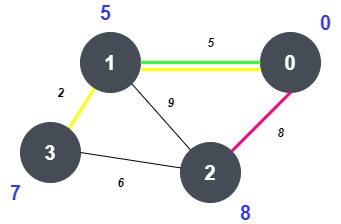
The source node is node 0.

The shortest distance from node 0 to node 0 is 0.

The shortest distance from node 0 to node 1 is 5. In the above figure, the green path represents this distance. The path goes from node 0->1, giving distance = 5.

The shortest distance from node 0 to node 2 is 8. In the above figure, the pink path represents this distance. The path goes from node 0->2, giving distance = 8.

The shortest distance from node 0 to node 3 is 7. In the above figure, the yellow path represents this distance. The path goes from node 0->1->3, giving distance = 7.
02
Round
Medium
Video Call
Duration80 minutes
Interview date5 Jan 2021
Coding problem1
1. Rectangular Numbers
Moderate
30m average time
70% success
0/80
Asked in companies



Ninja has a number ‘N’. He wants to print the pattern in such a way that the outer rectangle is of the number ‘N’ and the number goes on decreasing as we move inside the rectangles.
For example, if ‘N’ = 4, then pattern will be:
4 4 4 4 4 4 4
4 3 3 3 3 3 4
4 3 2 2 2 3 4
4 3 2 1 2 3 4
4 3 2 2 2 3 4
4 3 3 3 3 3 4
4 4 4 4 4 4 4
03
Round
Medium
Video Call
Duration60 minutes
Interview date5 Jan 2021
Coding problem1
1. The Skyline Problem
Hard
15m average time
85% success
0/120
Asked in companies



You are given 'N' rectangular buildings in a 2-dimensional city. Your task is to compute the skyline of these buildings, eliminating hidden lines return the skyline formed by these buildings collectively. A city's skyline is the outer contour of the silhouette formed by all the buildings in that city when viewed from a distance. The geometric information of each building is given in the array of buildings where BUILDINGS[i] = [LEFT_i, RIGHT_i, HEIGHT_i]:
-> LEFT_i is the x coordinate of the left edge of the ith building.
-> RIGHT_i is the x coordinate of the right edge of the ith building.
-> HEIGHT_i is the height of the ith building.
You may assume all buildings are perfect rectangles grounded on an absolutely flat surface at height 0.
The skyline should be represented as a list of "key points" sorted by their x-coordinate in the form [[x1, y1], [x2, y2], ...]. Each key point is the left endpoint of some horizontal segment in the skyline except the last point in the list, which always has a y-coordinate 0 and is used to mark the skyline's termination where the rightmost building ends. Any ground between the leftmost and rightmost buildings should be part of the skyline's contour.
Note:
There must be no consecutive horizontal lines of equal height in the output skyline. For instance, [...,[2 3], [4 5], [7 5], [11 5], [12 7],...] is not acceptable; the three lines of height 5 should be merged into one in the final output.

As such: [..., [2 3], [4 5], [12 7],...].

Also, the buildings are sorted by a non-decreasing order.

For more clarification see sample case 1.
04
Round
Medium
Video Call
Duration90 minutes
Interview date6 Jan 2021
Coding problem0
It was a managerial round. All the topics/ projects in my resume were questioned extensively. A range of topics were asked include os, dsa dbms, compiler design ,android, neural networks along with some HR style questions.


Here's your problem of the day 
Solving this problem will increase your chance to get selected in this company
Skill covered: Programming
How do you remove whitespace from the start of a string?
Choose another skill to practice
Similar interview experiences
SDE - 1
2 rounds | 4 problems
Interviewed by Citrix
 Selected
1710 views

0 comments

0 upvotes
Software Engineer
4 rounds | 7 problems
Interviewed by Citrix
Selected 1302 views
1 comments
0 upvotes
Software Engineer
3 rounds | 3 problems
Interviewed by Citrix
 Selected
 1931 views
0 comments
0 upvotes
SDE - 1
4 rounds | 9 problems
Interviewed by Citrix
Selected 1370 views
0 comments
0 upvotes
Companies with similar interview experiences

Software Engineer
3 rounds | 7 problems
Interviewed by Optum
 Selected
 8607 views
1 comments
0 upvotes

Software Engineer
5 rounds | 5 problems
Interviewed by Microsoft
 Selected
 11120 views
1 comments
0 upvotes

Software Engineer
2 rounds | 4 problems
Interviewed by Amazon
Selected 5208 views
1 comments
0 upvotes