





CityMall interview experience Real time questions & tips from candidates to crack your interview
SDE - Intern
CityMall


2 rounds | 3 Coding
problems

Rejected
Interview preparation journey

Preparation
Duration: 4 months
Topics: Data Structures, Algorithms, Aptitude, OOPS

Tip 1: Must do Previously asked Interviews as well as Online Test Questions.
Tip 2: Must have good knowledge of DSA
Tip 3: Do at least 2 good projects and you must know every bit of them.
Application process
Where: Referral
Eligibility: Good Knowledge of Backend Development
Tip 1: Have at least 2 good projects explained in short with all important points covered.
Tip 2: Every skill must be mentioned.
Tip 3: Focus on skills, projects, and experiences more.

Interview rounds
01
Round
Hard
Video Call
Duration60 mins
Interview date5 Jan 2022
Coding problem2
Those who cleared the Backend Assignment(Backend for a shopping site) for CityMall were called for interview. The interview asked pretty good questions for testing knowledge of coding. lots of questions were asked on projects, resume, Assignment.
1. Ayush and Expression
Moderate
25m average time
75% success

0/80
Asked in companies


Ayush read about irreducible fractions in the school and made an expression ‘EXPRESSION’ of fraction addition and subtraction.
Note:
An irreducible fraction is a fraction in which the numerator and denominator are integers that have no other common divisors than 1.

Example: 2/3, 8/9, 0/1 are irreducible fractions, where 8/12, 9/12 are not irreducible fractions.
Expression ‘EXPRESSION’ contains integers from '0' to '9', and characters '/', '+' and '-'.
Each fraction will be an irreducible fraction and will be in the format of ±(numerator/denominator).
Ayush does not know how to solve the expression he made, so he gave you the expression to solve. Your task is to solve the expression.
Note:
Ayush expects your answer to be an irreducible fraction, so if your answer is an integer, convert it into an irreducible fraction by putting 1 in the denominator.

For example, if your answer is "9", then print "9/1" (without quotes).
2. Palindrome Pairs
Moderate
25m average time
75% success
0/80
Asked in companies



You are given a list of ‘N’ words ‘WORDS’. Your task is to return all pairs of the distinct indices (i, j) in ‘WORDS’, such that the concatenation of WORDS[i] and WORDS[j] is a palindrome.
For Example:
You are given ‘WORDS’ = [“cat”, “mat”, “tac”]. Then the answer will be [(0, 2), (2, 0)}, because “cat” + “tac” = “cattac” which is a palindrome and “tac” + “cat” = “taccat” which is also a palindrome.
Problem approach
Build a HashMap to store the String-idx pairs.
Case1: If s1 is a blank string, then for any string that is palindrome s2, s1+s2 and s2+s1 are palindrome.
Case 2: If s2 is the reversing string of s1, then s1+s2 and s2+s1 are palindrome.
Case 3: If s1[0:cut] is palindrome and there exists s2 is the reversing string of s1[cut+1:] , then s2+s1 is palindrome.
Case 4: Similiar to case3. If s1[cut+1: ] is palindrome and there exists s2 is the reversing string of s1[0:cut] , then s1+s2 is palindrome.
02
Round
Medium
Video Call
Duration60 mins
Interview date7 Jan 2022
Coding problem1
This round was more of a hiring manager round where my backend knowledge is tested and question on my my past project tech stack was asked followed by an easy coding question.
1. Intersection of Two Linked Lists
Easy
25m average time
73% success
0/40
Asked in companies



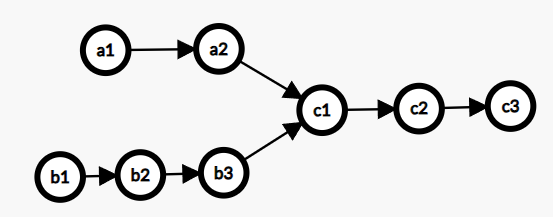
You are given two Singly Linked Lists of integers, which may have an intersection point.
Your task is to return the first intersection node. If there is no intersection, return NULL.
Example:-
The Linked Lists, where a1, a2, c1, c2, c3 is the first linked list and b1, b2, b3, c1, c2, c3 is the second linked list, merging at node c1.
Problem approach
In the first iteration, we will reset the pointer of one linkedlist to the head of another linkedlist after it reaches the tail node. In the second iteration, we will move two pointers until they points to the same node. Our operations in first iteration will help us counteract the difference. So if two linkedlist intersects, the meeting point in second iteration must be the intersection point. If the two linked lists have no intersection at all, then the meeting pointer in second iteration must be the tail node of both lists, which is null


Here's your problem of the day 
Solving this problem will increase your chance to get selected in this company
Skill covered: Programming
How do you remove whitespace from the start of a string?
Choose another skill to practice
Similar interview experiences

SDE - 1
3 rounds | 7 problems
Interviewed by OYO
 Selected
6182 views

0 comments

0 upvotes
SDE - Intern
2 rounds | 3 problems
Interviewed by CityMall
Rejected
1004 views
0 comments
0 upvotes

SDE - 1
2 rounds | 5 problems
Interviewed by Meesho
Rejected
7245 views
0 comments
0 upvotes

SDE - 1
3 rounds | 9 problems
Interviewed by Salesforce
 Selected
 4552 views
0 comments
0 upvotes
Companies with similar interview experiences

SDE - Intern
2 rounds | 4 problems
Interviewed by Arcesium
 Selected
 3915 views
0 comments
0 upvotes
SDE - Intern
3 rounds | 5 problems
Interviewed by Arcesium
Selected 2888 views
0 comments
0 upvotes

SDE - Intern
3 rounds | 5 problems
Interviewed by BNY Mellon
 Selected
 2483 views
0 comments
0 upvotes