





Cognizant interview experience Real time questions & tips from candidates to crack your interview

SDE - 1
Cognizant


2 rounds | 6 Coding
problems

 Selected
 Interview preparation journey

Journey
I am an Information and communication student passionate about technology and programming. I spent countless hours studying, practicing coding, and working on personal projects to enhance his skills. In my final year of college, I started to apply for IT jobs at various companies.
I quickly realized that getting a job in the highly competitive IT industry would not be easy. I faced rejections and struggled to stand out among the many other applicants. However, I did not give up and continued to work hard and improve his skills.
I received an interview invitation from our college regarding Cognizant On campus hiring. I spent days researching the company, practicing interview skills, and preparing for potential questions.
During the interview, I was able to showcase my strong technical skills and ability to think critically and problem-solve. I also emphasized his passion for technology and willingness to continuously learn and improve. The interviewer was impressed with my skills and enthusiasm and offered me a position in the company.
I think my hard work and dedication had paid off. I believe that with the right mindset and skills, anyone can succeed in this highly competitive field.
Application story
Applying for the Drive: Once the company announces the on-campus drive, I applied through my college's placement cell. I submitted my resume and any other required documents.
Pre-Placement Talk: The company conducted a pre-placement talk where they provided an overview of their company, products, and services. This was a great opportunity to learn more about the company and ask any questions I had.
Aptitude Test: The company then conducted an aptitude test to assess my logical, quantitative, and reasoning skills.
Technical Interview + HR: I clear the aptitude test, and I got called for a technical interview.
Why selected/rejected for the role?
here are some possible reasons why I may be selected for this role:
Technical Skills: Having strong technical skills is often a key requirement for IT roles. I had relevant technical skills and experience in the required programming languages, tools, and frameworks.
Soft Skills: Soft skills such as communication, problem-solving, teamwork, and adaptability are also important aspects.
Preparation
Duration: 6 months
Topics: Programming Languages: To work in the IT industry, you should be proficient in at least one programming language such as Java, Python, C++, or JavaScript,Data Structures and Algorithms: This is a crucial topic for IT job interviews. You should be familiar with common data structures such as arrays, linked lists, and trees, as well as algorithms such as sorting and searching,Operating Systems: An understanding of how operating systems work is essential for many IT jobs. You should be familiar with concepts such as memory management, process management, and file systems,Networking: Knowledge of computer networking is important for IT jobs that involve developing and maintaining the network infrastructure. You should be familiar with concepts such as TCP/IP, routing, and switching,Databases: Many IT jobs require a strong understanding of databases and SQL. You should be comfortable working with relational databases, understanding data modeling, and using SQL to query data.

Tip 1 : Research the Company: Before your interview, research the company thoroughly. Understand their business, products, and services. This will help you to understand their needs and align your skills and experiences with their requirements.
Tip 2 : Practice Coding: Practicing coding problems is a great way to prepare for IT job interviews. There are many online resources available where you can find coding challenges and practice problems. This will help you improve your coding skills and prepare for technical interviews.
Tip 3 : Review Your Resume: Make sure your resume is up-to-date and highlights your relevant experiences and skills
Application process
Where: Campus
Eligibility: Students should possess consistent academic record with 60% or greater in X, XII, Diploma, UG & PG (all subjects will be taken into consideration) calculated as below. – Aggregate% = sum of all subjects marks scored / total no. of subjects (as of 5th semester result declared) • Students with standing arrears or more than 2 years gap in education are not eligible • At the time of joining, recruits should have an overall aggregate score of 60% or greater (all subjects will be taken into consideration) with no standing arrears • Aggregate for the Students who have applied for re-evaluation (and are waiting for the results) will be derived based on the initial scores • CGPA to % conversion will be considered as per University norms • Opportunities are open to Indian nationals/OCIs/ PIOs who are currently residing in India only • Students should be of 18-28 years of age to apply
Tip 1:Tailor Your Resume: Tailor your resume to the specific job you are applying for. Highlight the skills and experiences that are most relevant to the job.
Tip 2: Showcase Projects: Showcase any relevant projects you have worked on. This will give the recruiter an idea of your practical skills and how you have applied your knowledge in real-world scenarios.
Tip 3:Highlight Technical Skills: Highlight your technical skills and experience in the field. List the programming languages, frameworks, and tools you are proficient in.
Interview rounds
01
Round
Medium
Online Coding Interview
Duration90 mins
Interview date6 Apr 2023
Coding problem2
Timing: The round was conducted for 90 minutes from 2 PM.
Environment: As it was an online round, the environment would depend on the individual candidates. However, I recommended taking the test in a quiet and distraction-free environment with a stable internet connection.
Coding Questions: The coding round had two questions, which I had to solve within the given time frame. The questions were based on any programming language, and I was expected to write efficient code that could pass all the test cases.
Aptitude MCQ: Along with the coding questions, the round also included multiple-choice questions (MCQs) on aptitude. These questions covered a wide range of topics such as quantitative aptitude, logical reasoning, verbal ability, and data interpretation.
1. Move All Negative Numbers To Beginning And Positive To End
Easy
10m average time
90% success

0/40
Asked in companies



You are given an array 'ARR' consisting of 'N' integers. You need to rearrange the array elements such that all negative numbers appear before all positive numbers.
Note:
The order of elements in the resulting array is not important.
Example:
Let the array be [1, 2, -3, 4, -4, -5]. On rearranging the array such that all negative numbers appear before all positive numbers we get the resulting array [-3, -5, -4, 2, 4, 1].
Problem approach
Initialize two pointers, 'left' and 'right'. The 'left' pointer will initially point to the first element of the array, and the 'right' pointer will initially point to the last element of the array.
Repeat the following until the 'left' pointer is less than or equal to the 'right' pointer:
a. If the value at the 'left' pointer is negative, move the 'left' pointer one position to the right.
b. If the value at the 'right' pointer is positive, move the 'right' pointer one position to the left.
c. If the value at the 'left' pointer is positive and the value at the 'right' pointer is negative, swap the values and then move the 'left' pointer one position to the right and the 'right' pointer one position to the left.
When the 'left' pointer is greater than the 'right' pointer, all negative numbers will be at the beginning of the array, and all positive numbers will be at the end of the array.
2. Check Permutation
Easy
15m average time
85% success
0/40
Asked in companies



You have been given two strings 'STR1' and 'STR2'. You have to check whether the two strings are anagram to each other or not.
Note:
Two strings are said to be anagram if they contain the same characters, irrespective of the order of the characters.
Example :
If 'STR1' = “listen” and 'STR2' = “silent” then the output will be 1.

Both the strings contain the same set of characters.
Problem approach
Convert both strings to lowercase or uppercase to ensure case insensitivity.
Remove all whitespace and punctuation marks from both strings using regular expressions.
Convert both strings to arrays of characters.
Sort both arrays of characters in ascending order.
Compare both arrays of characters. If they are equal, the original strings are anagrams of each other. Otherwise, they are not.
02
Round
Medium
Video Call
Duration60 mins
Interview date22 Sep 2022
Coding problem4
Introduction: The interview started with the interviewer asking me to introduce myself briefly. I mentioned my name, my education, my skills, and my career aspirations.
Project Discussion: The interviewer then asked me to explain one of the projects I had mentioned on my resume. I briefly described the project, its purpose, and the role I played in it. The interviewer asked me some technical questions related to the project to gauge my understanding of the technology stack I had used.
Coding Question + CS fundamentals: The interviewer then presented me with a coding question related to arrays. I was given a few minutes to think about the solution and then asked to write the code. The interviewer was looking for my problem-solving approach, coding skills, and ability to write clean and efficient code. After solving the coding question I was asked basic questions from OS, DBMS, and CN.
HR Questions: After the coding question, the interviewer asked me some basic HR questions related to my strengths, weaknesses, and how I handle challenging situations at work. The questions were aimed at understanding my personality, communication skills, and how I would fit into the company culture.
Overall, the interview was a mix of technical and HR questions. The technical questions were designed to assess my knowledge and skills in the relevant technologies, while the HR questions were aimed at understanding my personality and work ethic. The interviewer was friendly and supportive throughout the interview, and I felt comfortable discussing my experiences and answering the questions.
1. Intersection of Two Linked Lists
Easy
25m average time
73% success
0/40
Asked in companies


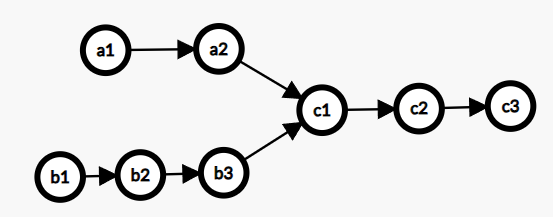
You are given two Singly Linked Lists of integers, which may have an intersection point.
Your task is to return the first intersection node. If there is no intersection, return NULL.
Example:-
The Linked Lists, where a1, a2, c1, c2, c3 is the first linked list and b1, b2, b3, c1, c2, c3 is the second linked list, merging at node c1.
Problem approach
Create two empty sets, one for storing the union of the two linked lists, and the other for storing the intersection of the two linked lists.
Traverse the first linked list and add each node's value to the union set. Also, add the node's value to the intersection set only if the same value is present in the second linked list.
Traverse the second linked list and add each node's value to the union set. Also, add the node's value to the intersection set only if the same value is already present in the union set.
The union set now contains all the distinct values from both linked lists, while the intersection set contains only the common values.
Create two new linked lists, one for the union, and the other for the intersection.
Traverse the union set and create a new node for each value. Add the node to the union linked list.
Traverse the intersection set and create a new node for each value. Add the node to the intersection linked list.
Return both the union and intersection linked lists.
2. OS Questions
What is an operating system, and what are its key functions?
Explain the differences between a kernel and a shell.
Describe the process of virtual memory management in an operating system.
Problem approach
Tip for Que 1:When answering this question, it's important to remember that an operating system (OS) is a software system that manages computer hardware and software resources and provides common services for computer programs. Its key functions include:
Managing memory and process resources
Providing security and protection for system resources
Managing input/output operations
Providing a user interface for interaction with the system
Providing networking capabilities
When answering this question, be sure to touch on each of these key functions and provide examples of how they work in an OS.
Tip for Que 2: The kernel is the core component of an operating system that provides low-level services to other parts of the system. The shell is a command-line interface that allows users to interact with the operating system.
When answering this question, explain the roles of both the kernel and the shell in an operating system, and provide examples of how they work together. Emphasize that the kernel is responsible for managing system resources and providing services to other parts of the system, while the shell is responsible for accepting user commands and executing them.
Tip for Que 3: Virtual memory is a technique used by operating systems to allow a computer to use more memory than it physically has available. It works by temporarily transferring data from RAM to disk storage when it is not actively being used.
When answering this question, explain the basic steps involved in virtual memory management, including:
Mapping virtual memory addresses to physical memory locations
Allocating and deallocating memory as needed
Managing page faults when data needs to be retrieved from disk storage
Implementing page replacement algorithms to determine which data to remove from physical memory when space is needed
Provide examples of these steps in action and explain the benefits of using virtual memory in an operating system.
3. DBMS Questions
Describe the difference between a database and a DBMS.
What is normalization, and why is it important in database design?
What is a transaction, and why is it important in database management?
Describe the ACID properties of a transaction.
Problem approach
Tip for Que 1: A database is a collection of related data, while a DBMS is a software system that manages the storage, organization, retrieval, security, and integrity of that data. When answering this question, provide a clear explanation of both terms and emphasize the role of the DBMS in managing the database. Be sure to touch on the different types of DBMS, such as relational, object-oriented, and NoSQL, and provide examples of each.
Tip for Que 2: Normalization is the process of organizing data in a database to minimize redundancy and dependency. It is important in database design because it helps to reduce data anomalies, improve data consistency, and increase data integrity. When answering this question, explain the different levels of normalization (1NF, 2NF, 3NF, etc.) and provide examples of how normalization can be applied to a database schema.
Tip for Que 3:A transaction is a sequence of database operations that are treated as a single unit of work. It is important in database management because it ensures that changes to the database are made in a consistent and atomic manner, meaning that either all of the changes are applied or none of them are. When answering this question, explain the different types of transactions (read-only, read-write, distributed) and provide examples of how transactions can be used in a database.
Tip for Que 4:The ACID properties are a set of characteristics that define a reliable transaction in a database:
Atomicity: the transaction is treated as a single unit of work, and either all of the changes are applied or none of them are.
Consistency: the transaction must bring the database from one valid state to another.
Isolation: the changes made by a transaction are not visible to other transactions until they are committed.
Durability: once a transaction is committed, its changes are permanent and cannot be undone.
When answering this question, provide a clear explanation of each property and give examples of how they ensure the reliability of a transaction.
4. HR Questions
Can you give an example of a time when you went above and beyond for a project or task?
How do you prioritize and manage your workload?
How do you handle conflicts with colleagues or superiors?
Problem approach
Tip for Que 1: When answering this question, choose an example that demonstrates your work ethic, creativity, and commitment to achieving results. Describe the situation, the actions you took, and the impact of your efforts. Be specific and quantify your achievements where possible. For example, you could talk about a project where you took on additional responsibilities, worked long hours, or found a new and innovative solution to a problem.
Tip for Que 2: This question is designed to assess your organizational skills, time management, and ability to work efficiently under pressure. When answering, describe your process for prioritizing tasks, such as using a to-do list, assessing deadlines, or evaluating the importance and urgency of each task. Explain how you ensure that you meet deadlines and maintain high quality work, such as by breaking down larger projects into smaller tasks, delegating where appropriate, or asking for help if needed.
Tip for Que 3: Conflict resolution is an important skill in any workplace, and this question aims to assess your ability to work collaboratively with others. When answering, describe a situation where you had a conflict with a colleague or superior, and explain how you resolved the conflict in a professional and constructive manner. Emphasize your ability to listen actively, communicate effectively, and find common ground. Also, mention how you strive to maintain positive relationships with colleagues and superiors, even in challenging situations.


Here's your problem of the day 
Solving this problem will increase your chance to get selected in this company
Skill covered: Programming
To make an AI less repetitive in a long paragraph, you should increase:
Choose another skill to practice
Similar interview experiences
SDE - 1
2 rounds | 5 problems
Interviewed by Cognizant
Selected 
1745 views

1 comments

0 upvotes
SDE - 1
2 rounds | 6 problems
Interviewed by Cognizant
Selected 1759 views
0 comments
0 upvotes
SDE - 1
2 rounds | 4 problems
Interviewed by Cognizant
Rejected
971 views
0 comments
0 upvotes
SDE - 1
3 rounds | 9 problems
Interviewed by Cognizant
Selected 909 views
0 comments
0 upvotes
Companies with similar interview experiences
SDE - 1
1 rounds | 2 problems
Interviewed by Tata Consultancy Services (TCS)
Rejected
0 views
0 comments
0 upvotes
SDE - 1
3 rounds | 4 problems
Interviewed by Tata Consultancy Services (TCS)
Selected 6876 views
0 comments
0 upvotes

SDE - 1
2 rounds | 3 problems
Interviewed by BNY Mellon
 Selected
 6240 views
3 comments
0 upvotes