





CTS interview experience Real time questions & tips from candidates to crack your interview
Genc Next
CTS


3 rounds | 7 Coding
problems
 Selected
 Interview preparation journey

Preparation
Duration: 5 months
Topics: Data Structures , Algorithms , SQL , DBMS , Operating Systems , Computer Networks

Tip 1 : Start with DSA and practice it well . Try to learn the basics of things as basics are very important Complex topics are just combinations of basic topics only. Try to see the process behind various algorithms and try to visualize it..
Tip 2 : When applying as a fresher it's like crucial to have good developmental skills. I will suggest to start with Web Development (preferably MERN Stack) and try to make some decent projects.
Tip 3 : Never forget to put your project on Github etc and if practising on online platform make sure to attach those links in resume.
Tip 4 : Also, practice SQL queries and Oops concepts well. They are widely asked.
Application process
Where: Campus
Eligibility: 6 CGPA
Tip 1 : Try not to put fake projects. Basic and your own projects are better than faking it.
Tip 2 : Try to put link of your profiles i.e. whichever is applicable to you.
Tip 3 : Don't mention much about Extra curricular or the stuff company doesn't need. Try to make your resume in sync with company's Job description.

Interview rounds
01
Round
Easy
Online Coding Interview
Duration120 minutes
Interview date22 Jul 2022
Coding problem2
MCQ Questions regarding OOPS , OS , DBMS AND COMPUTER NETWORKS.
2 Coding Questions and 2 SQL queries.
1. Print Permutations - String
Easy
30m average time
80% success

0/40
Asked in companies



You are given an input string 'S'. Your task is to find and return all possible permutations of the input string.
Note:
1. The input string may contain the same characters, so there will also be the same permutations.

2. The order of permutation does not matter.
Problem approach
Step 0 : I solved it using backtracking algorithm.
Step 1 : Fix a character in the first position and swap the rest of the character with the first character. Like in ABC, in the first iteration three strings are formed: ABC, BAC, and CBA by swapping A with A, B and C respectively.
Step 2 : Repeat step 1 for the rest of the characters like fixing second character B and so on.
Step 3 : Now swap again to go back to the previous position. E.g., from ABC, we formed ABC by fixing B again, and we backtrack to the previous position and swap B with C. So, now we got ABC and ACB.
Step 4 : Repeat these steps for BAC and CBA, to get all the permutations.
Algorithm :
1) Define a string.
2) Fix a character and swap the rest of the characters.
3) Call the generatePermutation() for rest of the characters.
4) Backtrack and swap the characters again.
2. Maximum width of a Binary Tree
Easy
15m average time
80% success
0/40
Asked in companies



You are given an arbitrary binary tree consisting of N nodes, where each node is associated with a certain value, your task is to find the maximum width of the given tree.
Width of a binary tree is defined as the maximum width of all levels.
For example, consider the following binary tree:
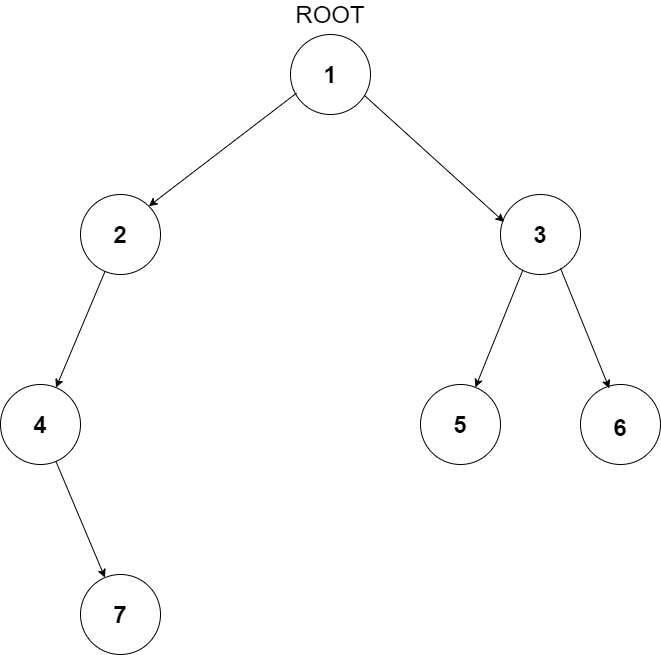
For the above tree, width of level 1 is 1, width of level 2 is 2, width of level 3 is 3 and width of level 4 is 1. So the maximum width of the tree is 3.
Problem approach
Step 0 : To find out the maximum width of the binary tree. The width of the binary tree is the number of nodes present in any level. So, the level which has the maximum number of nodes will be the maximum width of the binary tree. To solve this problem, traverse the tree level-wise and count the nodes in each level.
Step 1 : Define Node class which has three attributes namely: data left and right. Here, left represents the left child of the node and right represents the right child of the node.
Step2 : When a node is created, data will pass to data attribute of the node and both left and right will be set to null.
Step 3 : Define another class which has an attribute root.
Root represents the root node of the tree and initializes it to null.
Step 4 : findMaximumWidth() will find out the maximum width of the given binary tree:
4.1)Variable maxWidth will store the maximum number of nodes present in any level.
4.2)The queue is used for traversing binary tree level-wise.
4.3)It checks whether the root is null, which means the tree is empty.
4.4)f not, add the root node to queue. Variable nodesInLevel keeps track of the number of nodes in each level.
4.5)If nodesInLevel > 0, remove the node from the front of the queue and add its left and right child to the queue. For the first iteration, node 1 will be removed and its children nodes 2 and 3 will be added to the queue. In the second iteration, node 2 will be removed, its children 4 and 5 will be added to the queue and so on.
4.6)MaxWidth will store max(maxWidth, nodesInLevel). So, at any given point of time, it will represent the maximum number of nodes.
4.7)This will continue till all the levels of the tree is traversed.
02
Round
Easy
Video Call
Duration45 minutes
Interview date12 Aug 2022
Coding problem4
Basics questions around Oops , DBMS , SQL , OS , 2 puzzles and 2 codes.
It took place virtually and at 11:00 am. The interviewer was friendly in nature and started with introduction and some general stuff about my interests related to tech. The interview went smoothly.
1. Operating System
- What do you mean by process synchronization?
- What do you mean by overlays in OS?
- What is a process? What are the different states of a process?
- What is thrashing in OS?
- Explain zombie process?
Problem approach
Tip 1 : Try to give relevant examples as well.
Tip 2 : Study and go through basics of OS.
2. DBMS
- What is meant by ACID properties in DBMS?
- What is a lock? Explain the major difference between a shared lock and an exclusive lock during a transaction in a database.
- Explain different types of Normalization forms in a DBMS.
Problem approach
Tip 1 : Study and go through basics of DBMS.
3. Reverse The Array
Easy
15m average time
85% success
0/40
Asked in companies



Given an array/list 'ARR' of integers and a position ‘M’. You have to reverse the array after that position.
Example:
We have an array ARR = {1, 2, 3, 4, 5, 6} and M = 3 , considering 0
based indexing so the subarray {5, 6} will be reversed and our
output array will be {1, 2, 3, 4, 6, 5}.
Problem approach
I first used the iterative method to solve.
Iterative way :
1) Initialize start and end indexes as start = 0, end = n-1
2) In a loop, swap arr[start] with arr[end] and change start and end as follows :
start = start +1, end = end – 1
Then interviewer asked to code recursively. Then i used recursive method
Recursive Way :
1) Initialize start and end indexes as start = 0, end = n-1
2) Swap arr[start] with arr[end]
3) Recursively call reverse for rest of the array.
4. Move Zeroes To End
Moderate
30m average time
70% success
0/80
Asked in companies


Given an unsorted array of integers, you have to move the array elements in a way such that all the zeroes are transferred to the end, and all the non-zero elements are moved to the front. The non-zero elements must be ordered in their order of appearance.
For example, if the input array is: [0, 1, -2, 3, 4, 0, 5, -27, 9, 0], then the output array must be:
[1, -2, 3, 4, 5, -27, 9, 0, 0, 0].
Expected Complexity: Try doing it in O(n) time complexity and O(1) space complexity. Here, ‘n’ is the size of the array.
Problem approach
I used the partioning of array . it goes like :
I use 0 as a pivot element and whenever I see a non zero element I will swap it with the pivot element. So all the non zero element will come at the beginning.
03
Round
Easy
HR Round
Duration20 minutes
Interview date24 Aug 2022
Coding problem1
Basics Questions were aked about my interests.
The interview took place in morning at 10:30 am and the environment was relaxed and interview went well.
Also, they verified me by asking for aadhar card , college marksheets and college Id.
1. Basic HR Questions
- Why we should hire you?
- What do you know about Cognizant?
- In which tech you are more inclined towards?
- You want to know something from us?
- If you are working in a team and a two colleagues then what will you do ?
- If you were told to work on a technology you have no prior knowledge then what course of actions will you take ?
Problem approach
Tip 1 : Be relaxed and try to speak your mind loud.
Tip 2 : Don't panic and remember for some behavioural sometimes there's no right or wrong. So, don't panic. They just want to check your thought process.


Here's your problem of the day 
Solving this problem will increase your chance to get selected in this company
Skill covered: Programming
How do you remove whitespace from the start of a string?
Choose another skill to practice
Similar interview experiences
SDE - 1
3 rounds | 7 problems
Interviewed by OYO
 Selected
6182 views

0 comments

0 upvotes
SDE - Intern
2 rounds | 3 problems
Interviewed by Amazon
Rejected
1565 views
0 comments
0 upvotes

SDE - 1
2 rounds | 5 problems
Interviewed by Meesho
Rejected
7245 views
0 comments
0 upvotes

SDE - 1
3 rounds | 9 problems
Interviewed by Salesforce
 Selected
 4552 views
0 comments
0 upvotes