





Cvent interview experience Real time questions & tips from candidates to crack your interview

SDE - Intern
Cvent


4 rounds | 7 Coding
problems
 Selected
 Interview preparation journey

Journey
Working for an MNC was something I always looked forward to, and an interview at Microsoft was an on-campus opportunity for me. Road to start practicing coding in the middle of sophomore year. To see what my coding skills were like, I started doing basic problems on various portals, including Coding ninjas, Leetcode, Gfg. However, at that time it did not solve the core problem of DSA. Then I started following a YouTube channel with about 150 issues specifically created for placements and internships. Which YouTube course or channel you choose is up to you. In my fifth semester, they started hiring a company for our industrial semester.This was the first one I gave them.
Application story
Cvent India came for on campus for heiring of SDE intern at my college (NIT kurukshetra)
They just shortlisted students for 1st online tese on the basis of resumes and cgpa.
Why selected/rejected for the role?
i was rejected due to my poor communication skills at i'm not able to explain things to the interviewer, so i look confuse at that time
Preparation
Duration: 3 months
Topics: Data Structures, Operating System, OOPS, Project, CN

Tip 1 : Data Structures
Tip 2 : Interview Experience by my seniors
Tip 3 : Project
Application process
Where: Campus
Tip 1 : Must have good project
Tip 2 : Mention your skills

Interview rounds
01
Round
Medium
Online Coding Interview
Duration60 minutes
Interview date10 Oct 2021
Coding problem1
1. Maximum Subarray Sum
Moderate
25m average time
75% success

0/80
Asked in companies



Given an array of numbers, find the maximum sum of any contiguous subarray of the array.
For example, given the array [34, -50, 42, 14, -5, 86], the maximum sum would be 137, since we would take elements 42, 14, -5, and 86.
Given the array [-5, -1, -8, -9], the maximum sum would be -1.
Follow up: Do this in O(N) time.
02
Round
Easy
Online Coding Test
Duration30 minutes
Interview date10 Oct 2022
Coding problem1
A coding round of 3 minutes containing one Question of dynamic programming
1. Longest Repeating Subsequence
Moderate
15m average time
85% success
0/80
Asked in companies


You are given a string ‘st’, Your task is to find the length of the longest repeating subsequence such that two subsequences don’t have the same character at the same position.
For Example :
The given string st = AABCBDC.
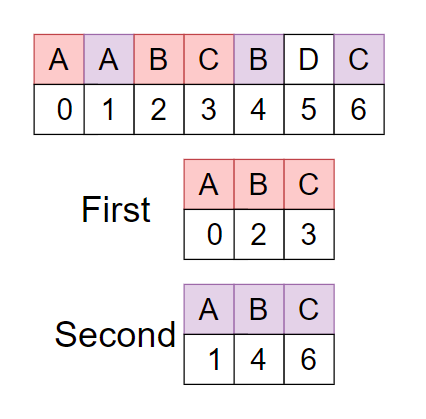
As you can see there are two repeating longest subsequences “ABC” with the same character but different position. Therefore the required answer is ‘3’ as the length of “ABC” is 3.
Problem approach
int LongestRepeatingSubsequence(string str){
int n=str.length();
string str1=str;
string str2=str;
int t[n+1][n+1];
for(int i=0;i for(int j=0;j if(i==0){
t[i][j]=0;
}
if(j==0){
t[i][j]=0;
}
}
}
for(int i=1;i for(int j=1;j if(str1[i-1]==str2[j-1] && i!=j){
t[i][j]=1+t[i-1][j-1];
}
else{
t[i][j]=max(t[i-1][j],t[i][j-1]);
}
}
}
return t[n][n];
}
03
Round
Easy
Video Call
Duration45 minutes
Interview date11 Oct 2022
Coding problem2
Interviewer was very good he asked some basic question about me and my college and then gave me two dsa problem to solve
1. Find all occurrences
Moderate
35m average time
60% success
0/80
Asked in companies



You are given a 'M' x 'N' matrix of characters, 'CHARACTER_MATRIX' and a string 'WORD'. Your task is to find and print all occurrences of the string in the given character matrix. You are allowed to search the string in all eight possible directions, i.e. North, South, East, West, North-East, North-West, South-East, South-West.
Note: There should not be any cycle in the output path. The entire string must lie inside the matrix boundary. You should not jump across boundaries, i.e. from row 'N' - 1 to 0 or column 'N' - 1 to 0 or vice versa.
Example:
Consider below matrix of characters,
[ 'D', 'E', 'X', 'X', 'X' ]
[ 'X', 'O', 'E', 'X', 'E' ]
[ 'D', 'D', 'C', 'O', 'D' ]
[ 'E', 'X', 'E', 'D', 'X' ]
[ 'C', 'X', 'X', 'E', 'X' ]

If the given string is "CODE", below are all its occurrences in the matrix:

'C'(2, 2) 'O'(1, 1) 'D'(0, 0) 'E'(0, 1)
'C'(2, 2) 'O'(1, 1) 'D'(2, 0) 'E'(3, 0)
'C'(2, 2) 'O'(1, 1) 'D'(2, 1) 'E'(1, 2)
'C'(2, 2) 'O'(1, 1) 'D'(2, 1) 'E'(3, 0)
'C'(2, 2) 'O'(1, 1) 'D'(2, 1) 'E'(3, 2)
'C'(2, 2) 'O'(2, 3) 'D'(2, 4) 'E'(1, 4)
'C'(2, 2) 'O'(2, 3) 'D'(3, 3) 'E'(3, 2)
'C'(2, 2) 'O'(2, 3) 'D'(3, 3) 'E'(4, 3)
Problem approach
int countOccurrences(char *str,
string word)
{
char *p;
vector a;
p = strtok(str, " ");
while (p != NULL)
{
a.push_back(p);
p = strtok(NULL, " ");
}
int c = 0;
for (int i = 0; i < a.size(); i++)
if (word == a[i])
c++;
return c;
}
2. Find All Anagrams in a String
Easy
15m average time
85% success
0/40
Asked in companies



You have been given a string STR and a non-empty string PTR. Your task is to find all the starting indices of PTR’s anagram in STR.
An anagram of a string is another string which contains the same characters and is obtained by rearranging the characters.
For example: ‘SILENT’ and ‘LISTEN’ are anagrams of each other. ‘ABA’ and ‘ABB’ are not anagram because we can’t convert ‘ABA’ to ‘ABB’ by rearranging the characters of particular strings.
Note:
1. Both STR and PTR consist of English uppercase letters.
2. Length of string 'STR' will always be greater than or equal to the length of string ‘PTR’.
3. In case, there is no anagram substring, then return an empty sequence.
4. In case of more than one anagrams, return the indices in increasing order.
Problem approach
bool areAnagram(string str1, string str2)
{
int n1 = str1.length();
int n2 = str2.length();
if (n1 != n2)
return false;
sort(str1.begin(), str1.end());
sort(str2.begin(), str2.end());
for (int i = 0; i < n1; i++)
if (str1[i] != str2[i])
return false;
return true;
}
04
Round
Easy
Video Call
Duration60 minutes
Interview date11 Oct 2022
Coding problem3
1. Reverse Words In A String
Easy
10m average time
90% success
0/40
Asked in companies


You are given a string 'str' of length 'N'.
Your task is to reverse the original string word by word.
There can be multiple spaces between two words and there can be leading or trailing spaces but in the output reversed string you need to put a single space between two words, and your reversed string should not contain leading or trailing spaces.
Example :
If the given input string is "Welcome to Coding Ninjas", then you should return "Ninjas Coding to Welcome" as the reversed string has only a single space between two words and there is no leading or trailing space.
Problem approach
class Solution {
private:
void reverse(string &s, int i, int j){
while(i char temp=s[i];
s[i++]=s[j];
s[j--]=temp;
}
}
public:
string reverseWords(string &s) {
int i=0, j=0;
int l=0;
int len=s.length();
int wordcount=0;
while(true){
while(i if(i==len) break;
if(wordcount) s[j++]=' ';
l=j;
while(i reverse(s,l,j-1);
wordcount++;
}
s.resize(j);
reverse(s,0,j-1);
return s;
}
};
2. Puzzle
There are 4 persons (A, B, C and D) who want to cross a bridge in night.
A takes 1 minute to cross the bridge.
B takes 2 minutes to cross the bridge.
C takes 5 minutes to cross the bridge.
D takes 8 minutes to cross the bridge.
There is only one torch with them and the bridge cannot be crossed without the torch. There cannot be more than two persons on the bridge at any time, and when two people cross the bridge together, they must move at the slower person’s pace.
Problem approach
Step 1 : A and B cross the bridge. A comes back. Time taken 3 minutes. Now B is on the other side.
Step 2 : C and D cross the bridge. B comes back. Time taken 8 + 2 = 10 minutes. Now C and D are on the other side.
Step 3 : A and B cross the bridge. Time taken is 2 minutes. All are on the other side.
Total time spent: 3 + 10 + 2 = 15 minutes.
3. Puzzle
Find the last ball to remain after the entire process
Problem Statement: You have 20 Red and 16 Blue balls in a bag. You pull out 2 balls one after another. If the balls are of the same color, then you replace them with a Blue ball – but if they are of different color, you replace them with a Red ball. Once you take out the balls, you do not put them back in the bag – so the balls keep reducing. What would be the color of the last ball remaining in the bag?
Problem approach
Answer: Red Balls
Observations:
Blue balls can only be reduced by two and that too if the 1st condition is satisfied, i.e., if you choose both blue balls, then they are replaced by a single red ball. In no other ways you can reduce blue balls. Red balls can be reduced by one on the basis of 2nd condition if you choose both different balls and on the basis of 1st condition if you choose both red balls.
Now, because there are an even number of blue balls and blue balls can only be reduced by two, you will end up with either 0 or 2 or 4…(even number) blue balls in the bag at any point during the replacement process. There will never be a situation in which the bag contains an odd number of blue balls. As a result, the last ball in the bag will be a red ball in any combination of replacements.


Here's your problem of the day 
Solving this problem will increase your chance to get selected in this company
Skill covered: Programming
What does the SQL function NOW() return?
Choose another skill to practice
Similar interview experiences
Software Developer
5 rounds | 1 problems
Interviewed by Cvent
 Selected
1510 views

0 comments

0 upvotes
SDE - Intern
3 rounds | 3 problems
Interviewed by Cvent
Rejected
0 views
0 comments
0 upvotes
SDE - 1
3 rounds | 4 problems
Interviewed by Cvent
 Selected
 1026 views
0 comments
0 upvotes
Software Engineer
4 rounds | 12 problems
Interviewed by Cvent
Selected 1258 views
0 comments
0 upvotes
Companies with similar interview experiences

SDE - Intern
3 rounds | 6 problems
Interviewed by Amazon

Rejected
15731 views
4 comments
0 upvotes

SDE - Intern
4 rounds | 7 problems
Interviewed by Microsoft
 Selected
 15671 views
1 comments
0 upvotes
SDE - Intern
2 rounds | 4 problems
Interviewed by Amazon
Selected 10289 views
2 comments
0 upvotes