





D.E.Shaw interview experience Real time questions & tips from candidates to crack your interview
Technology Development intern
D.E.Shaw


2 rounds | 4 Coding
problems
 Selected
 Interview preparation journey

Preparation
Duration: 6 months
Topics: DSA, OOPS, System Design, Graphs, Trees, Dynamic Programming.

Tip 1 : Focus on DSA
Tip 2 : Practice as much questions as you can
Tip 3 : Do at least 2 projects
Application process
Where: Referral
Eligibility: No criteria
Tip 1 : Make it one pager
Tip 2 : Put things related to job profile only

Interview rounds
01
Round
Medium
Online Coding Interview
Duration90 Minutes
Interview date16 Mar 2022
Coding problem2
1. Minimum Moves to Equal Array Elements
Moderate

0/80
Asked in companies



Ninja has given an array 'ARR' containing 'N' integers; he can perform several moves on that array. In one move, he can increment any 'N' - 1 element of it by 1.
Ninja wants to make all elements of the array equal by performing some finite number of moves. As Ninjas friend, your task is to tell the Ninja that the minimum number of moves is needed to make all array elements equal.
Example:
Input: 'N' = 3, ‘ARR’ = [1, 2, 3]
Output: 3

It is possible to make all elements of the given array equal by three moves only. There is no possible solution that can perform the task in minimum moves than 3.
[1, 2, 3] => [2, 3, 3] => [3, 4, 3] => [4, 4, 4]
2. Trapping Rain Water
Moderate
15m average time
80% success
0/80
Asked in companies



You have been given a long type array/list 'arr’ of size 'n’.
It represents an elevation map wherein 'arr[i]’ denotes the elevation of the 'ith' bar.
Print the total amount of rainwater that can be trapped in these elevations.
Note :
The width of each bar is the same and is equal to 1.
Example:
Input: ‘n’ = 6, ‘arr’ = [3, 0, 0, 2, 0, 4].

Output: 10

Explanation: Refer to the image for better comprehension:

Note :
You don't need to print anything. It has already been taken care of. Just implement the given function.
Problem approach
It was a standard question, I did it by two pointers
02
Round
Medium
Video Call
Duration90 Minutes
Interview date5 Apr 2022
Coding problem2
2 Coding Questions were asked
1. Form the Biggest Number
Moderate
25m average time
70% success
0/80
Asked in companies



Given an array “A” of positive integers. Your task is to make the largest number possible formed by concatenating each of the array elements exactly once.
Example:
Let's say the given array is [ 9, 98, 7].

All the possible numbers formed by concatenating each of the array elements are 7989,7998,9879,9897,9987,9798. Among the six numbers, 9987 is the greatest number. Hence the answer is 9987.
Problem approach
I try to did it by sorting but was stuck in getting the final solution
2. Max Sum Matrix
Moderate
0/80
Asked in companies


You are given a matrix “mat” of size ‘m’ * ‘n’ and an integer “val”. You need to find the maximum length of the side of a square having sum not greater than “val”.
If there is no such square, return 0.
For Example :
m = 4, n = 3, mat = {{1, 1, 1}, {2, 1, 2}, {1, 2, 1}, {1, 1, 1}}, val = 5.
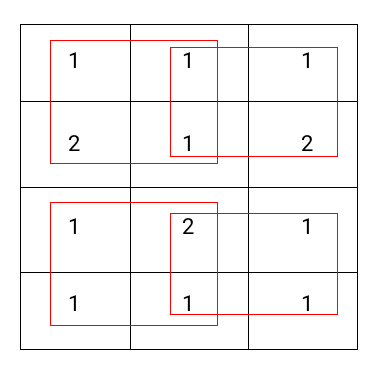
In this example, the maximum value of length of side which can be obtained is 2, Having the starting index: {0, 0} or {0, 1} or {2, 0} or {2, 1}.
Problem approach
I try to solve it by using dp.


Here's your problem of the day 
Solving this problem will increase your chance to get selected in this company
Skill covered: Programming
How do you remove whitespace from the start of a string?
Choose another skill to practice
Similar interview experiences
SDE - Intern
2 rounds | 3 problems
Interviewed by D.E.Shaw
 Selected
2237 views

1 comments

0 upvotes
SDE - 1
3 rounds | 3 problems
Interviewed by D.E.Shaw
 Selected
 0 views
0 comments
0 upvotes
SDE - Intern
3 rounds | 6 problems
Interviewed by D.E.Shaw
 Selected
 866 views
0 comments
0 upvotes
Technology Developer
3 rounds | 13 problems
Interviewed by D.E.Shaw
Rejected
1523 views
0 comments
0 upvotes