





D.E.Shaw interview experience Real time questions & tips from candidates to crack your interview
MTS 1
D.E.Shaw


3 rounds | 8 Coding
problems

 Selected
 Interview preparation journey

Preparation
Duration: 6 months
Topics: Data Structures, Algorithms, System Design, Aptitude, OOPS

Tip 1 : Must do Previously asked Interview as well as Online Test Questions.
Tip 2 : Go through all the previous interview experiences from Codestudio and Leetcode.
Tip 3 : Do at-least 2 good projects and you must know every bit of them.
Application process
Where: Campus
Eligibility: Above 7 CGPA
Tip 1 : Have at-least 2 good projects explained in short with all important points covered.
Tip 2 : Every skill must be mentioned.
Tip 3 : Focus on skills, projects and experiences more.

Interview rounds
01
Round
Easy
Face to Face
Duration60 minutes
Interview date4 Jun 2015
Coding problem3
Technical Interview round with questions on DSA and core subjects.
1. Union and Intersection of two arrays:
Easy
10m average time
90% success

0/40
Asked in companies



You are given two arrays 'A' and 'B' of size 'N' and 'M' respectively. Both these arrays are sorted in non-decreasing order. You have to find the intersection of these two arrays.
Intersection of two arrays is an array that consists of all the common elements occurring in both arrays.
Note :
1. The length of each array is greater than zero.
2. Both the arrays are sorted in non-decreasing order.
3. The output should be in the order of elements that occur in the original arrays.
4. If there is no intersection present then return an empty array.
Problem approach
Union :
1) Initialize an empty hash set or hash map mp.
2) Iterate through the first array and put every element of the first array in the set mp.
3) Repeat the process for the second array.
4) Print the set mp.
Intersection :
1) Initialize an empty set mp.
2) Iterate through the first array and put every element of the first array in the set mp.
3) For every element x of the second array, do the following :
Search x in the set mp. If x is present, then print it.
Time complexity : O(m+n) under the assumption that hash table search and insert operations take O(1) time.
Space complexity : O(m+n) in case of Union and O(min(m,n)) in case of Intersection
2. Inorder Traversal of Binary Tree without recursion
Easy
32m average time
0/40
Asked in companies



You have been given a Binary Tree of 'n' nodes, where the nodes have integer values. Your task is to return the In-Order traversal of the given binary tree.
For example :
For the given binary tree:
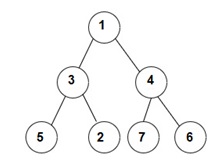
The Inorder traversal will be [5, 3, 2, 1, 7, 4, 6].
Problem approach
Inorder traversal requires that we print the leftmost node first and the right most node at the end.
So basically for each node we need to go as far as down and left as possible and then we need to come back and go right. So the steps would be :
1. Start with the root node.
2. Push the node in the stack and visit it's left child.
3. Repeat step 2 while node is not NULL, if it's NULL then pop the topmost node from the stack and print it.
4. Now move to node's right child and repeat step 1
5. Repeat the above steps while node is not NULL and stack is not empty.
3. Operating System Question
Static vs Dynamic Loading
Problem approach
1. In static loading, the complete program is linked and complied without dependency of an external program. In dynamic loading, all the modules are loaded dynamically. The developer provides a reference to all of them and the rest of the work is done at execution time.
2. In static loading, absolute data and program are loaded into the memory to start execution. In dynamic loading, loading of data and information takes bit by bit in run time.
3. In static loading, the linker combines the object program with other object modules to make a a single program. In dynamic loading, the linking process takes place dynamically in relocatable form. Data is loaded into the memory only when it is needed in the program.
4. In static loading, the processing speed is faster as no files are updated during the processing time. In dynamic loading, the processing speed is slower as files are uploaded at the time of processing.
5. In static loading, the code may or may not be executed once it is loaded into the memory. In dynamic loading,, execution takes place only when it is required.
02
Round
Medium
Face to Face
Duration45 minutes
Interview date4 Jun 2015
Coding problem4
Technical interview round with questions on core subjects.
1. Operating System Question
How does a C program gets executed?
Problem approach
C Code − This is the code that you have written. This code is sent to the Preprocessors section.
Preprocessing − In this section the preprocessor files are attached with our code. We have use different header files like stdio.h, math.h etc. These files are attached with the C Source code and the final C Source generates. (‘#include’, ‘#define’ These are Preprocessor Directives.)
Compiler − After generating the preprocessed source code, it moves to the compiler and the compiler generates the assembly level code after compiling the whole program.
Assembler − This part takes the assembly level language from compiler and generates the Object code, this code is quite similar to the machine code (set of binary digits).
Linker − Linker is another important part of the compilation process. It takes the object code and link it with other library files, these library files are not the part of our code, but it helps to execute the total program. After linking the Linker generates the final Machine code which is ready to execute.
Loader − A program, will not be executed until it is not loaded in to Primary memory. Loader helps to load the machine code to RAM and helps to execute it. While executing the program is named as Process. So process is (Program in execution).
2. Operating System Question
What is Banker's Algorithm?
Problem approach
Banker’s Algorithm is used to resource allocation and deadlock avoidance that determine to safety by simulating the allocation for predetermined maximum possible amounts of all resources, then makes an “s-state” check to test for possible activities, before deciding whether allocation should be allowed to continue.
Banker’s Algorithm is named because it is implemented in the banking sector, and main objective of using this algorithm is to check that loan can be sanctioned or not to clients.
3. OOPS Question
What are the types of polymorphism?
Problem approach
Polymorphism is of two types :
1. Compile Time Polymorphism :
Invokes the overloaded functions by matching the number and type of arguments. The information is present during compile-time. This means the C++ compiler will select the right function at compile time. It is achieved through function overloading and operator overloading.
2. Run Time Polymorphism :
This happens when an object’s method is called during runtime rather than during compile time. Runtime polymorphism is achieved through function overriding. The function to be called is established during runtime.
4. C Question
Difference Between malloc() and calloc()
Problem approach
Initialization :
malloc() allocates a memory block of given size (in bytes) and returns a pointer to the beginning of the block. malloc() doesn’t initialize the allocated memory. If you try to read from the allocated memory without first initializing it, then you will invoke undefined behavior, which will usually mean the values you read will be garbage.
calloc() allocates the memory and also initializes every byte in the allocated memory to 0. If you try to read the value of the allocated memory without initializing it, you’ll get 0 as it has already been initialized to 0 by calloc().
Parameters :
malloc() takes a single argument, which is the number of bytes to allocate.
Unlike malloc(), calloc() takes two arguments:
1) Number of blocks to be allocated.
2) Size of each block in bytes.
Return Value :
After successful allocation in malloc() and calloc(), a pointer to the block of memory is returned otherwise NULL is returned which indicates failure.
03
Round
Easy
HR Round
Duration30 minutes
Interview date4 Jun 2015
Coding problem1
HR round with typical behavioral problems.
1. Basic HR Question
Why do you want to join DE Shaw?
Problem approach
Tip 1 : The cross questioning can go intense some time, think before you speak.
Tip 2 : Be open minded and answer whatever you are thinking, in these rounds I feel it is important to have opinion.
Tip 3 : Context of questions can be switched, pay attention to the details. It is okay to ask questions in these round, like what are the projects currently the company is investing, which team you are mentoring. How all is the work environment etc.


Here's your problem of the day 
Solving this problem will increase your chance to get selected in this company
Skill covered: Programming
How do you remove whitespace from the start of a string?
Choose another skill to practice
Similar interview experiences
SDE - Intern
2 rounds | 3 problems
Interviewed by D.E.Shaw
 Selected
2237 views

1 comments

0 upvotes
SDE - 1
3 rounds | 3 problems
Interviewed by D.E.Shaw
Selected 0 views
0 comments
0 upvotes
SDE - Intern
3 rounds | 6 problems
Interviewed by D.E.Shaw
 Selected
 866 views
0 comments
0 upvotes
Technology Developer
3 rounds | 13 problems
Interviewed by D.E.Shaw
Rejected
1523 views
0 comments
0 upvotes
Companies with similar interview experiences

MTS 1
6 rounds | 10 problems
Interviewed by Adobe

Rejected
4051 views
1 comments
0 upvotes

MTS 1
4 rounds | 14 problems
Interviewed by Oracle
 Selected
 4097 views
0 comments
0 upvotes
MTS 1
2 rounds | 5 problems
Interviewed by Adobe
Rejected
1551 views
1 comments
0 upvotes