





D.E.Shaw interview experience Real time questions & tips from candidates to crack your interview
SDE - 1
D.E.Shaw


2 rounds | 4 Coding
problems

 Selected
 Interview preparation journey

Preparation
Duration: 6 months
Topics: Data Structures, Algorithms, System Design, Aptitude, OOPS

Tip 1 : Must do Previously asked Interview as well as Online Test Questions.
Tip 2 : Go through all the previous interview experiences from Codestudio and Leetcode.
Tip 3 : Do at-least 2 good projects and you must know every bit of them.
Application process
Where: Campus
Eligibility: Above 7 CGPA
Tip 1 : Have at-least 2 good projects explained in short with all important points covered.
Tip 2 : Every skill must be mentioned.
Tip 3 : Focus on skills, projects and experiences more.

Interview rounds
01
Round
Medium
Coding Test - Pen and paper
Duration40 minutes
Interview date11 Mar 2015
Coding problem1
The test has 3 sections :
1. Quantitative contains 20 questions. These questions are easy to me. If u practice quant, you can easily solve it.
2. Technical contains 20 questions. Some questions are on C , C++ , java outputs. Remaining are based on DSA. If u Know all the time complexities of algorithms then it is easy . In technical they gave one DSA problem.
3. Essay: They have given one picture and then asked to write an essay by seeing the picture.
1. Dijikstra's Algorithm
Moderate
25m average time
65% success

0/80
Asked in companies



You have been given an undirected graph of ‘V’ vertices (labeled 0,1,..., V-1) and ‘E’ edges. Each edge connecting two nodes (‘X’,’Y’) will have a weight denoting the distance between node ‘X’ and node ‘Y’.
Your task is to find the shortest path distance from the source node, which is the node labeled as 0, to all vertices given in the graph.
Example:
Input:
4 5
0 1 5
0 2 8
1 2 9
1 3 2
2 3 6
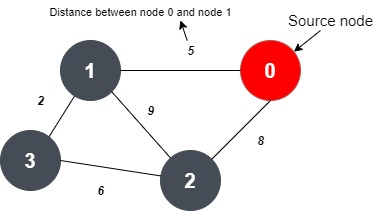
In the given input, the number of vertices is 4, and the number of edges is 5.

In the input, following the number of vertices and edges, three numbers are given. The first number denotes node ‘X’, the second number denotes node ‘Y’ and the third number denotes the distance between node ‘X’ and ‘Y’.

As per the input, there is an edge between node 0 and node 1 and the distance between them is 5.

The vertices 0 and 2 have an edge between them and the distance between them is 8.
The vertices 1 and 2 have an edge between them and the distance between them is 9.
The vertices 1 and 3 have an edge between them and the distance between them is 2.
The vertices 2 and 3 have an edge between them and the distance between them is 6.
Note:
1. There are no self-loops(an edge connecting the vertex to itself) in the given graph.

2. There can be parallel edges i.e. two vertices can be directly connected by more than 1 edge.
Problem approach
Dijkstra's Algorithm basically starts at the source node and it analyzes the graph to find the shortest path between that node and all the other nodes in the graph.
The algorithm keeps track of the currently known shortest distance from each node to the source node and it updates these values if it finds a shorter path.
Once the shortest path between the source node and another node is found, that node is marked as "visited" and added to the path.
The process continues until all the nodes in the graph have been added to the path. This way, we have a path that connects the source node to all other nodes following the shortest path possible to reach each node.
Pseudocode :
function Dijkstra(Graph, source) :
2: for each vertex v in Graph: // Initialization
3: dist[v] := infinity // initial distance from source to vertex v is set to infinite
4: previous[v] := undefined // Previous node in optimal path from source
5: dist[source] := 0 // Distance from source to source
6: Q := the set of all nodes in Graph // all nodes in the graph are unoptimized - thus are in Q
7: while Q is not empty: // main loop
8: u := node in Q with smallest dist[ ]
9: remove u from Q
10: for each neighbor v of u: // where v has not yet been removed from Q.
11: alt := dist[u] + dist_between(u, v)
12: if alt < dist[v] // Relax (u,v)
13: dist[v] := alt
14: previous[v] := u
15: return previous[ ]
02
Round
Easy
Face to Face
Duration60 minutes
Interview date11 Mar 2015
Coding problem3
3 persons are there in panel. They are asking questions on basic concepts in subjects and some advanced concepts.
1. Operating System Question
What is Daemon Process?
Problem approach
In Unix and other multitasking computer operating systems, daemon is a computer program that runs as a background process, rather than being under the direct control of an interactive user. Typically daemon names end with the letter d: for example, syslogd is the daemon that implements the system logging facility and sshd is a daemon that services incoming SSH connections.
2. Operating System Question
Advantages of System calls
Problem approach
The system call is a technique of calling the system in such a way that a computer program requests a service from the kernel of the operating system. The system can only provide the services if we call the system with a system call.
There are two kinds of modes. The first one is kernel mode and another is user mode. The user can only get the services from the OS and the user is able to send the commands to the kernel mode. User from the user-mode sends systems calls to the kernel mode.
3. Operating System Question
Explain select() system call.
Problem approach
select() allow a program to monitor multiple file descriptors, waiting until one or more of the file descriptors become "ready" for some class of I/O operation (e.g., input possible). A file descriptor is considered ready if it is possible to perform the corresponding I/O operation (e.g., read(2)) without blocking.


Here's your problem of the day 
Solving this problem will increase your chance to get selected in this company
Skill covered: Programming
How do you remove whitespace from the start of a string?
Choose another skill to practice
Similar interview experiences
SDE - 1
4 rounds | 7 problems
Interviewed by D.E.Shaw
Selected 
12832 views

1 comments

0 upvotes
SDE - 1
2 rounds | 4 problems
Interviewed by D.E.Shaw
Rejected
3170 views
0 comments
0 upvotes
SDE - 1
3 rounds | 10 problems
Interviewed by D.E.Shaw
Rejected
1259 views
0 comments
0 upvotes
SDE - 1
3 rounds | 3 problems
Interviewed by D.E.Shaw
Selected 0 views
0 comments
0 upvotes
Companies with similar interview experiences

SDE - 1
5 rounds | 12 problems
Interviewed by Amazon
 Selected
 115097 views
24 comments
0 upvotes

SDE - 1
4 rounds | 5 problems
Interviewed by Microsoft
Selected 58238 views
5 comments
0 upvotes
SDE - 1
3 rounds | 7 problems
Interviewed by Amazon
 Selected
 35147 views
7 comments
0 upvotes