





Delhivery interview experience Real time questions & tips from candidates to crack your interview

SDE - 2
Delhivery


3 rounds | 6 Coding
problems

 Selected
 Interview preparation journey

Journey
I was unaware of this coding stuff until my school life. I got to know about the field of computer science in my 11th grade. I found it interesting and decided that I would pursue my career in the field of computer science. I took admission in B.Tech CSE and learned various concepts like DSA and others. But I found that they were not easy to learn at all.
Application story
I got a message in my Telegram group about the company visiting our campus to hire SDE-1. It was a very happy moment. It was a great company, and since I was in the fourth year, it was certain that I was going to apply for it. I started preparing accordingly and was selected in the end.
Why selected/rejected for the role?
I think my skills and knowledge were up to the mark, which is why they found me to be a valuable candidate. Moreover, my communication skills contributed to my success.
Preparation
Duration: 3 months
Topics: Data Structures, Pointers, OOPS, Algorithms, Dynamic Programming, DBMS, Operating System, System Design, Computer Networks, Machine Learning, C++, Python

Tip 1: Be thorough with your basics – Data Structures and Algorithms, Pointers, DBMS, OOPS, OS, etc.
Tip 2: Practice Competitive Programming and improve your programming skills. (Take a data structures course from CN. That’s enough for cracking any service-based or product-based company). Practice questions on online coding platforms.
Tip 3: Be confident in your answers. You should not fumble while answering.
Tip 4: Also, practice aptitude well. Managing time during the test is an important skill.
Tip 5: Work on good projects using recent technologies (ML, Web D, Blockchain, Analytics, etc.). Have in-depth knowledge about the project, as the interviewer may go deep and ask difficult questions.
Tip 6: Start your preparation as early as possible and work on your communication skills as well.
Application process
Where: Campus
Eligibility: 7 CGPA
Tip 1: Mention good projects.
Tip 2: Write about things you're 100% sure you can answer questions on.
Tip 3: Do not try to appear high profile by mentioning too many skills, projects, or extracurriculars on your resume.

Interview rounds
01
Round
Medium
Online Coding Interview
Duration90 mins
Interview date6 Nov 2019
Coding problem2
Online test. The test consisted of two parts:
Timing: Morning 10:00-11:30. The platform used was Mettl.
English: 15 questions in 10 minutes. The questions covered topics such as synonyms/antonyms, critical thinking, and passage-based questions. The difficulty level ranged from easy to medium.
Aptitude: 25 questions in 40 minutes. The questions covered topics such as Simple Interest, Profit and Loss, Permutations and Combinations, Blood Relations, etc. The difficulty level ranged from medium to hard.
Coding problems: There were 2 coding questions.
1. Longest Substring Without Repeating Characters
Moderate
30m average time
65% success

0/80
Asked in companies



Given a string input of length n, find the length of the longest substring without repeating characters i.e return a substring that does not have any repeating characters.
Substring is the continuous sub-part of the string formed by removing zero or more characters from both ends.
Problem approach
I solved using sliding window technique.
2. Convert a binary tree to its sum tree
Easy
15m average time
85% success
0/40
Asked in companies



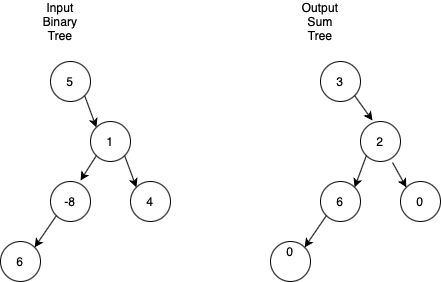
Given a binary tree of integers, you are supposed to modify the given binary tree to a sum tree where each node value is replaced by the sum of the values of both left and right subtrees in the given tree. The value of leaf nodes is changed to zero.
Example:
Below is the example showing the input tree and its sum tree.
Problem approach
I solved it using preorder traversal.
02
Round
Medium
Online Coding Test
Duration60 mins
Interview date7 Nov 2019
Coding problem2
There were two questions in this test:
- This was an easy-level question based on Math.
- This was a medium-level question based on string manipulation.
1. Encode the Message
Easy
18m average time
90% success
0/40
Asked in companies

You have been given a text message. You have to return the Run-length Encoding of the given message.
Run-length encoding is a fast and simple method of encoding strings. The basic idea is to represent repeated successive characters as the character and a single count. For example, the string "aaaabbbccdaa" would be encoded as "a4b3c2d1a2".
Problem approach
Keep the frequency of each character in an array. Mainly, hashing helped me solve this problem.
2. Count Sequences Of Positive Integers Having Product X
Hard
15m average time
85% success
0/120
Asked in companies

You are given an array 'NUM' consisting of N positive Integers. Your task is to find the total number of possible sequences of positive integers (greater than 1) whose product is 'X'.
The value of 'X' is calculated as the product of the N terms, where the ith term is generated by raising the ith prime number to the power of an ith element in the given array.
In mathematical terms, we can write X as:
X = 2 ^ NUM[1] * 3 ^ NUM[2] * 5 ^ NUM[3] * 7 ^ NUM[4] * 11 ^ NUM[5] * … up to Nth term
Note :
1. Sum of all the elements in the array 'NUM' will always be less than or equal to 400.
2. As the total number of such sequences can be very large, print the answer modulo 1000000007.
Problem approach
Binary search implementation.
03
Round
Easy
Face to Face
Duration40 mins
Interview date7 Nov 2019
Coding problem2
1. Technical Questions
Why C++? The difference between C++ and C. (Learn)
What are constructors? Why are they used? What is the syntax for writing a constructor? (Learn)
What is OOPS? Explain the four pillars of OOPS with examples. (Learn)
What is foreign key, candidate key, and primary key? (Learn)
Different sorting algorithms. (Learn)
What is big data, machine learning, and IoT? (Learn) (They do not expect formal definitions. Support your answers with examples.)
They gave some code snippets and asked whether the code was right or wrong, as well as some output prediction questions. These questions were a little tricky.
They also asked me to write code in an online compiler. In my case, the code was based on Binary Search.
A brief discussion about the projects mentioned in the resume.
2. HR Questions
About relocation, plans for further study, different products of TCS, whether I had any issues working in shifts, and whether I had any backlogs or year gaps.


Here's your problem of the day 
Solving this problem will increase your chance to get selected in this company
Skill covered: Programming
How do you remove whitespace from the start of a string?
Choose another skill to practice
Similar interview experiences
SDE - Intern
4 rounds | 5 problems
Interviewed by Delhivery
 Selected
1495 views

0 comments

0 upvotes
SDE - 2
3 rounds | 3 problems
Interviewed by Delhivery
 Selected
 1098 views
0 comments
0 upvotes
SDE - 2
3 rounds | 4 problems
Interviewed by Delhivery
Selected 2060 views
0 comments
0 upvotes
SDE - 1
1 rounds | 3 problems
Interviewed by Delhivery
Selected 449 views
0 comments
0 upvotes
Companies with similar interview experiences

SDE - 2
3 rounds | 4 problems
Interviewed by HashedIn
 Selected
 9697 views
0 comments
0 upvotes

SDE - 2
3 rounds | 4 problems
Interviewed by Arcesium
Selected 1827 views
0 comments
0 upvotes
SDE - 2
3 rounds | 4 problems
Interviewed by HashedIn
 Selected
 1937 views
0 comments
0 upvotes