





Deutsche Bank interview experience Real time questions & tips from candidates to crack your interview

SDE - Intern
Deutsche Bank


4 rounds | 8 Coding
problems

 Selected
 Interview preparation journey

Preparation
Duration: 2 months
Topics: Data structures, Algorithms, Object-oriented programming, Database management system, Flask and android development (project related), Problem-solving, Aptitude.

Tip 1 : Strengthen DSA skills initially, know the basics and understand the working of different data structures
Tip 2 : Learn to implement them and enhance your coding skills. Make mistakes and learn from them instead of just cramming everything before practicing.
Tip 3 : To enhance coding skills, try your best to crack a question instead of giving up and looking at the solution. This will improve your problem-solving skills.
Tip 4 : It's a must to do the standard coding questions under every category of data structure and algorithms
Tip 5 : Study the topics and practice coding questions regularly. Take part in coding contests.
Tip 6 : Be thorough with OOPs and DBMS for interview
Tip 7 : Have at least 2 projects in your resume and make sure you can answer the questions related to them.
Application process
Where: Campus
Eligibility: Above 7 CGPA
Tip 1 : Make sure your resume fits everything into a single page.
Tip 2 : Have at least 2 projects on your resume.
Tip 3 : Mention only those technical skills that you are confident in.
Tip 4 : Include an objective in your resume.

Interview rounds
01
Round
Medium
Online Coding Interview
Duration90 minutes
Interview date12 Aug 2020
Coding problem2
There were around 10 MCQS and 2 coding questions. The MCQs mainly had questions related to DBMS and OOPs. There were also questions related to error debugging and give the output of a segment of code. Questions in DBMS were related to SQL commands. The test duration was from 5:30 to 7 pm. There were 2 questions in the coding round. The first one was based on a matrix and the second was based on dynamic programming.
1. Matrix Flip Bit
Easy
10m average time
90% success

0/40
Asked in companies

You have been given a binary matrix ‘MAT’ of size ‘N’ * ’N’. Let ‘i’, ’j’ denote the row and column of the matrix, respectively. If ‘MAT’[i][j] is equal to 0, flip every 1 in the ‘i’th row and ‘j’th column i.e., in the same row and the column as 0.
Your task is to return the total number of flips done over all the elements of the matrix.
Note:
1. Each element in the matrix 'MAT' is either a ‘0’ or ‘1.’

2. The flip operation is performed only for the 0s in the original matrix, and not for the new 0s formed as a result of flipping 1s in the original matrix.

3. If a cell is already flipped, don’t flip it twice.

4. Return the minimum number of flips needed.
For example:
Let the matrix be:
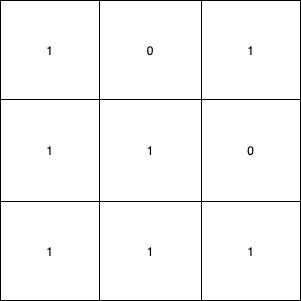
Then we return 6. As shown in the figure, the cells marked in red will be counted as they lie in the same row or column as 0 and will be flipped.

Problem approach
I first applied brute force but the solution was exceeding the time limit so I looked for ways to avoid traversing every
row and column of the matrix. Take the input of the matrix and in a map stored the location of every 0 in the original matrix. Then I traversed through the matrix whenever I encountered a 0 I traversed through its row and column and counted the number of ones. I also marked the row and column visited on the map to make sure I don't visit them again to reduce the time complexity.
2. Jump Game
Moderate
15m average time
85% success
0/80
Asked in companies



You have been given an array 'ARR' of ‘N’ integers. You have to return the minimum number of jumps needed to reach the last index of the array i.e ‘N - 1’.
From index ‘i’, we can jump to an index ‘i + k’ such that 1<= ‘k’ <= ARR[i] .
'ARR[i]' represents the maximum distance you can jump from the current index.
If it is not possible to reach the last index, return -1.
Note:
Consider 0-based indexing.
Example:
Consider the array 1, 2, 3, 4, 5, 6
We can Jump from index 0 to index 1
Then we jump from index 1 to index 2
Then finally make a jump of 3 to reach index N-1

There is also another path where
We can Jump from index 0 to index 1
Then we jump from index 1 to index 3
Then finally make a jump of 2 to reach index N-1

So multiple paths may exist but we need to return the minimum number of jumps in a path to end which here is 3.
02
Round
Easy
Video Call
Duration45 minutes
Interview date19 Aug 2020
Coding problem4
It was an interview round that took place over skype and it lasted for about 45 minutes. My interviewer was polite and gave me time to think for a few answers and was patient when there were technical difficulties. I was also asked to share my screen and show the working code for a few of the questions asked in the interview. I used an online compiler to do so (onlinegdb). Overall the interview went pretty decent with a mix of easy and tough questions.
1. SQL Query
I was asked to write a query to select all the people who are below the age of 75 from a set of people.
2. OOPS
What is the diamond problem?
Problem approach
The diamond problem occurs when two superclasses of a class have a common base class. For example, in the following diagram, the TA class gets two copies of all attributes of Person class, this causes ambiguities.
3. Dijkstra's shortest path
Moderate
25m average time
65% success
0/80
Asked in companies

You have been given an undirected graph of ‘V’ vertices (labeled 0,1,..., V-1) and ‘E’ edges. Each edge connecting two nodes (‘X’,’Y’) will have a weight denoting the distance between node ‘X’ and node ‘Y’.
Your task is to find the shortest path distance from the source node, which is the node labeled as 0, to all vertices given in the graph.
Example:
Input:
4 5
0 1 5
0 2 8
1 2 9
1 3 2
2 3 6
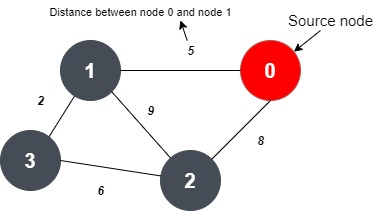
In the given input, the number of vertices is 4, and the number of edges is 5.

In the input, following the number of vertices and edges, three numbers are given. The first number denotes node ‘X’, the second number denotes node ‘Y’ and the third number denotes the distance between node ‘X’ and ‘Y’.

As per the input, there is an edge between node 0 and node 1 and the distance between them is 5.

The vertices 0 and 2 have an edge between them and the distance between them is 8.
The vertices 1 and 2 have an edge between them and the distance between them is 9.
The vertices 1 and 3 have an edge between them and the distance between them is 2.
The vertices 2 and 3 have an edge between them and the distance between them is 6.
Note:
1. There are no self-loops(an edge connecting the vertex to itself) in the given graph.

2. There can be parallel edges i.e. two vertices can be directly connected by more than 1 edge.
Problem approach
I followed the same steps as given by the algorithm and also showed the output using some test cases.
4. Merge Sort
Easy
15m average time
85% success
0/40
Asked in companies



Given a sequence of numbers ‘ARR’. Your task is to return a sorted sequence of ‘ARR’ in non-descending order with help of the merge sort algorithm.
Example :
Merge Sort Algorithm -

Merge sort is a Divide and Conquer based Algorithm. It divides the input array into two-parts, until the size of the input array is not ‘1’. In the return part, it will merge two sorted arrays a return a whole merged sorted array.
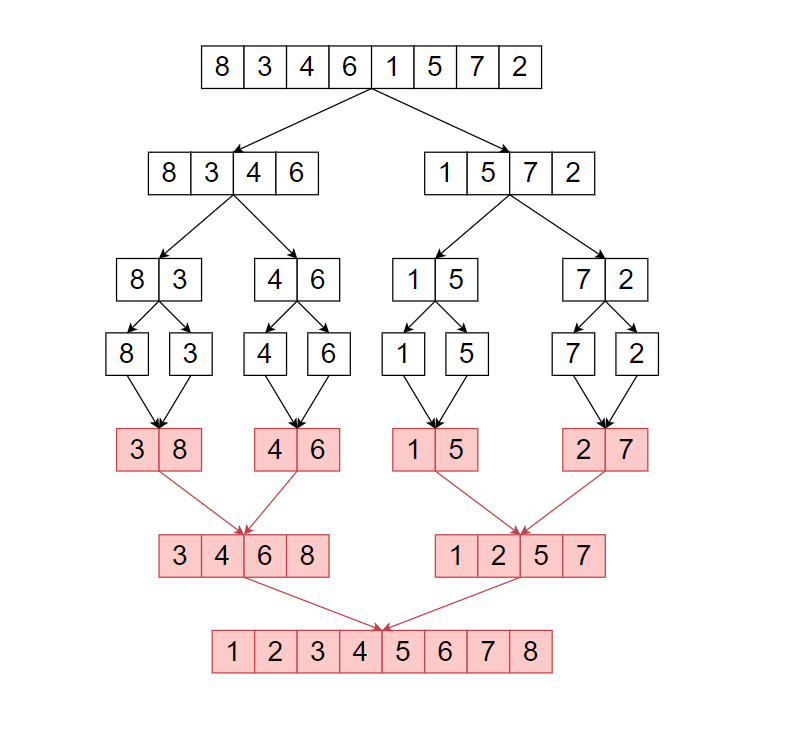
The above illustrates shows how merge sort works.
Note :
It is compulsory to use the ‘Merge Sort’ algorithm.
Problem approach
I had gone through the topic of time complexities really well before the interview. Whenever you practice coding do look at the time complexities of various standard problems like merge sort or bubble sort and also know all the possible ways to do them. Do all the standard coding problems and know their optimized solutions under every topic. Make sure you know your projects thoroughly. Be confident and don't beat around the bush when you don't know an answer.
03
Round
Easy
Video Call
Duration30 minutes
Interview date19 Aug 2020
Coding problem1
This was a professional fitness round. It lasted for about 20-30 minutes. I was asked general questions about my future and career and the interviewer wanted to know what kind of a person I am and if I am fit for working in their company.
1. HR Questions
First I was asked to introduce myself wherein I spoke about my hometown and my earlier education and also included my hobbies. Then I was asked why I wanted to work in that particular company to which I answered that I wanted to because of a few reasons (Know about the company beforehand). I was also asked which was my dream company and why was it my dream company. The interviewer then asked me about my future plans...if I wanted to go for further studies etc. I was also asked what drives me in life. I was also questioned on "cloud" as that was the technology being used by the company recently.
Problem approach
Tip 1 : Be confident
Tip 2 : Know everything there is to know about the company
Tip 3 : Know about the recent technologies that are being adopted by various companies
Tip 4 : Have answers prepared for questions like "What are your future plans" and "why do you want to work here?"
Tip 5 : Know where your interests lie in the technical field.
04
Round
Easy
Video Call
Duration15 minutes
Interview date19 Aug 2020
Coding problem1
This round was an HR round. Here I wasn't asked anything related to tech. Very general questions were asked and the purpose of this round was mainly to know if I had an aadhar card or had Indian citizenship or not or if have anyone related to me who was working in that company. Everyone who made it to this round was selected, this round wasn't to test your abilities but just to know if you can work in DB in India.
1. HR Questions
I was asked to introduce myself and about my hobbies and hometown. They were very general questions. It was a fun and relaxed round.
Problem approach
Tip 1 : When the interviewer asks you "How are you?" respond and ask them the same question
Tip 2 : Be polite and confident


Here's your problem of the day 
Solving this problem will increase your chance to get selected in this company
Skill covered: Programming
How do you remove whitespace from the start of a string?
Choose another skill to practice
Similar interview experiences
SDE - Intern
3 rounds | 5 problems
Interviewed by Deutsche Bank

Rejected

2032 views

0 comments

0 upvotes
SDE - Intern
4 rounds | 5 problems
Interviewed by Deutsche Bank
 Selected
 1831 views
0 comments
0 upvotes
SDE - Intern
4 rounds | 2 problems
Interviewed by Deutsche Bank
 Selected
 1367 views
0 comments
0 upvotes
SDE - Intern
4 rounds | 7 problems
Interviewed by Deutsche Bank
Selected 2774 views
0 comments
0 upvotes
Companies with similar interview experiences
SDE - Intern
3 rounds | 6 problems
Interviewed by Amazon

Rejected
16213 views
4 comments
0 upvotes

SDE - Intern
4 rounds | 7 problems
Interviewed by Microsoft
Selected 16224 views
1 comments
0 upvotes
SDE - Intern
2 rounds | 4 problems
Interviewed by Amazon
 Selected
 10541 views
2 comments
0 upvotes