





Dunzo interview experience Real time questions & tips from candidates to crack your interview

Senior SDET
Dunzo


4 rounds | 7 Coding
problems
 Selected
 Interview preparation journey

Preparation
Duration: 2 months
Topics: Arrays, Strings, Linked List, Dynamic Programming, Recursion

Tip 1 : Focus more on problem solving
Tip 2 : Effective communication skills are a must
Application process
Where: Campus
Eligibility: No criteria
Tip 1 : Keep the resume short, simple and concise
Tip 2 : Highlight important achievements like certifications and projects

Interview rounds
01
Round
Medium
Online Coding Test
Duration90 minutes
Interview date22 Apr 2022
Coding problem2
The coding round had an attempt window of 8 hours from 12 pm to 8pm and it had 2 coding questions.
1. Maximum Sum
Moderate
35m average time
70% success

0/80
Asked in companies


You are given an array “ARR” of N integers. You are required to perform an operation on the array each time until it becomes empty. The operation is to select an element from the array(let’s say at ith index i.e ARR[i]) and remove one occurrence of the selected element from the array and remove all the occurrences of (ARR[i]-1) and (ARR[i]+1) from the array(if present). Your task is to maximize the sum of selected elements from the array.
For example, let’s say the given array is [2, 3, 3, 3, 4, 5].
The maximum possible sum for the given array would be 14. Because if we select one of the 3’s from the array, then one 3 and all occurrences of (3-1) and (3+1) i.e 2 and 4 will be deleted from the array. Now we left with {3,3,5} elements in the array. Then again we select 3 in the next two steps and in both steps 3 will be deleted also (3-1) and (3+1) doesn't exist in the array so nothing extra to delete in both steps. Now we left with only {5} and in the next step, we select the 5 and delete it. Then the array becomes empty. Thus the sum of selected elements will be 3+3+3+5 = 14.
Problem approach
Sorting each row of the array and picking up the maximum element from each of them to get the maximum sum.
2. Stack using queue
Moderate
25m average time
65% success
0/80
Asked in companies



Implement a Stack Data Structure specifically to store integer data using two Queues.
There should be two data members, both being Queues to store the data internally. You may use the inbuilt Queue.
Implement the following public functions :
1. Constructor:
It initializes the data members(queues) as required.

2. push(data) :
This function should take one argument of type integer. It pushes the element into the stack and returns nothing.

3. pop() :
It pops the element from the top of the stack and, in turn, returns the element being popped or deleted. In case the stack is empty, it returns -1.

4. top :
It returns the element being kept at the top of the stack. In case the stack is empty, it returns -1.

5. size() :
It returns the size of the stack at any given instance of time.

6. isEmpty() :
It returns a boolean value indicating whether the stack is empty or not.
Operations Performed on the Stack:
Query-1(Denoted by an integer 1): Pushes an integer data to the stack. (push function)

Query-2(Denoted by an integer 2): Pops the data kept at the top of the stack and returns it to the caller. (pop function)

Query-3(Denoted by an integer 3): Fetches and returns the data being kept at the top of the stack but doesn't remove it, unlike the pop function. (top function)

Query-4(Denoted by an integer 4): Returns the current size of the stack. (size function)

Query-5(Denoted by an integer 5): Returns a boolean value denoting whether the stack is empty or not. (isEmpty function)
Example
Operations:
1 5
1 10
2
3
4

Enqueue operation 1 5: We insert 5 at the back of the queue.
  Queue: [5]

Enqueue operation 1 10: We insert 10 at the back of the queue.
  Queue: [5, 10]

Dequeue operation 2: We remove the element from the front of the queue, which is 5, and print it.
  Output: 5
  Queue: [10]

Peek operation 3: We return the element present at the front of the queue, which is 10, without removing it.
  Output: 10
  Queue: [10]

IsEmpty operation 4: We check if the queue is empty.
  Output: False
  Queue: [10]
Problem approach
Make sure that newly entered element is always at the front of ‘q1’, so that pop operation just dequeues from ‘q1’. ‘q2’ is used to put every new element at front of ‘q1’.
02
Round
Medium
Video Call
Duration60 minutes
Interview date29 Apr 2022
Coding problem2
It was a round which revolved around Data Structures. 2 questions were asked in this round.
1. Count Triplets
Easy
15m average time
85% success
0/40
Asked in companies

You have been given an integer ‘X’ and a non-decreasing sorted doubly linked list with distinct nodes.
Your task is to return the number of triplets in the list that sum up to the value ‘X’.
Problem approach
It was pretty straightforward I used 3 loops to count the pairs according to the condition
2. Segregate Even And Odd Nodes In a Linked List
Easy
15m average time
85% success
0/40
Asked in companies


You are given the head node of a singly linked list 'head'. Your task is to modify the linked list in such a way that all the even valued nodes appear before the all odd valued node and order of nodes remain the same.
Example :-
The given singly linked list is 6 -> 5 -> 3 -> 4 -> 7 -> 1 -> 2
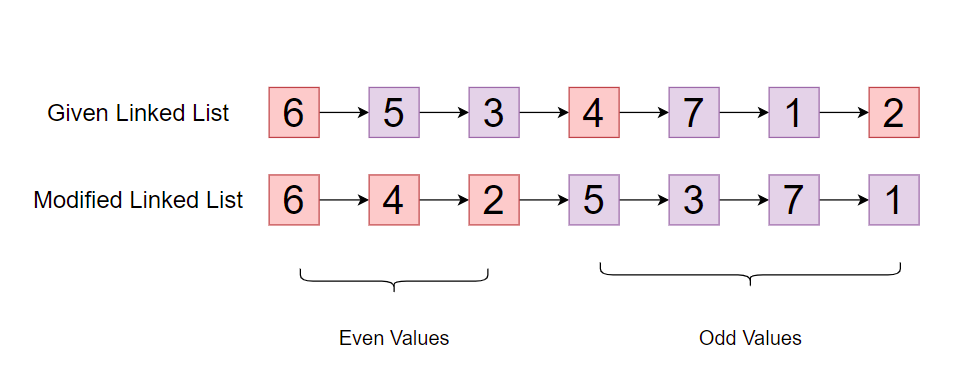
The modified linked list should have all even values in starting and odd values in the end.
Problem approach
I iterated on the linked list maintaining 2 heads and then merged the linked list using them and lastly set the head of the even linked list to Null
03
Round
Medium
Video Call
Duration60 minutes
Interview date12 May 2022
Coding problem2
It was a Data Structure based round. One pattern based question and one normal coding question were asked
1. Stock Span
Moderate
20m average time
65% success
0/80
Asked in companies
Afzal has been working with an organization called 'Money Traders for the past few years. The organization is in the money trading business. His manager assigned him a task.
Given an array ’prices’ which denotes stock prices for ’n’ days, e.g., 'prices[ i ]' = price of the stock at ‘ith’ day, Find the stock's span for each day.
The span of the stock's price today is defined as the maximum number of consecutive days(starting from today and going backward) for which the price of the stock was less than today's price.
Example:
Input: ‘n’ = 7,  ‘prices’ = [100, 80, 60, 70, 60, 75, 85]

Output: [1, 1, 1, 2, 1, 4, 6]

Explanation:
On the sixth day, when the stock price was 75,

The span came out to be 4 because the last three prices(plus today) were less than the current or the sixth day's price.

Similarly, we can deduce the remaining results.
Note:
You don’t need to print anything. Just implement the given function
Problem approach
I used stack to solve this problem.
2. Pattern: Triangle of numbers
Moderate
0/80
Asked in companies


Print the following pattern for the given number of rows.
Pattern for N = 4

The dots represent spaces.
Problem approach
Used for loops for this question
04
Round
Medium
HR Round
Duration60 minutes
Interview date16 May 2022
Coding problem1
It was a general discussion round with the HR. He just started by giving up his introduction and then asked for mine. He then followed the introduction with basic HR Questions
1. Basic HR Questions
- Tell me about yourself
- What are your strengths and your weakness?
- How do you manage conflicts at workplace?
- What do you want to be in future?
- What motivated you to pursue this field?
Problem approach
Tip 1 : Be frank, don't hesitate to ask anything from manager
Tip 2 : Good communication skills are the key to this round


Here's your problem of the day 
Solving this problem will increase your chance to get selected in this company
Skill covered: Programming
How do you remove whitespace from the start of a string?
Choose another skill to practice
Similar interview experiences
SDE - Intern
2 rounds | 4 problems
Interviewed by Dunzo
 Selected
945 views

0 comments

0 upvotes
SDE - 1
3 rounds | 6 problems
Interviewed by Dunzo

Rejected
781 views
0 comments
0 upvotes
SDE - 1
3 rounds | 7 problems
Interviewed by Dunzo
Rejected
725 views
0 comments
0 upvotes
SDE - 1
3 rounds | 5 problems
Interviewed by Dunzo
Rejected
807 views
0 comments
0 upvotes