





Dunzo interview experience Real time questions & tips from candidates to crack your interview

SDE - 1
Dunzo


4 rounds | 9 Coding
problems

 Selected
 Interview preparation journey

Preparation
Duration: 4 months
Topics: Data Structures, Pointers, OOPS, System Design, Algorithms, Dynamic Programming

Tip 1 : Practice Atleast 250 Questions
Tip 2 : Ex- Do atleast 2 projects
Application process
Where: Campus
Eligibility: 7 CGPA
Tip 1 : Have some projects on resume.
Tip 2 : Highlight your major skills.

Interview rounds
01
Round
Medium
Online Coding Test
Duration60 minutes
Interview date13 Jul 2021
Coding problem3
This assessment consists of 2-3 Coding problems
1. Longest Alternating Subsequence
Moderate
15m average time
85% success

0/80
Asked in companies



You are given an array ‘ARR’ of integers. Your task is to find the length of the longest alternating subsequence.
Note:
A sequence a1, a2, .... an is called an alternating sequence if its elements satisfy one of the following relations : a1 < a2 > a3 < a4 > a5..... or a1 > a2 < a3 > a4 < a5.
For example:
'ARR' = {3, 10, 1, 2, 30}, the longest alternating subsequence for this array can be {3, 10, 1, 30} or {3, 10, 2, 30}. Therefore, the answer will be 4.
2. Binary Tree Pruning
Moderate
20m average time
80% success
0/80
Asked in companies


You have been given a Binary Tree where the value of each node is either 0 or 1. Your task is to return the same Binary Tree but all of its subtrees that don't contain a 1 have been removed.
Note :
A subtree of a node X is X, plus every node that is a descendant of X.
For Example :
Look at the below example to see a Binary Tree pruning.
Input: [1, 1, 1, 0, 1, 0, 1, 0, 0, -1, -1, -1, -1, -1, -1, -1, -1, -1, -1]
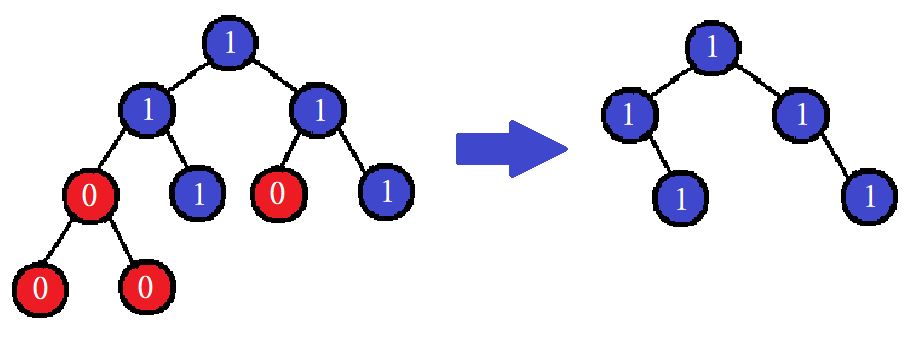
Output: [1, 1, 1, -1, 1, -1, 1, -1, -1, -1, -1]

For example, the input for the tree depicted in the below image would be :
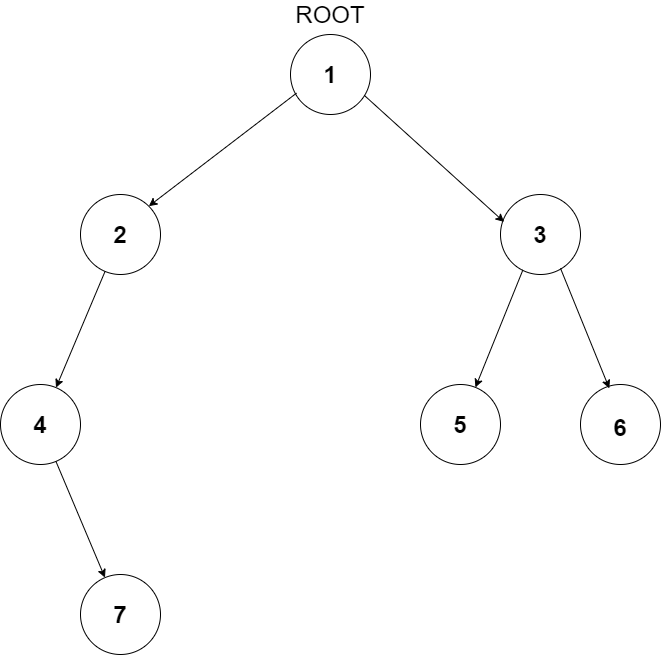
1
2 3
4 -1 5 6
-1 7 -1 -1 -1 -1
-1 -1
Explanation :
Level 1 :
The root node of the tree is 1

Level 2 :
Left child of 1 = 2
Right child of 1 = 3

Level 3 :
Left child of 2 = 4
Right child of 2 = null (-1)
Left child of 3 = 5
Right child of 3 = 6

Level 4 :
Left child of 4 = null (-1)
Right child of 4 = 7
Left child of 5 = null (-1)
Right child of 5 = null (-1)
Left child of 6 = null (-1)
Right child of 6 = null (-1)

Level 5 :
Left child of 7 = null (-1)
Right child of 7 = null (-1)

The first not-null node (of the previous level) is treated as the parent of the first two nodes of the current level. The second not-null node (of the previous level) is treated as the parent node for the next two nodes of the current level and so on.
The input ends when all nodes at the last level are null (-1).
Note :
The above format was just to provide clarity on how the input is formed for a given tree.

The sequence will be put together in a single line separated by a single space. Hence, for the above-depicted tree, the input will be given as:
1 2 3 4 -1 5 6 -1 7 -1 -1 -1 -1 -1 -1
3. Cut Into Segments
Moderate
25m average time
75% success
0/80
Asked in companies


You are given an integer ‘N’ denoting the length of the rod. You need to determine the maximum number of segments you can make of this rod provided that each segment should be of the length 'X', 'Y', or 'Z'.
02
Round
Medium
Video Call
Duration45 minutes
Interview date16 Jul 2021
Coding problem2
it was a DSA round
1. Maximum Coins
Hard
16m average time
78% success
0/120
Asked in companies



You are given a two-dimensional matrix of integers of dimensions N*M, where each cell represents the number of coins in that cell. Alice and Bob have to collect the maximum number of coins. The followings are the conditions to collect coins:
Alice starts from top left corner, i.e., (0, 0) and should reach left bottom corner, i.e., (N-1, 0). Bob starts from top right corner, i.e., (0, M-1) and should reach bottom right corner, i.e., (N-1, M-1).
From a point (i, j), Alice and Bob can move to (i+1, j+1) or (i+1, j-1) or (i+1, j)
They have to collect all the coins that are present at a cell. If Alice has already collected coins of a cell, then Bob gets no coins if goes through that cell again.
For example :
If the matrix is
0 2 4 1
4 8 3 7
2 3 6 2
9 7 8 3
1 5 9 4

Then answer is 47. As, Alice will collect coins 0+8+3+9+1 = 21 coins. Bob will collect coins 1+7+6+8+4 = 26 coins. Total coins is 21+26 = 47 coins.
2. Pair Sum in BST.
Easy
15m average time
85% success
0/40
Asked in companies

You are given a Binary Search Tree (BST) and a target value ‘K’. Your task is to return true if there exist two nodes in the given BST such that the sum of their values is equal to the given target ‘K’, else return false.
A binary search tree (BST) is a binary tree data structure which has the following properties.
• The left subtree of a node contains only nodes with data less than the node’s data.

• The right subtree of a node contains only nodes with data greater than the node’s data.

• Both the left and right subtrees must also be binary search trees.
Note:
1. All the elements of the Binary Search Tree are unique.

2. You can’t use the same node value/element of BST twice.
For example:
tree: 8 5 10 2 6 -1 -1 -1 -1 -1 7 -1 -1
'K' = 13,
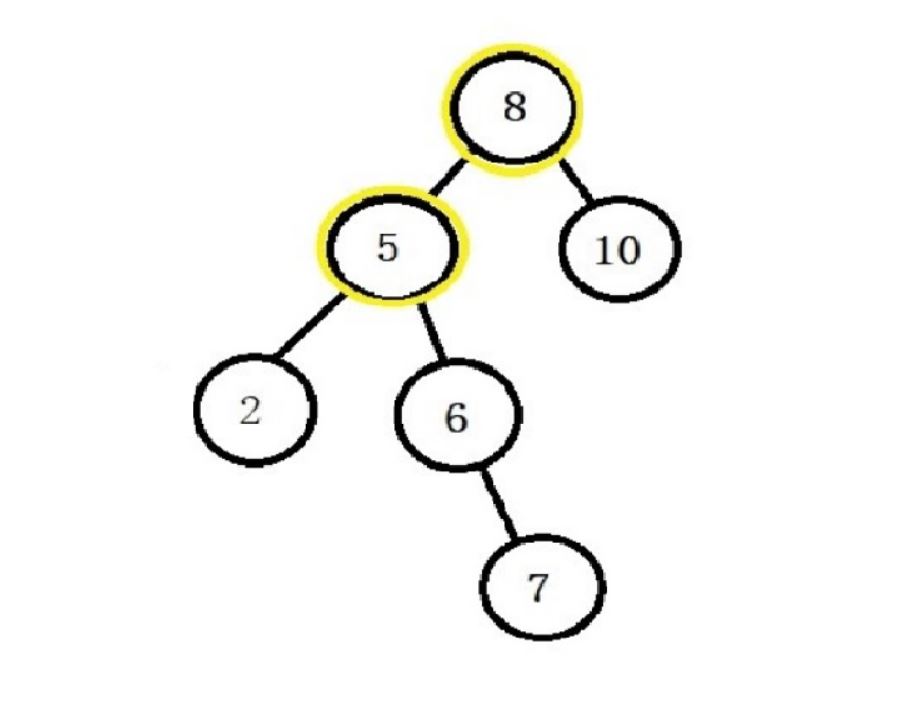
The nodes with values 8 and 5 as shown in the above figure gives sum equal to the given target 13.

Therefore, the output will be “true” i.e it is possible to find a pair in the given BST having sum equal to ‘K’.
03
Round
Hard
Video Call
Duration60 minutes
Interview date22 Jul 2021
Coding problem3
DSA round -2
1. Time To Burn Tree
Hard
50m average time
50% success
0/120
Asked in companies



You have a binary tree of 'N' unique nodes and a Start node from where the tree will start to burn. Given that the Start node will always exist in the tree, your task is to print the time (in minutes) that it will take to burn the whole tree.
It is given that it takes 1 minute for the fire to travel from the burning node to its adjacent node and burn down the adjacent node.
For Example :
For the given binary tree: [1, 2, 3, -1, -1, 4, 5, -1, -1, -1, -1]
Start Node: 3

    1
   / \
  2   3
     / \
    4   5

Output: 2

Explanation :
In the zeroth minute, Node 3 will start to burn.

After one minute, Nodes (1, 4, 5) that are adjacent to 3 will burn completely.

After two minutes, the only remaining Node 2 will be burnt and there will be no nodes remaining in the binary tree.

So, the whole tree will burn in 2 minutes.
2. Remove 9
Easy
15m average time
85% success
0/40
Asked in companies


A committee of mathematicians decided to remove every natural number which contains digit 9 such as 9, 19, 29, ... . Hence the new sequence of natural numbers will be: 1, 2, 3, 4, 5, 6, 7, 8, 10, 11, ….
Given the natural number ‘N’, can you find the ‘N’th number in the new sequence formed after removing every integer that contains 9?
Note:
The sequence of natural numbers are integers that start from 1.
3. 0 1 Knapsack
Easy
15m average time
85% success
0/40
Asked in companies



A thief is robbing a store and can carry a maximal weight of W into his knapsack. There are N items and the ith item weighs wi and is of value vi. Considering the constraints of the maximum weight that a knapsack can carry, you have to find and return the maximum value that a thief can generate by stealing items.
04
Round
Easy
HR Round
Duration30 minutes
Interview date24 Jul 2021
Coding problem1
This was Cultural + HR round
1. Basic HR Questions
Tell me about yourself.
What projects you did? Explain all of them
He then asked questions from My projects.
How do you handle stress?
what are the key qualities in you that makes you eligible for this job rather than coding skills


Here's your problem of the day 
Solving this problem will increase your chance to get selected in this company
Skill covered: Programming
How do you remove whitespace from the start of a string?
Choose another skill to practice
Similar interview experiences
SDE - 1
3 rounds | 5 problems
Interviewed by Dunzo
Selected 
4718 views

0 comments

0 upvotes
SDE - 1
3 rounds | 6 problems
Interviewed by Dunzo
Rejected
781 views
0 comments
0 upvotes
SDE - 1
3 rounds | 7 problems
Interviewed by Dunzo
Rejected
725 views
0 comments
0 upvotes
SDE - 1
3 rounds | 5 problems
Interviewed by Dunzo
Rejected
807 views
0 comments
0 upvotes
Companies with similar interview experiences
SDE - 1
5 rounds | 12 problems
Interviewed by Amazon
 Selected
 115097 views
24 comments
0 upvotes
SDE - 1
4 rounds | 5 problems
Interviewed by Microsoft
Selected 58238 views
5 comments
0 upvotes
SDE - 1
3 rounds | 7 problems
Interviewed by Amazon
 Selected
 35147 views
7 comments
0 upvotes