





Ernst & Young (EY) interview experience Real time questions & tips from candidates to crack your interview

Analyst
Ernst & Young (EY)


3 rounds | 10 Coding
problems

 Selected
 Interview preparation journey

Journey
Duration: 3 months
Topics: Data Structure, Oops, DBMS, Algorithm, SDLC, SQL, Python & Cloud, Web Development, Operating System
It was off campus placement for me because I was coming from tier 3 college where no companies came for hiring students .
Application story
I got this opportunity through off campus placements. I applied through my resume on their portal and after reviewing my resume I got the OA link .There were total 2 OA round and 2 interview round i.e. Technical & HR Round and each round was elimination round .
Why selected/rejected for the role?
I was able to solve and answer of almost all the questions asked me during the selection process and interview process. Deep understanding of Core CS/IT Subjects & programming skills . My good communication skills are also one reason of my selection.
Preparation
Duration: 3 months
Topics: Data Structure, Oops, Algorithm, Operating System, DBMS, SDLC, SQL, Python, Web Development & Cloud

Tip 1 : Constantly focused in the preparation.
Tip 2 : Confidence is a key of success ( Make eye contact).
Tip 3 : Also try to cover all the CS core subjects explanation clearly & be very clear with your project explanation.
Application process
Where: Linkedin
Eligibility: 7 CGPA with no current backlog and 65% in 10th & 12th minimum
Tip 1: Make it clean with appropriate knowledge.
Tip 2: Provide true information and avoid telling lie in which You are not sure.
Tip 3: Resume should be specific in your domain. Don't try to exaggerate. Try to make it of one page only

Interview rounds
01
Round
Medium
Online Coding Interview
Duration180 minutes
Interview date5 Jul 2022
Coding problem2
It was Computer Based Online Recruitment Test on (AMCAT) Portal . There were some instructions which was to be followed during test .
There is no negative marking.
You have to answer all the questions mandatorily i.e. you cannot skip any question.
Do not click on Submit Module.
You cannot change your answer to any previous question.
Use of Mobile devices during the test is strictly prohibited.
Test Date & Time was July-05 & 11.00 AM to 2.00 PM
After clearing online aptitude test I was eligible to attend hacker rank coding test because each round was elimination round and was to complete the test by July-10, Sunday ( 3.00 PM)
1. Intersection of Two Linked Lists
Easy
25m average time
73% success

0/40
Asked in companies



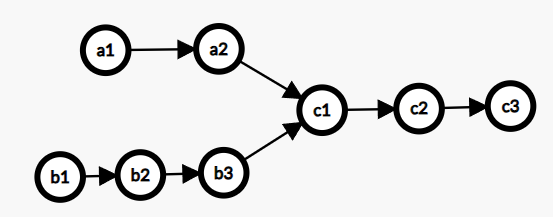
You are given two Singly Linked Lists of integers, which may have an intersection point.
Your task is to return the first intersection node. If there is no intersection, return NULL.
Example:-
The Linked Lists, where a1, a2, c1, c2, c3 is the first linked list and b1, b2, b3, c1, c2, c3 is the second linked list, merging at node c1.
Problem approach
We can first determine the lengths of both lists by traversing through the lists. Note that after the intersection the number of nodes remains the same for both the lists. Let the lengths come out to be equal to len1 and len2. If len1 exceeds len2 then we move the head pointer of ListNode1 by (len1 - len2) times forward otherwise len2 exceeds len1 so we will move the head pointer of ListNode2 by (len2 - len1) times ahead.
Now we will iterate unless either of them (head1 or head2) becomes NULL or head1 and head2 pointing to the same node.
At the end of the iteration, we will check whether either of the head of lists is NULL, if it is so then we will return -1 otherwise we will return value (data) stored at head1 or head2.
2. Sort 0s, 1s, 2s
Easy
0/40
Asked in companies



You are given an array ‘arr’ consisting only of 0s , 1s, and 2s.
Sort the given array.
For Example:
For ‘arr’ = {1, 0, 0, 2, 1}.
‘Answer’ = {0, 0, 1, 1, 2}.
‘Answer’ should contain all 0s first, then all 1s and all 2s in the end.
Problem approach
This approach is based on the following idea:
The problem is similar to "Segregate 0s and 1s in an array".
The problem was posed with three colors, here `0', `1' and `2'. The array is divided into four sections:
arr[1] to arr[low - 1]
arr[low] to arr[mid - 1]
arr[mid] to arr[high - 1]
arr[high] to arr[n]
If the ith element is 0 then swap the element to the low range.
Similarly, if the element is 1 then keep it as it is.
If the element is 2 then swap it with an element in high range.
02
Round
Medium
Video Call
Duration45 minutes
Interview date15 Jul 2022
Coding problem7
The technical interview lasted for around 45 mins and I would rate It at an intermediate level.
The interview began with a discussion of the projects from my resume which led to the kind of work I had done at my internship. I had done lots of work in cloud domain and since the interviewer was from the Cloud Team, she was keener to know about Cloud Computing Architecture , Cloud Storage Levels and advantages and disadvantages of serverless computing.
After that, a couple of case scenarios were given based on root cause analysis which was to be solved using SLDC and its models.
Coming to the DBMS section, I was asked to operate two general queries where I had to fetch the data of the employees and implement the left join in it. Coming to this, she asked me the difference between DBMS and RDBMS. Along with that, I was different types of keys and joins.
After that, the difference between method overloading and overriding was asked. And, the four fundamental pillars of OOPS and to represent polymorphism in the given code where asked.
Then, she asked me what is heap memory and why we use it. This leads to a discussion on the approach to reverse a stack without using the pop function. Here, the interviewer was just interested to know my path.
Then since I have done a project using the Django framework, she was keen to know how we could read a CSV file with the datasets in python and split it into two parts.
Then she asked me about my technical community experiences where I was involved in my college days .
This led to the end of the interview and I guess the interviewer was convinced with the performance.
Tips:
1. I would just like to say to be accurate with your answers.
2. They are just trying to check your basics whether you are well versed in it or not.
3. Along that, I would like to add that try to be a little more curious and maintain a positive attitude during the whole span of your interview. This will help you to get to your next stage.
1. DBMS Question
Mention the issues with traditional file-based systems that make DBMS a better choice?
Problem approach
Tip 1: Make good communication skills with the interviewer .
Tip 2: If you have any doubt in question feel free to ask it again that is best instead of giving wrong answers .
Tip 3: Read Database System Concepts, by Silberschatz, Sudarshan, and Korth for good understanding of dbms and practice question for SQL on hackerrank .
2. DBMS Question
What is meant by ACID properties in DBMS?
3. DBMS Question
What is meant by an entity-relationship (E-R) model?
4. DBMS Question
Explain the terms Entity, Entity Type, and Entity Set in DBMS.
5. Python Question
how we could read a CSV file with the datasets in python and split it into two parts.
6. OOPs Question
the difference between method overloading and overriding was asked
7. OOPs Question
represent polymorphism in the form of code
03
Round
Easy
HR Round
Duration30 minutes
Interview date19 Jul 2022
Coding problem1
The HR interview did last for around 30 mins.
The HR was keen to know everything about me, family background, college life, projects, and interests.
This led to the finishing up of the HR Round.
1. Basic HR Questions
I was asked about a case scenario leading to teaming and leadership.
I was asked where I see myself in 5 years
Why EY-GDS?
Are u up for Relocation?


Here's your problem of the day 
Solving this problem will increase your chance to get selected in this company
Skill covered: Programming
How do you remove whitespace from the start of a string?
Choose another skill to practice
Similar interview experiences
React developer
3 rounds | 19 problems
Interviewed by Ernst & Young (EY)
 Selected
4687 views

0 comments

0 upvotes
Software Engineer
3 rounds | 5 problems
Interviewed by Ernst & Young (EY)
Selected 1831 views
0 comments
0 upvotes
SDE - 2
4 rounds | 11 problems
Interviewed by Ernst & Young (EY)
 Selected
 1890 views
0 comments
0 upvotes
Analyst
3 rounds | 4 problems
Interviewed by Ernst & Young (EY)
 Selected
 2196 views
1 comments
0 upvotes
Companies with similar interview experiences

Analyst
3 rounds | 9 problems
Interviewed by HCL Technologies
 Selected
 0 views
0 comments
0 upvotes