





Expedia Group interview experience Real time questions & tips from candidates to crack your interview

SDE - Intern
Expedia Group


2 rounds | 4 Coding
problems
 Selected
 Interview preparation journey

Journey
My coding journey started in the first year of college. In the beginning, I concentrated on mainly two things: Language Fundamentals (C and C++ in my case) and Logic building (via implementing many algorithms manually). Then, in my second year, I focused on problem solving at GeeksforGeeks and Leetcode. By the end of the second year, my DSA concepts were strong enough. Simultaneously, I practised competitive programming on Codechef and then I prepared CS Fundamentals like OOPs, OS, DBMS in the second year (as they were my semester subjects) and they proved to be very important in my interview. Finally, when my third year began, I applied for the on-campus Expedia Group internship opportunity and got selected there.
Application story
I got this opportunity through campus placements. Expedia Group visited our campus for internships and placements. I applied through my resume on their portal.
Why selected/rejected for the role?
My interviewer questioned me on all of the skills that I had mentioned in my resume and I was successful at answering all of them. I attempted all the coding questions given to me and explained my approach clearly with a discussion of time and space complexity. This was the reason for which I got selected.
Preparation
Duration: 6 Months
Topics: Dynamic Programming, OOPS, Data Structures (Arrays, Graphs, Trees, Stack), Algorithms, Machine Learning

Tip 1 : Prepare DSA for atleast 5-6 months on a regular basis before internship/placement opportunity.
Tip 2 : CS Fundamentals are very important (OOPs, OS, DBMS, System Design)
Tip 3 : Having prior internship experience is a plus point but not necessary.
Application process
Where: Campus
Eligibility: No CGPA criteria
Tip 1 : 2-3 Projects (preferably on different domains).
Tip 2 : Any kind of achievements mentioned will be a part of discussion in interview (either Academic achievement or any contest rank or anything else).
Tip 3 : DO NOT PUT ANYTHING THAT YOU DON'T KNOW!!!

Interview rounds
01
Round
Medium
Face to Face
Duration60 minutes
Interview date24 Aug 2022
Coding problem2
Timing: Evening
Environment: Pretty chill environment
Focus: This interview round was majorly focused on resume discussion and Algorithms.
In this interview I was asked questions related to Machine Learning as it was mentioned in my interview. They also I asked question regarding of my prior projects (that were mentioned in my resume). Then I was asked to describe my previous internship experiences.
1. Topological Sort
Easy

0/40
Asked in companies


You are given a directed acyclic graph. Your task is to find any topological sorting of the graph.
A directed acyclic graph is a directed graph with no directed cycles.
Topological sorting for Directed Acyclic Graph (DAG) is a linear ordering of vertices such that for every directed edge from u to v, vertex u comes before v in the ordering.
For example-
For the given DAG-
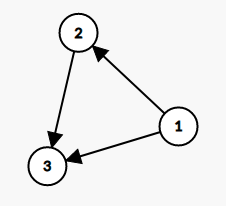
One of the possible topological sort will be-
1  2  3
2. Container With Most Water
Moderate
15m average time
90% success
0/80
Asked in companies



Given a sequence of ‘N’ space-separated non-negative integers A[1],A[2],A[3],......A[i]…...A[n]. Where each number of the sequence represents the height of the line drawn at point 'i'. Hence on the cartesian plane, each line is drawn from coordinate ('i',0) to coordinate ('i', 'A[i]'), here ‘i’ ranges from 1 to ‘N’. Find two lines, which, together with the x-axis forms a container, such that the container contains the most area of water.
Note :
1. You can not slant the container i.e. the height of the water is equal to the minimum height of the two lines which define the container.

2. Do not print anything, you just need to return the area of the container with maximum water.
Example
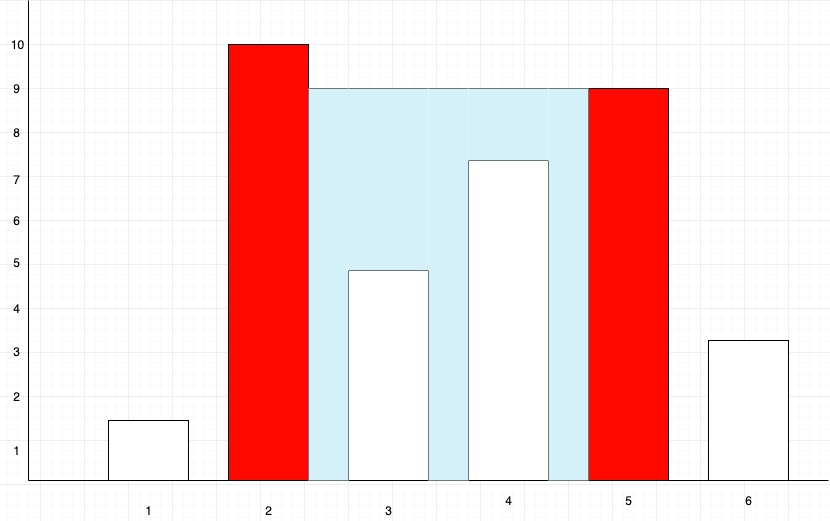
For the above Diagram, the first red marked line is formed between coordinates (2,0) and (2,10), and the second red-marked line is formed between coordinates (5,0) and (5,9). The area of water contained between these two lines is (height* width) = (5-2)* 9 = 27, which is the maximum area contained between any two lines present on the plane. So in this case, we will return 3* 9=27.
Problem approach
Step 1 : I solved this problem with brute force approach. By taking two vertical lines at a time, we can find the maximum amount of water that could have been stored into this container. And then finally taking the maximum of all the possibilities to get the final answer.
Step 2 : Interviewer asked me to optimise the solution.
Step 3 : Then I gave the solution using two pointer approach and coded it on a paper. Interviewer was happy with my code.
02
Round
Easy
Face to Face
Duration40 minutes
Interview date24 Aug 2022
Coding problem2
This interview round was a mix of HR round and Data Structures round.
The interviewer particularly showed interest in my research intern and discussed few things around it.
1. Merge Two Sorted Linked Lists
Moderate
15m average time
80% success
0/80
Asked in companies


You are given two sorted linked lists. You have to merge them to produce a combined sorted linked list. You need to return the head of the final linked list.
Note:
The given linked lists may or may not be null.
For example:
If the first list is: 1 -> 4 -> 5 -> NULL and the second list is: 2 -> 3 -> 5 -> NULL

The final list would be: 1 -> 2 -> 3 -> 4 -> 5 -> 5 -> NULL
Problem approach
Step 1 : I first applied brute force approach. My approach was to first iterate over both the given Linked List and store the number represented by their nodes in a vector. Then sort the vector and convert the vector into a Linked List.
Step 2 : Interviewer asked me to optimise the solution.
Step 3 : Then I proposed a solution where we take two pointers at the beginning of both the sorted Linked List. Using the fact that both the Linked Lists were sorted we can progressively increment one of the pointer at a time and add the corresponding nodes' value to a new Linked List (before updating the pointer).
2. Level Order Traversal
Easy
15m average time
85% success
0/40
Asked in companies



You have been given a Binary Tree of integers. You are supposed to return the level order traversal of the given tree.
For example:
For the given binary tree
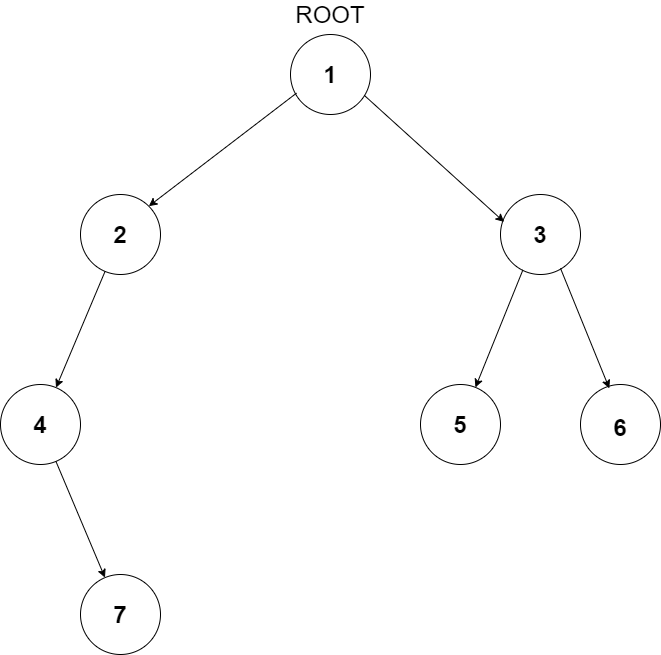
The level order traversal will be {1,2,3,4,5,6,7}.
Problem approach
I implemented the level order traversal of a binary tree using BFS algorithms and queue Data Structure.


Here's your problem of the day 
Solving this problem will increase your chance to get selected in this company
Skill covered: Programming
How do you remove whitespace from the start of a string?
Choose another skill to practice
Similar interview experiences
SDE - Intern
1 rounds | 2 problems
Interviewed by Expedia Group

Rejected

566 views

0 comments

0 upvotes
SDE - Intern
2 rounds | 4 problems
Interviewed by Expedia Group
Rejected
451 views
0 comments
0 upvotes
SDE - Intern
3 rounds | 5 problems
Interviewed by Expedia Group
Rejected
579 views
0 comments
0 upvotes
SDE - Intern
2 rounds | 3 problems
Interviewed by Expedia Group
 Selected
 865 views
0 comments
0 upvotes
Companies with similar interview experiences
SDE - Intern
3 rounds | 6 problems
Interviewed by Amazon

Rejected
15605 views
4 comments
0 upvotes

SDE - Intern
4 rounds | 7 problems
Interviewed by Microsoft
 Selected
 15499 views
1 comments
0 upvotes
SDE - Intern
2 rounds | 4 problems
Interviewed by Amazon
Selected 10216 views
2 comments
0 upvotes