





Expedia Group interview experience Real time questions & tips from candidates to crack your interview

SDE - 1
Expedia Group


3 rounds | 6 Coding
problems
 Selected
 Interview preparation journey

Preparation
Duration: 2 Months
Topics: Data Structures, OOPs, Algorithms, Dynamic Programming, Backtracking.

Tip 1 : Be clear on recursion concepts
Tip 2 : Dynamic Programming paradigms are must
Tip 3 : Foundation concepts should be crystal
Application process
Where: Other
Eligibility: No criteria as such.
Tip 1 : Keep it 1 pager, include only relevant skills & projects.
Tip 2 : Keep it crisp, don't include confidential details.

Interview rounds
01
Round
Medium
Online Coding Interview
Duration60 Minutes
Interview date14 Aug 2020
Coding problem3
3 Coding Questions, 1 easy, 1 medium & 1 hard level question.
1. Third greatest element
Easy
20m average time
80% success

0/40
Asked in companies


Given an array/list 'ARR' of ‘N’ distinct integers, you are supposed to find the third largest element in the given array 'ARR'.
2. Wildcard Pattern Matching
Hard
50m average time
30% success
0/120
Asked in companies


Given a text and a wildcard pattern of size N and M respectively, implement a wildcard pattern matching algorithm that finds if the wildcard pattern is matched with the text. The matching should cover the entire text not partial text.
The wildcard pattern can include the characters ‘?’ and ‘*’
 ‘?’ – matches any single character
 ‘*’ – Matches any sequence of characters(sequence can be of length 0 or more)
3. Conquer the Best Kingdom
Moderate
0/80
Asked in companies


Aragorn is a great ruler and desires to become the most powerful in the entire world. There are ‘N’ kingdoms, kingdoms are numbered from 0 to 'N' - 1 and form of a tree, you are also given the information about the edges of this tree depicting all the Kingdoms that are adjacent to each other.
The ruler with the most kingdoms is considered the most powerful. You desire to become the greatest ruler without having to fight with Aragorn. Kingdoms are conquered one at a time in turns in order to make the process smooth and less violent.
Aragorn initially rules only the ‘Xth’ kingdom and all other kingdoms are not ruled by anyone. In each turn, a ruler can conquer another kingdom that is adjacent to one of his current kingdoms and is ruled by none of the rulers, the opponent plays the next turn and the process is repeated. The game continues until both the players run out of moves. If a ruler has no available adjacent kingdom to conquer then he passes his turn. In the end, the ruler with more kingdoms under his control wins the game.
Aragorn gives you an advantage in the first turn, letting you choose a kingdom of your choice, but for all other moves, you can only conquer a kingdom adjacent to one of your current kingdoms. If Aragorn plays optimally, determine if it’s possible for you to win by becoming the most powerful or not, print “true” if you can become more powerful than Aragorn, else return “false”.
For Example :
If N = 7, X = 2 and Edges = { {0, 1}, {0, 2}, {1, 4}, {1, 5}, {2, 3}, {4, 6} }

Then the tree is:
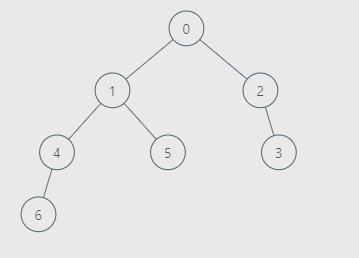
Here N = 7 depicts that there are seven kingdoms (numbered from 0 to 6). Edges depict that kingdom-0 and kingdom-1 are adjacent, kingdom-0 and kingdom-2 are adjacent, and so on. And Aragorn initially controls kingdom-2.
Then in this case, if you select kingdom-1 in your first then, then Aargon will select kingdom-0 in the next turn, as both rulers play optimally, therefore in the end Aargon will be ruling kingdom-0, kingdom-2 and kingdom-3 and the remaining four kingdoms will be ruled by you. Hence you will be able to win the game and therefore we will print “true”.
02
Round
Medium
Video Call
Duration60 Minutes
Interview date18 Aug 2020
Coding problem2
Video call Interview round
1. Hotel Rooms
Moderate
20m average time
20% success
0/80
Asked in companies


You are the manager of a hotel having 10 floors numbered 0-9. Each floor has 26 rooms [A-Z]. You will be given a sequence of strings of the room where ‘+’ suggests the room is booked and ‘-’ suggests the room is freed. You have to find which room is booked the maximum number of times.
Note:
You may assume that the sequence is always correct, i.e., every booked room was previously free, and every freed room was previously booked.

In case, 2 rooms have been booked the same number of times, you have to return Lexographically smaller room.

A string 'a' is lexicographically smaller than a string 'b' (of the same length) if in the first position where 'a' and 'b' differ, string 'a' has a letter that appears earlier in the alphabet than the corresponding letter in string 'b'. For example, "abcd" is lexicographically smaller than "acbd" because the first position they differ in is at the second letter, and 'b' comes before 'c'.
For Example :
n = 6, Arr[] = {"+1A", "+3E", "-1A", "+4F", "+1A", "-3E"}

Now in this example room “1A” was booked 2 times which is the maximum number of times any room was booked. Hence the answer is “1A”.
2. Zigzag Binary Tree Traversal
Easy
10m average time
90% success
0/40
Asked in companies


You are given a ‘Binary Tree’.
Return the level-order traversal of the Binary Tree.
Example:
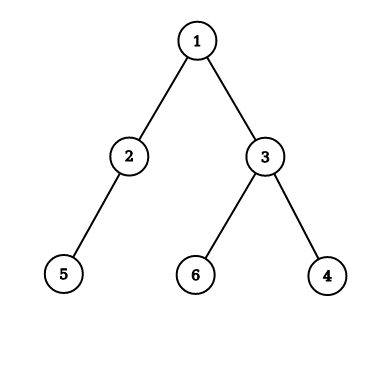
Input: Consider the following Binary Tree:
Output:
Following is the level-order traversal of the given Binary Tree: [1, 2, 3, 5, 6, 4]
03
Round
Easy
Video Call
Duration60 Minutes
Interview date19 Aug 2020
Coding problem1
Virtual round based on problem solving
1. Dot Product of Two Sparse Vectors
Moderate
0/80
Asked in companies

You are given two sparse vectors ‘vec1’ and ‘vec2’. You have to compute the dot product of these two vectors and print the final answer.
Implement class :
Sparse Vector: Initialize the vector.

dotProduct(vec2): Implement the dot product between vector ‘sparseVector’ and ‘vec2’.
For Example :
‘N’ = 6, ‘vec1’ = {2, 4, 0, 0, 1, 0}, ‘vec2’ = {0, 0, 3, 0, 5, 0}

Now in this example, the dot product of these two vectors is (2 * 0) + (4 * 0) + (0 * 3) + (0 * 0) + (1 * 5) + (0 * 0) = 5. Hence the final answer is 5.


Here's your problem of the day 
Solving this problem will increase your chance to get selected in this company
Skill covered: Programming
How do you remove whitespace from the start of a string?
Choose another skill to practice
Similar interview experiences
SDE - 1
4 rounds | 6 problems
Interviewed by Expedia Group
 Selected
2314 views

0 comments

0 upvotes
SDE - 1
4 rounds | 6 problems
Interviewed by Expedia Group
 Selected
 2737 views
0 comments
0 upvotes
SDE - 1
3 rounds | 6 problems
Interviewed by Expedia Group
Selected 0 views
0 comments
0 upvotes
SDE - 1
3 rounds | 6 problems
Interviewed by Expedia Group
 Selected
 822 views
0 comments
0 upvotes
Companies with similar interview experiences
SDE - 1
5 rounds | 12 problems
Interviewed by Amazon
 Selected
 115097 views
24 comments
0 upvotes

SDE - 1
4 rounds | 5 problems
Interviewed by Microsoft
Selected 58238 views
5 comments
0 upvotes
SDE - 1
3 rounds | 7 problems
Interviewed by Amazon
 Selected
 35147 views
7 comments
0 upvotes