





Filenet interview experience Real time questions & tips from candidates to crack your interview
SDE - 1
Filenet


3 rounds | 5 Coding
problems

Rejected
Interview preparation journey

Journey
I was advised by my seniors to practice DSA from the very beginning of B.Tech, but I did not take that seriously. Honestly speaking, I regretted not taking their advice, and in the third year, I started doing coding. I had to increase my practice hours because I started late. But by the end of the third year, I was confident in both DSA and development. Even then, I kept revising the concepts.
Application story
This company visited my campus for the placement. We just had to upload our resumes and fill in all the details on the form. First, they conducted the online assessment. Later, they called us for the interview rounds.
Why selected/rejected for the role?
The basic reason for my rejection was my not having strong knowledge of core DSA fundamentals, and my problem-solving ability is also not very good.
Preparation
Duration: 4 months
Topics: Data Structures, Algorithms, OOPS, Dynamic Programming

Tip 1: Practice popular questions from Arrays, Binary Trees, and Linked Lists from CodeStudio's Interview Problems.
Tip 2: Make sure you are aware of calculating the time and space complexity for every problem you solve.
Tip 3: Prepare through Mock Interviews to practice explaining your approach while solving problems in an actual interview.
Application process
Where: Campus
Eligibility: Above 7 CGPA
Tip 1: Describe the best of your projects in as few words as possible. Don't forget to add buzzwords like REST APIs, DB Indexing, Benchmarking, etc., if you worked on the backend.
Tip 2: Don't include school achievements like Olympiads or being Class Topper in your resume.
Tip 3: If you have some work experience, present it as if you're marketing yourself. Use terms like 'Created/Owned the project through the entire SDLC.

Interview rounds
01
Round
Medium
Video Call
Duration60 minutes
Interview date9 Nov 2022
Coding problem2
1. Longest Increasing Subsequence
Moderate
30m average time
65% success

0/80
Asked in companies



For a given array with N elements, you need to find the length of the longest subsequence from the array such that all the elements of the subsequence are sorted in strictly increasing order.
Strictly Increasing Sequence is when each term in the sequence is larger than the preceding term.
For example:
[1, 2, 3, 4] is a strictly increasing array, while [2, 1, 4, 3] is not.
2. Inorder Traversal
Easy
32m average time
0/40
Asked in companies


You have been given a Binary Tree of 'n' nodes, where the nodes have integer values. Your task is to return the In-Order traversal of the given binary tree.
For example :
For the given binary tree:
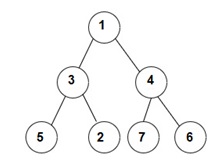
The Inorder traversal will be [5, 3, 2, 1, 7, 4, 6].
02
Round
Medium
Video Call
Duration60 minutes
Interview date9 Nov 2022
Coding problem2
1. Combination Sum
Easy
15m average time
85% success
0/40
Asked in companies


You are given an array 'ARR' of 'N' distinct positive integers. You are also given a non-negative integer 'B'.
Your task is to return all unique combinations in the array whose sum equals 'B'. A number can be chosen any number of times from the array 'ARR'.
Elements in each combination must be in non-decreasing order.
For example:
Let the array 'ARR' be [1, 2, 3] and 'B' = 5. Then all possible valid combinations are-

(1, 1, 1, 1, 1)
(1, 1, 1, 2)
(1, 1, 3)
(1, 2, 2)
(2, 3)
2. Longest Palindromic Substring
Moderate
35m average time
78% success
0/80
Asked in companies


You are given a string ‘S’ of length ‘N’.
You must return the longest palindromic substring in ‘S’.
Note: Return any of them in case of multiple substrings with the same length.
Example:
Input: ‘S’ =’badam’

Output: ‘ada’

‘ada’ is the longest palindromic substring, and it can be proved that it is the longest possible palindromic substring.
03
Round
Medium
HR Round
Duration20 minutes
Interview date9 Nov 2022
Coding problem1
1. Basic HR Questions
- What makes you angry?
- Give me an example of your creativity.
- How long would you expect to work for us if hired?
- Aren't you overqualified for this position?


Here's your problem of the day 
Solving this problem will increase your chance to get selected in this company
Skill covered: Programming
How do you remove whitespace from the start of a string?
Choose another skill to practice
Similar interview experiences

SDE - 1
3 rounds | 7 problems
Interviewed by OYO
 Selected
6182 views

0 comments

0 upvotes
SDE - Intern
2 rounds | 3 problems
Interviewed by Amazon
Rejected
1566 views
0 comments
0 upvotes

SDE - 1
2 rounds | 5 problems
Interviewed by Meesho
Rejected
7246 views
0 comments
0 upvotes

SDE - 1
3 rounds | 9 problems
Interviewed by Salesforce
 Selected
 4552 views
0 comments
0 upvotes
Companies with similar interview experiences
SDE - 1
5 rounds | 12 problems
Interviewed by Amazon
 Selected
 117552 views
24 comments
0 upvotes
SDE - 1
4 rounds | 5 problems
Interviewed by Microsoft
Selected 60143 views
5 comments
0 upvotes
SDE - 1
3 rounds | 7 problems
Interviewed by Amazon
 Selected
 36138 views
7 comments
0 upvotes