





Flipkart limited interview experience Real time questions & tips from candidates to crack your interview
SDE - 2
Flipkart limited


5 rounds | 6 Coding
problems

 Selected
 Interview preparation journey

Preparation
Duration: 3.5 months
Topics: Data Strucures, Algorithms, System Design, OOPs, Dynamic Programming, Graph, Trees

Tip 1 : Practice DS Algo from Striver's SDE sheet.
Tip 2 : Practice machine coding problems in advance. Code them during practice with timer.
Tip 3 : Learn OOPs concept and LLD from Udit Agarwal's youtube channel. The videos are very informative and high quality
Tip 4 : Make a good resume, use a good template available in website like novoresume.com
Application process
Where: Linkedin
Eligibility: Nothing as such. If worked in a startup before, this helps in getting highlighted.
Tip 1: Use a good template, available on websites like novoresume.com
Tip 2: Ensure working links in the resume
Tip 3: Highlight key terms and figures in the resume. You can make the font bold to highlight.

Interview rounds
01
Round
Medium
Video Call
Duration60 mins
Interview date30 Jul 2021
Coding problem2
1. Rotting Oranges
Easy
15m average time
85% success

0/40
Asked in companies


You are given an array ‘ARR’ of size ‘N’ and an integer ‘K’. Your task is to find the total number of distinct elements present in every ‘K’ sized window of the array. A ‘K’ sized window can also be viewed as a series of continuous ‘K’ elements present in the sequence.
Note:
1. The size of ‘ARR’ will always be greater than or equal to the ‘K’.
2. Here window refers to a subarray of ‘ARR’. Hence ‘K’ sized window means a subarray of size ‘K’.
3. You are not required to print the output explicitly. It has already been taken care of. Just implement the function and return an array of the count of all distinct elements in the ‘K’ size window.
Example
Consider ARR = [ 1, 2, 1, 3, 4, 2, 3 ] and K = 3.
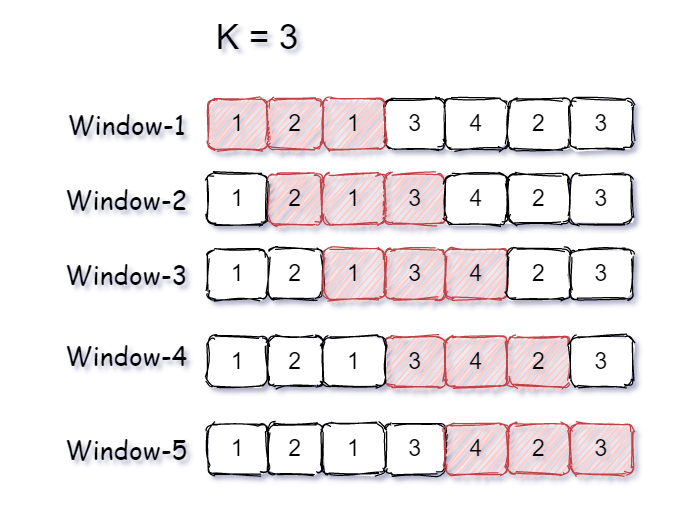
As per the given input, we have a sequence of numbers of length 7, and we need to find the number of distinct elements present in all the windows of size 3.

Window-1 has three elements { 1, 2, 1 } and only two elements { 1, 2 } are distinct because 1 is repeating two times.
Window-2 has three elements { 2, 1, 3 } and all three elements are distinct { 2, 1, 3 }.
Window-3 has three elements { 1, 3, 4 } and all three elements are distinct { 1, 3, 4 }.
Window-4 has three elements { 3, 4, 2 } and all three elements are distinct { 3, 4, 2 }.
Window-5 has three elements { 4, 2, 3 } and all three elements are distinct { 4, 2, 3 }.

Hence, the count of distinct elements in all K sized windows is { 2, 3, 3, 3, 3 }.
2. Count Distinct Element in Every K Size Window
Easy
15m average time
85% success
0/40
Asked in companies
You are given an array ‘ARR’ of size ‘N’ and an integer ‘K’. Your task is to find the total number of distinct elements present in every ‘K’ sized window of the array. A ‘K’ sized window can also be viewed as a series of continuous ‘K’ elements present in the sequence.
Note:
1. The size of ‘ARR’ will always be greater than or equal to the ‘K’.
2. Here window refers to a subarray of ‘ARR’. Hence ‘K’ sized window means a subarray of size ‘K’.
3. You are not required to print the output explicitly. It has already been taken care of. Just implement the function and return an array of the count of all distinct elements in the ‘K’ size window.
Example
Consider ARR = [ 1, 2, 1, 3, 4, 2, 3 ] and K = 3.
As per the given input, we have a sequence of numbers of length 7, and we need to find the number of distinct elements present in all the windows of size 3.

Window-1 has three elements { 1, 2, 1 } and only two elements { 1, 2 } are distinct because 1 is repeating two times.
Window-2 has three elements { 2, 1, 3 } and all three elements are distinct { 2, 1, 3 }.
Window-3 has three elements { 1, 3, 4 } and all three elements are distinct { 1, 3, 4 }.
Window-4 has three elements { 3, 4, 2 } and all three elements are distinct { 3, 4, 2 }.
Window-5 has three elements { 4, 2, 3 } and all three elements are distinct { 4, 2, 3 }.

Hence, the count of distinct elements in all K sized windows is { 2, 3, 3, 3, 3 }.
02
Round
Medium
Video Call
Duration90 mins
Interview date6 Aug 2021
Coding problem1
Machine Coding
1. Design question
Design a cab reservation system
03
Round
Medium
Video Call
Duration60 mins
Interview date13 Aug 2021
Coding problem1
Low level design
1. Snake and Ladder
Moderate
30m average time
60% success
0/80
Asked in companies



You have been given a Snake and Ladder Board with 'N' rows and 'N' columns with the numbers written from 1 to (N*N) starting from the bottom left of the board, and alternating direction each row.
For example
For a (6 x 6) board, the numbers are written as follows:
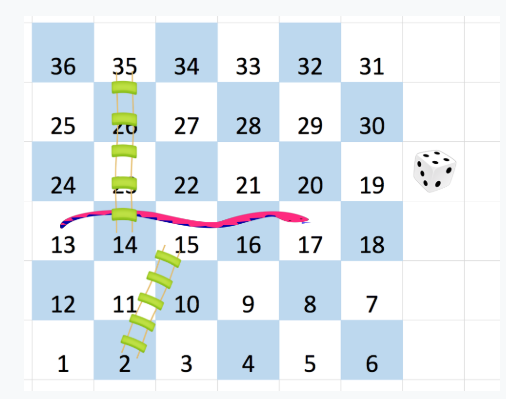
You start from square 1 of the board (which is always in the last row and first column). On each square say 'X', you can throw a dice which can have six outcomes and you have total control over the outcome of dice throw and you want to find out the minimum number of throws required to reach the last cell.
Some of the squares contain Snakes and Ladders, and these are possibilities of a throw at square 'X':
You choose a destination square 'S' with number 'X+1', 'X+2', 'X+3', 'X+4', 'X+5', or 'X+6', provided this number is <= N*N.
If 'S' has a snake or ladder, you move to the destination of that snake or ladder.  Otherwise, you move to S.
A board square on row 'i' and column 'j' has a "Snake or Ladder" if board[i][j] != -1. The destination of that snake or ladder is board[i][j].
Note :
You can only take a snake or ladder at most once per move: if the destination to a snake or ladder is the start of another snake or ladder, you do not continue moving - you have to ignore the snake or ladder present on that square.

For example, if the board is:
-1 1 -1
-1 -1 9
-1 4 -1
Let's say on the first move your destination square is 2  [at row 2, column 1], then you finish your first move at 4 [at row 1, column 2] because you do not continue moving to 9 [at row 0, column 0] by taking the ladder from 4.

A square can also have a Snake or Ladder which will end at the same cell.
For example, if the board is:
-1 3 -1
-1 5 -1
-1 -1 9
Here we can see Snake/Ladder on square 5 [at row 1, column 1] will end on the same square 5.
04
Round
Medium
Video Call
Duration60 mins
Interview date20 Aug 2021
Coding problem1
Hiring Manager Round
1. Situation based questions
Describe your recent project.
05
Round
Medium
Video Call
Duration90 mins
Interview date3 Sep 2021
Coding problem1
Machine Coding
1. Design question
Design google Doc


Here's your problem of the day 
Solving this problem will increase your chance to get selected in this company
Skill covered: Programming
How do you remove whitespace from the start of a string?
Choose another skill to practice
Similar interview experiences
SDE - 2
4 rounds | 6 problems
Interviewed by Flipkart limited
 Selected
3774 views

0 comments

0 upvotes
UI Developer 2
2 rounds | 2 problems
Interviewed by Flipkart limited
 Selected
 2430 views
0 comments
0 upvotes
SDE - 2
3 rounds | 5 problems
Interviewed by Flipkart limited
Selected 0 views
0 comments
0 upvotes
SDE - 2
4 rounds | 4 problems
Interviewed by Flipkart limited
Selected 5872 views
1 comments
0 upvotes
Companies with similar interview experiences

SDE - 2
5 rounds | 12 problems
Interviewed by Walmart
Selected 29892 views
8 comments
0 upvotes

SDE - 2
3 rounds | 4 problems
Interviewed by HashedIn
 Selected
 9698 views
0 comments
0 upvotes
SDE - 2
3 rounds | 5 problems
Interviewed by Amazon

Rejected
6765 views
1 comments
0 upvotes